
Spiti Valley
A Journey Through Rain, Roads, Monasteries & Moments That Stay Forever
I entered Spiti not the usual way a traveler enters.
I entered it after completing my Pin Bhaba Trek — tired, fulfilled, soaked in experiences — and reached Mudh Village, the last village of Pin Valley.
From here, the road to Spiti started… and so did the most unpredictable adventure of my life.
It was 1st September 2025, and it was raining. Heavily.
Not the usual mountain drizzle — but continuous, thick rain mixed with broken roads, landslides, and the kind of silence where nature warns you gently but firmly.
I had planned one entire week in Spiti after my trek.
But nature had other plans.
The Road from Mudh to Kaza
The journey from Mudh to Kaza that day felt like a movie where the script keeps changing every few minutes.
Roadblocks.
Multiple slides.
Uncertain visibility.
Streams crossing roads.
Cars waiting for hours.
Cold wind piercing through the window gaps.
And still… I moved forward.
Every mountain was teaching me something: slow down, listen, surrender.
By the time I reached Kaza, I felt like I had crossed not just distance — but an inner threshold.
Reaching Zostel Kaza — A Small Relief in a Stormy Day
I had pre-booked Zostel Kaza, and entering it felt like finally stepping into warmth after fighting the world outside.
The ambience, the community area, and the mountains right in front of the property — everything felt comforting, almost healing.
But the rain wasn’t stopping.
Road conditions were worsening.
Weather prediction said “no improvement.”
So instead of roaming freely for a week, I decided to cover as much as possible in one safe window.
A taxi felt like the smartest decision.

Hostels in Spiti Valley for Backpackers & Slow Travelers
Key Monastery: Where Spiti’s Spiritual Heart Beats
Before entering, I stopped at Noryang Restaurant for a quick meal. Much needed.
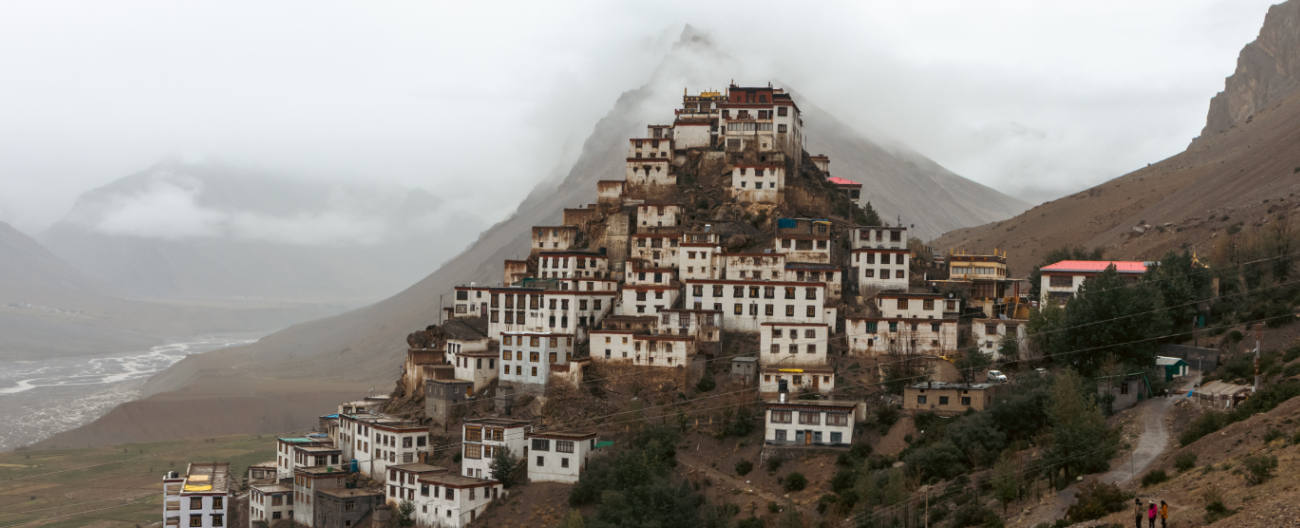
Then I walked to the viewpoint — the classic frame where Key Monastery sits like a white-and-brown fortress on stepped slopes, its tiny windows aligned like an ancient puzzle.
I kept staring, wondering how people centuries ago built something so magnificent, so balanced, so protective in the harshest climate of India.

Inside the Monastery
It was raining again, so I held my umbrella close and walked in, noticing the hand-painted gates, the ancient woodwork, and the narrow stone steps worn smooth by centuries of monks.
At the entrance were dozens of prayer wheels (Mani wheels), each one filled with the mantra Om Mani Padme Hum. Spinning them is believed to release compassion and purify intentions — and honestly, in that moment, I needed both.
Inside, in a dim room, a monk was praying near a giant old prayer bell.
Photos were prohibited, but the memory is permanent.
He invited me in and softly began explaining their belief, how Buddhists look at life, suffering, and purpose.

What “Om Mani Padme Hum” Really Means
He broke it down for me in the most beautiful and simple way:
- Om — our impure body, speech, and mind
- Mani (Jewel) — intention, love, compassion
- Padme (Lotus) — wisdom
- Hum — the unshakable truth within us
“It means,” he said,
“you become pure when compassion and wisdom meet inside you.”
I left that room feeling different — lighter, softer, grounded.

The Monastery Tea
At the upper level, I entered a small hall where monks serve tea to visitors.
One young monk filled my cup straight from a steel jug — warm, herbal, earthy.
It tasted like ayurveda melting into your throat, calming you from the inside out.
That tea was not just tea.
It was warmth in a cold land and kindness in a strange place.
The Road After Rain – Spiti Wearing Her Dark, Shiny Beauty
Rain had stopped by now.
The mountains were shining, the air smelled fresh, and clouds were wrapped like shawls around the peaks.
Spiti after rain looks like a painting washed clean.

Langza – The Land of Fossils, Clouds & The Giant Buddha
The drive to Langza itself felt like entering a postcard.
The village is known for its white homes with brown windows, fossil-rich lands, and the silent guardian —
The 14,300 ft tall sitting Buddha statue.
It faces the entire Langza village, symbolising protection, peace, and the Buddhist belief that no matter what storms life throws, wisdom keeps you grounded.
From the base of the statue, the whole village looks unreal — quiet, small, and beautifully preserved.

Lara’s Café
Lara’s Café is tiny but full of warmth.
Here I tasted Seabuckthorn Tea — a local tea made from bright orange berries rich in Vitamin C and antioxidants.
It was warm, tangy, and absolutely perfect for the cold weather.
Spoke to a few local girls in the café — innocent faces, shy smiles, curious questions…
I could feel the simplicity of Spiti here.


Hikkim — Reaching the World’s Highest Post Office Through Fear
If any part of Spiti scared me, it was this one.
The road from Langza to Hikkim was all mud, slipping wheels, deep gorges, and no margin for error.
At one point I literally told the driver,
“Let’s go back, this is too risky.”
He said, “It will be fine. I know the road.”
I trusted him, and honestly, that felt like another form of prayer.
We finally reached Hikkim Post Office — but it was closed.
We contacted the postmaster from the village, and he came all the way up just for us.
That kindness in freezing cold touched me deeply.
My hands were numb while writing postcards, but I still wrote them with all my heart.
I didn’t expect them to reach, but after a few days, they did.
I was honestly shocked and super happy.
Hikkim felt like humanity at 14,400 ft.

Komik
Komik is even higher and riskier, so the driver recommended skipping it due to weather and mud.
I agreed.
On the way back, the sky opened up and the mountains were showing all their colors — brown, grey, greenish patches, golden slopes, everything layered like art.
We stopped at viewpoints, took in the silence, and drove back slowly.
Back at Zostel, a warm tea, conversations with travellers, and that tired-but-happy feeling ended my adventurous day beautifully.
Next Morning – Local Market, Shopping & Slow Moments
Kaza Market is a treasure.
Unique things you won’t see anywhere else —
souvenirs, warm caps, traditional jewelry, local spices, dried seabuckthorn, prayer flags… I shopped a lot.
Later, after lunch, I visited Kaza Monastery — a large, calm, beautifully maintained monastery with peaceful vibes.
Also saw the world’s highest petrol pump here.


Leaving Spiti — Weather Had Other Plans Again
I planned a week in Spiti but weather had different plans.
Next morning, I walked to the bus stand and boarded the only available bus.
On the way, I saw Tabo, met kind people, changed buses multiple times, and finally reached Reckong Peo because the road to Shimla was still blocked.
(You can read my full journey back & challenges in my Pin Bhaba Trek)
Despite everything, I knew one thing —
I will return to Spiti.
For winter.
For Chandratal.
For peace.
For closure.
Is Spiti Valley safe in September?
Spiti is beautiful in September but unpredictable. Landslides, roadblocks, and sudden weather changes are common. Always keep buffer days.
Are roads open from Kaza to Komik, Hikkim, and Langza in rainy season?
They usually are, but road conditions can be extremely risky during rain.
Local drivers are best judges.
What is the specialty of Seabuckthorn tea?
It’s made from Himalayan seabuckthorn berries, rich in Vitamin C and great for altitude and cold.
Is Kaza safe for solo travelers?
Yes, very. People are kind, helpful, and warm.
What is the altitude of Langza & Hikkim?
Langza: ~14,300 ft
Hikkim: ~14,400 ft
How many days are ideal for Spiti?
7–10 days ideally, but weather can change plans anytime.
Best season for a full Spiti circuit?
May to early October (depending on snow & road conditions). However winter Spiti has different energy.

Rinkal
Rinkal is a passionate traveler from Ahmedabad who loves exploring hidden gems, savoring local foods, and sharing adventures with fellow wanderers. Rinkal’s goal is to inspire others to travel on a budget while truly experiencing the essence of each place.
Leave a Reply