
Kanamo Peak
Day 0: The Journey to Manali – Sometimes the Best Adventures Begin Unexpectedly
When I started planning a trip for July, I simply wanted to head to the mountains. While browsing different trekking options, I came across Kanamo Peak, one of the highest non-technical trekking summits in India. The combination of its nearly 6,000-metre altitude, stunning summit views, and the chance to experience the raw beauty of Spiti immediately caught my attention. It looked like the perfect challenge, so without overthinking, I booked the trek and began preparing both physically and mentally.
One of the biggest attractions of Kanamo Peak is that it lets ordinary trekkers stand at an extraordinary altitude. Rising to 5,944 metres (19,500 ft), the summit is higher than every mountain in Europe, yet it doesn’t require any technical climbing skills. The trek also passes through some of Spiti’s most iconic landscapes, making the journey just as memorable as the summit itself.
Why I Chose Kanamo Peak
Before the trek even began, these were the highlights that convinced me to book it:
- Trek to one of India’s highest non-technical summits.
- Experience the beautiful drive through Rohtang Pass, Kunzum Pass and the Spiti Valley.
- Witness breathtaking 360-degree views of peaks across Spiti, Ladakh, Kinnaur and Kullu from the summit.
- Start the trek from Kibber, one of the highest inhabited villages in the world.
- Explore the untouched landscapes and culture that make Spiti unlike anywhere else in India.
Flying to Chandigarh
My trek batch was scheduled to begin on 18th July, so I booked a flight to Chandigarh on 16th July to comfortably reach Manali a day in advance.
I landed in Chandigarh around 1:30 PM, expecting to take a bus to Manali later that afternoon. I hadn’t booked any tickets beforehand because my plan was simple—I would head to the bus stand and catch whichever bus was available first.
But travel often has better plans than we do.
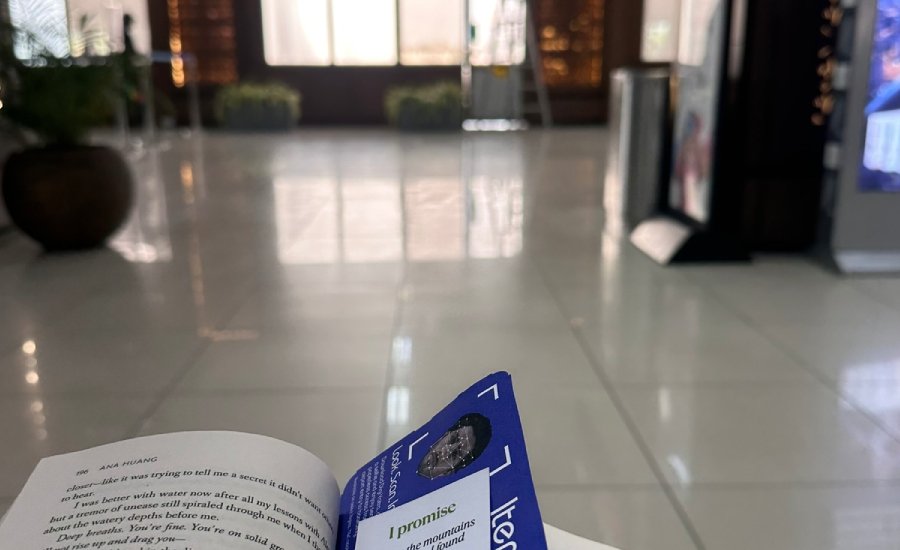
Meeting the Most Inspiring Travellers
During my flight, I happened to sit near a group of motorcycle riders. As we started talking, I discovered they were all over 60 years old, had travelled from the United States, and were riding all the way from Manali to Ladakh.
That immediately caught my attention.
Our conversation quickly shifted from travel to trekking, adventure, life, and the stories behind why each of us keeps exploring new places. Listening to them was genuinely inspiring. They weren’t chasing records or trying to prove anything—they simply loved travelling together and continued making their dreams happen even in their sixties.
When they asked how I was planning to reach Manali, I casually mentioned that I hadn’t booked a bus and would figure it out once I reached the bus station.
Without hesitation, they smiled and said,
“Why don’t you come with us?”
And just like that, my journey changed completely.
A Road Trip I'll Never Forget
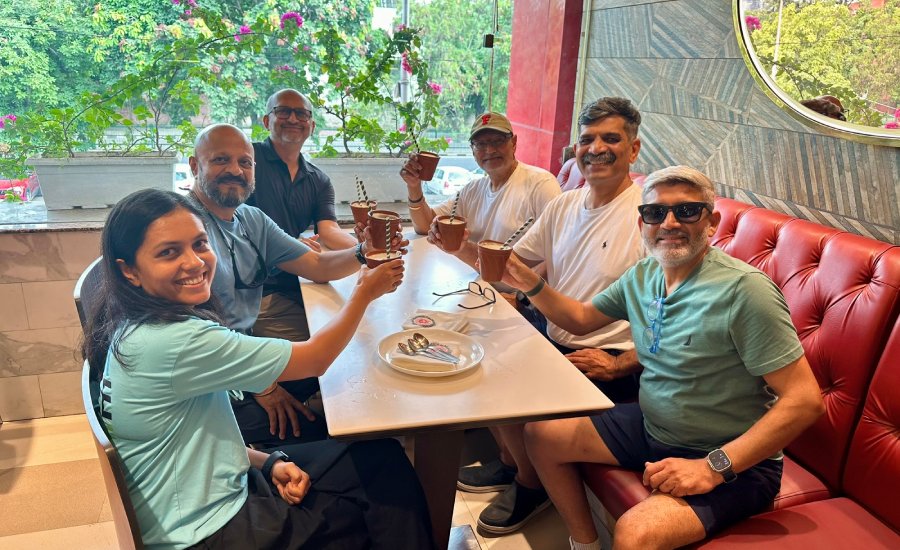
Instead of waiting at a crowded bus station, I found myself beginning an unforgettable road trip with complete strangers who soon felt like old friends.
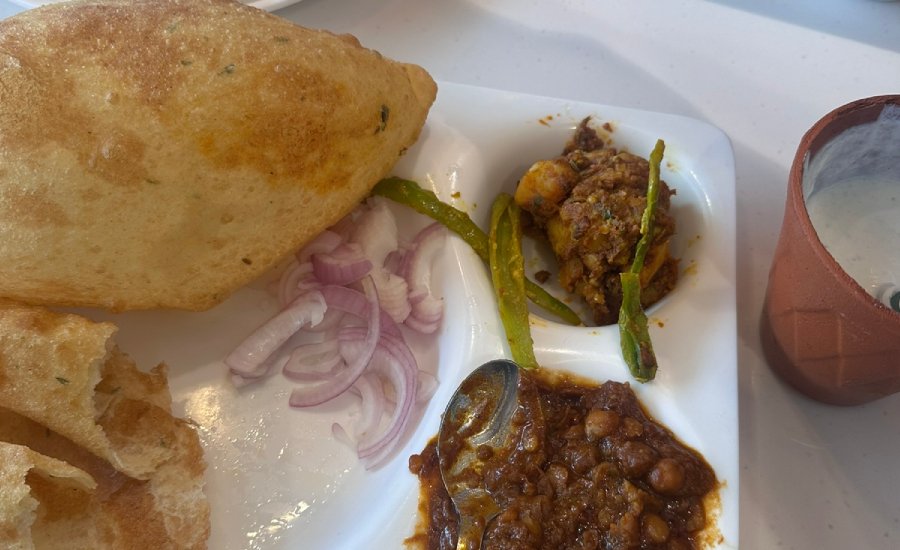
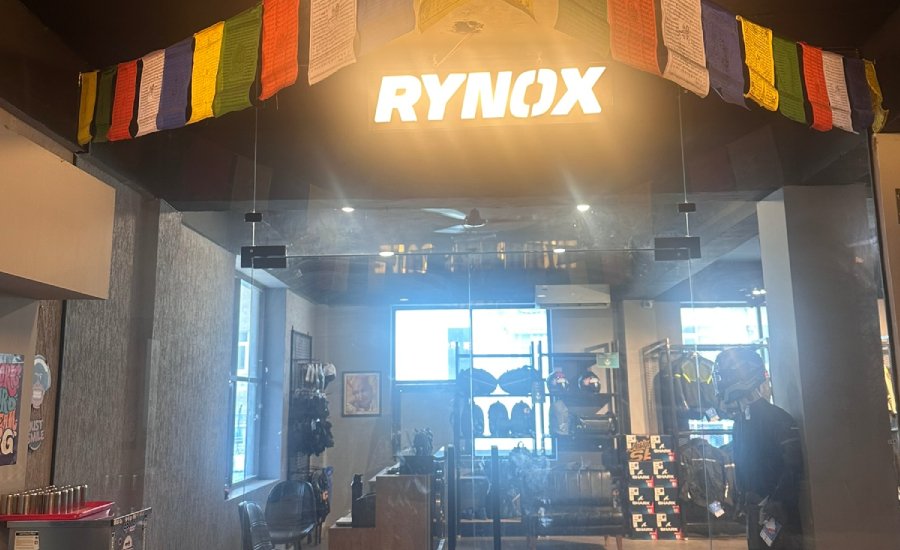
Before leaving Chandigarh, we stopped at Rynox so they could pick up a few riding essentials for their Ladakh expedition. Afterwards, we had lunch at Gopal’s, where I enjoyed one of the best Chole Puri meals I’ve ever had, paired with a refreshing glass of salted lassi.
The drive towards Manali was filled with conversations that moved effortlessly from current affairs and travel stories to our individual passions and dreams. It never felt like I had only met them a few hours earlier.
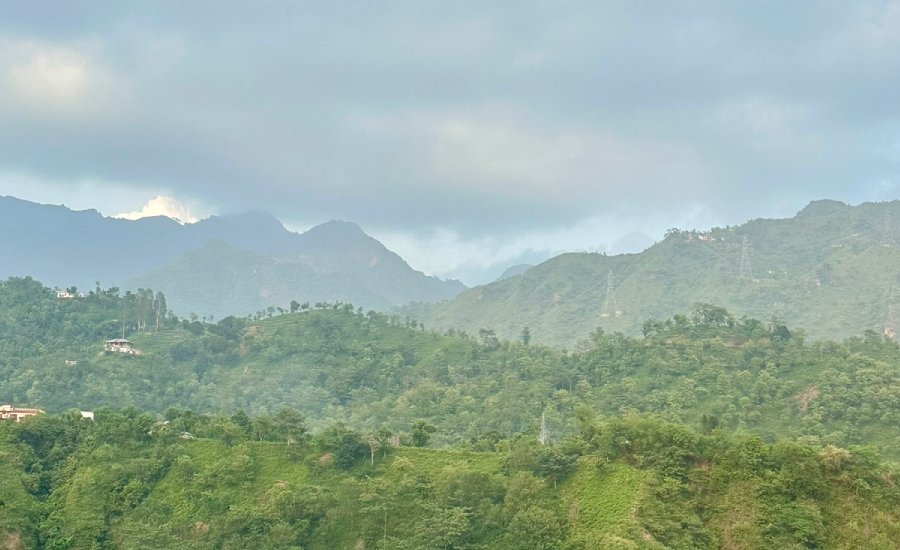
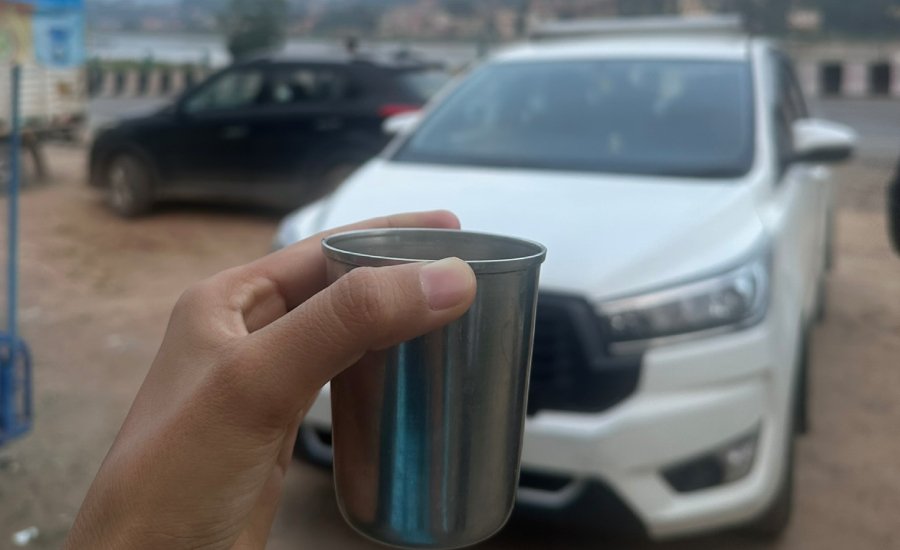
Along the way, we stopped for tea, admired the changing mountain scenery, and continued driving into the evening.
Kindness That Made the Journey Special
It was close to 11:30 PM by the time we finally reached Manali.
Even after such a long day on the road, they made sure I had dinner before dropping me at my accommodation. Since vehicles couldn’t reach the narrow lane leading to my hostel, one of them even carried my luggage and walked with me until I reached the entrance safely.
That small gesture stayed with me.
Moments like these remind me why I love travelling. Yes, the mountains are beautiful. The landscapes are unforgettable. But what often leaves the deepest impression are the people you meet along the way.
Travel has a wonderful way of restoring your faith in humanity. Sometimes, complete strangers become the reason a journey turns into a lifelong memory.
Overnight Stay in Manali
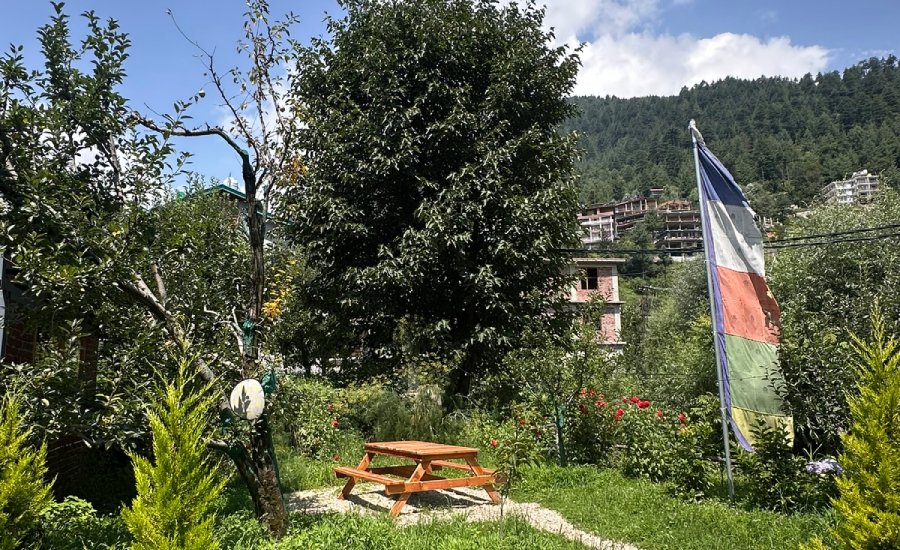
I spent the night at Zostel Old Manali (Goshal Road) before the trek officially began.
The hostel is surrounded by apple orchards, cosy cafés, and peaceful mountain views, making it a great place to unwind before heading into the high Himalayas. The staff were warm, welcoming, and incredibly helpful, creating a relaxed atmosphere that felt perfect before the adventure ahead.
After checking in and settling down, I called it a night—excited for the journey that would truly begin the next morning.
Day 1: A Peaceful Start Before the Adventure
I woke up to a calm morning in Old Manali, knowing this would be my last day before heading into the mountains. There wasn’t any rush, so I decided to enjoy the town at a slow pace before the trek officially began.
After freshening up, I had breakfast at the café inside Zostel. The peaceful atmosphere, surrounded by greenery and mountain air, was the perfect way to start the day.
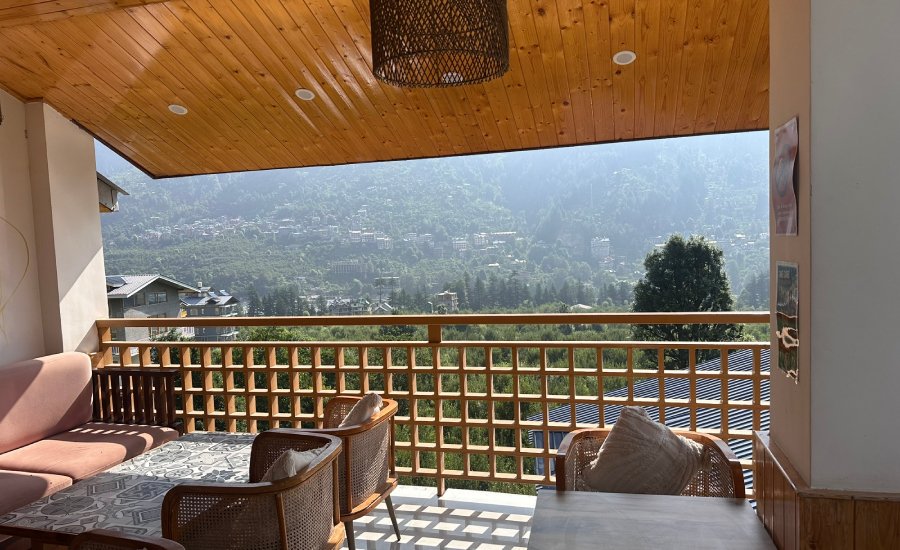
Exploring Old Manali
With a few hours to spare before my pickup, I wandered through the charming streets of Old Manali. One of my favourite parts of travelling is interacting with locals, and that morning was no different.
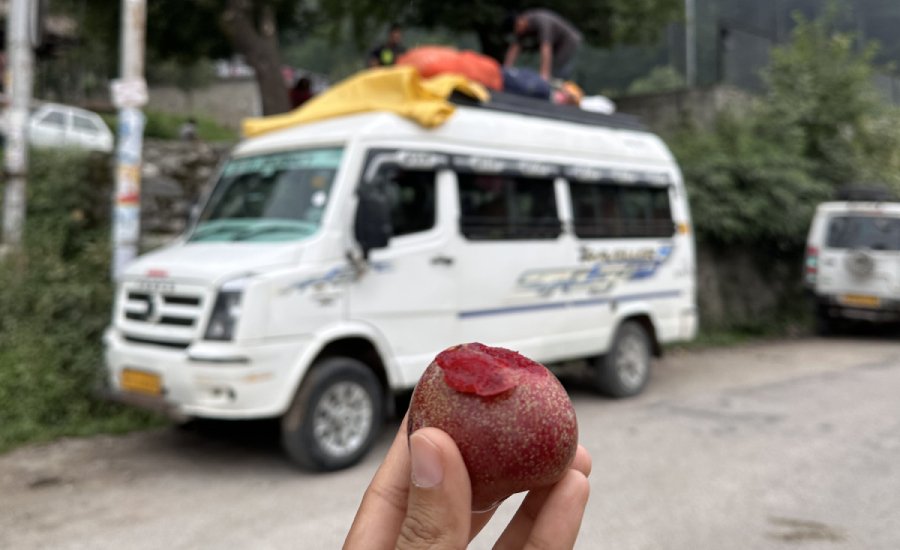
I met a sweet local aunty selling fresh plums from her own orchard. Naturally, I couldn’t resist buying some. They were incredibly fresh, juicy, and full of flavour—one of those simple travel moments that stay with you long after the journey ends.
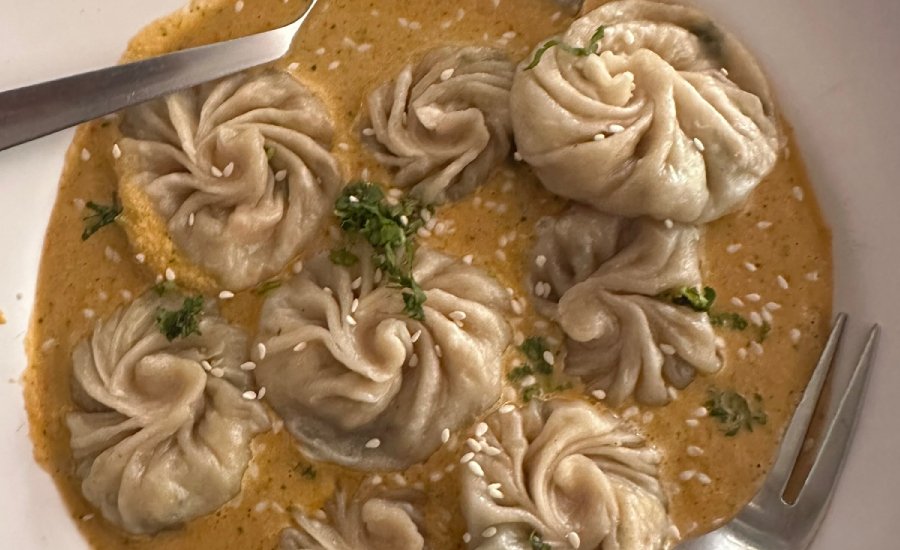
For lunch, I stopped at BAYITH Café and ordered Jhol Momos. If you’re someone who enjoys spicy food, this place deserves a visit. The broth was rich, flavourful, and wonderfully spicy, easily making it one of the best plates of momos I’ve had in Manali.
💛 Rinkal’s Note
If you’re spending a day in Old Manali before your trek, don’t skip the local cafés. It’s a great way to relax, eat well, and soak in the mountain vibe before the adventure begins.
Heading to the Indiahikes Pickup Point
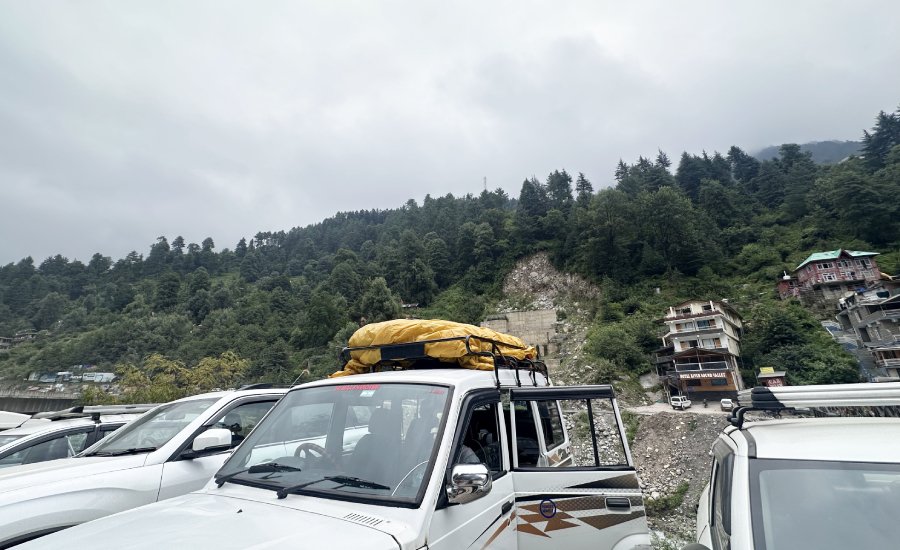
Our pickup was scheduled for 3:00 PM near Beas Bridge.
After checking out of the hostel, I hired an auto-rickshaw with my backpack and reached the pickup point. I accidentally waited on the opposite side of the road before meeting one of my fellow trekkers. We walked together to the correct pickup location.
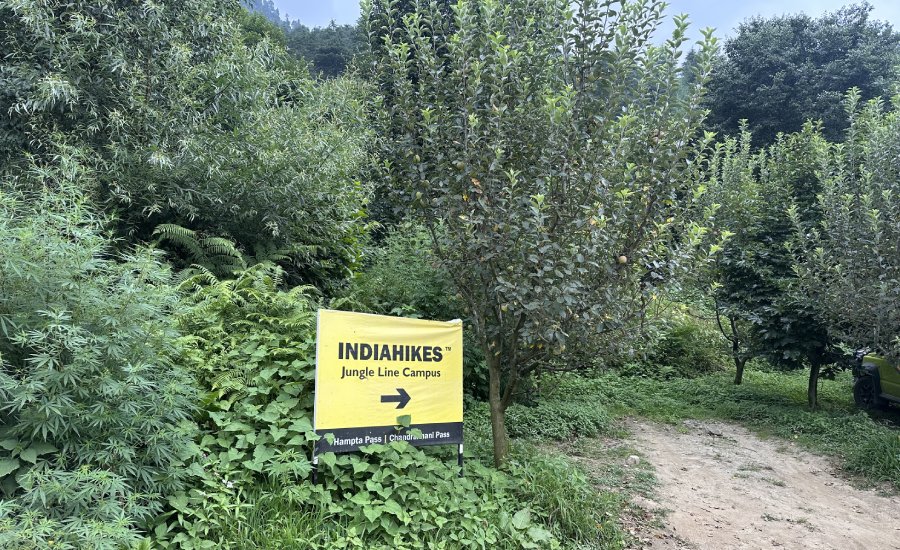
Indiahikes Jungle Line Campus
From the pickup point, we boarded a Sumo that took us to the Indiahikes Jungle Line Campus, located around 30 minutes from Manali.
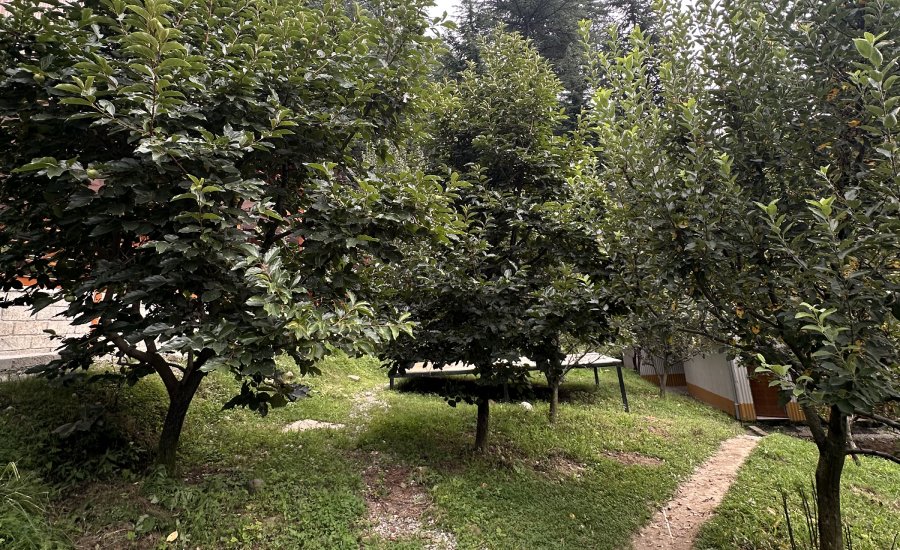
Hidden deep inside sprawling apple orchards, the campus immediately felt different from the busy tourist areas of Manali. It was peaceful, quiet, and surrounded by nature—a place where you could instantly disconnect from city life.
From the parking area, we carried our bags and walked a short uphill trail to reach the campus.
The moment I entered, my first thought was simple:
This place feels incredibly peaceful.
Surrounded by apple and persimmon orchards, the campus blended beautifully with nature.
A Beautifully Designed Base Before the Trek
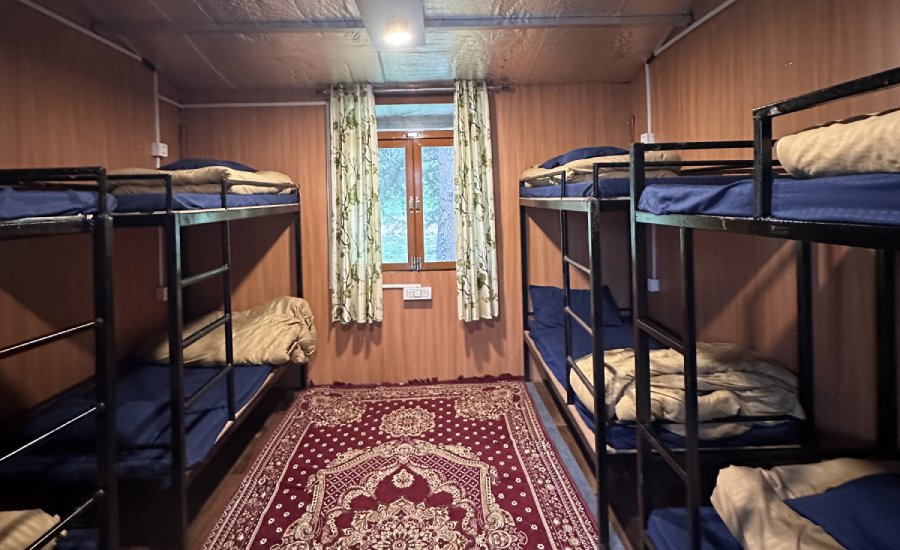
Our trek leader was not here, so another Indiahikes trek leader welcomed us, showed us to our dormitory, and assigned our beds.
After settling in, we gathered for evening snacks.
The menu was simple—Batata Vada with hot tea—but it tasted absolutely delicious after a day of travelling. Everyone secretly wished there were a few extra servings!
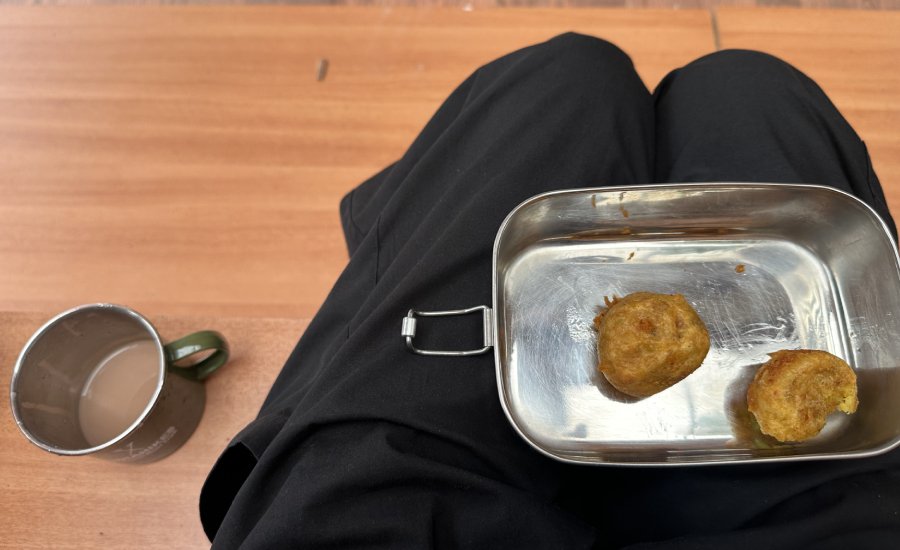
While spending time around the campus, I couldn’t help but admire how thoughtfully everything had been designed.
From the cosy seating spaces and comfortable dormitories to the clean washrooms and washing area, every corner reflected careful planning. Nothing felt excessive, yet everything was practical and beautifully integrated into the surroundings.
It was easily one of the most thoughtfully designed trek campuses I’ve stayed at.
Meeting My Trek Family
One of the best parts of any trek is the people you meet along the way.
That evening, I met my roommate and tent partner, Debarati. Within minutes, we found ourselves talking endlessly about trekking, mountains, travel experiences, and life. Sometimes you meet people and instantly feel comfortable around them—and that’s exactly how it felt.
You’ll get to meet the entire team as this journey unfolds, but Debarati was one of the first friendships that made this trek even more memorable.
Then came one of the cutest moments of the day.
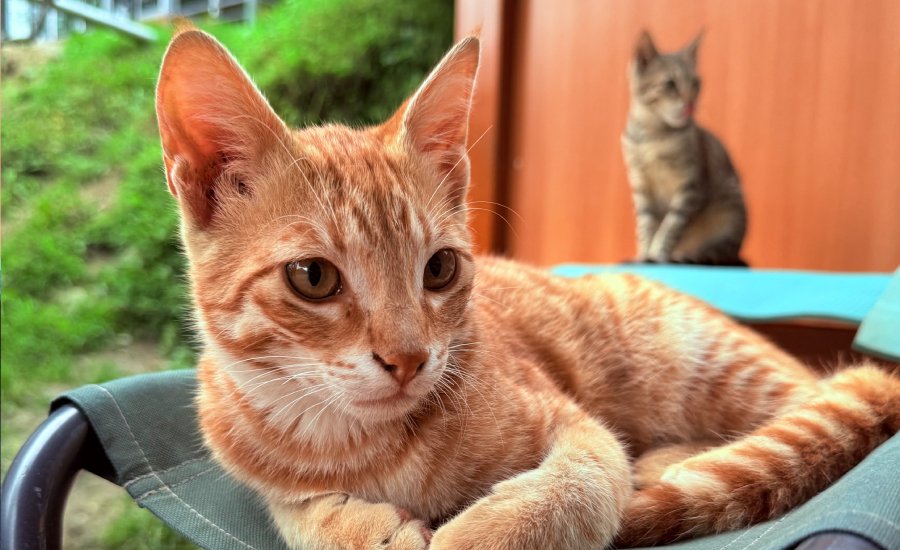
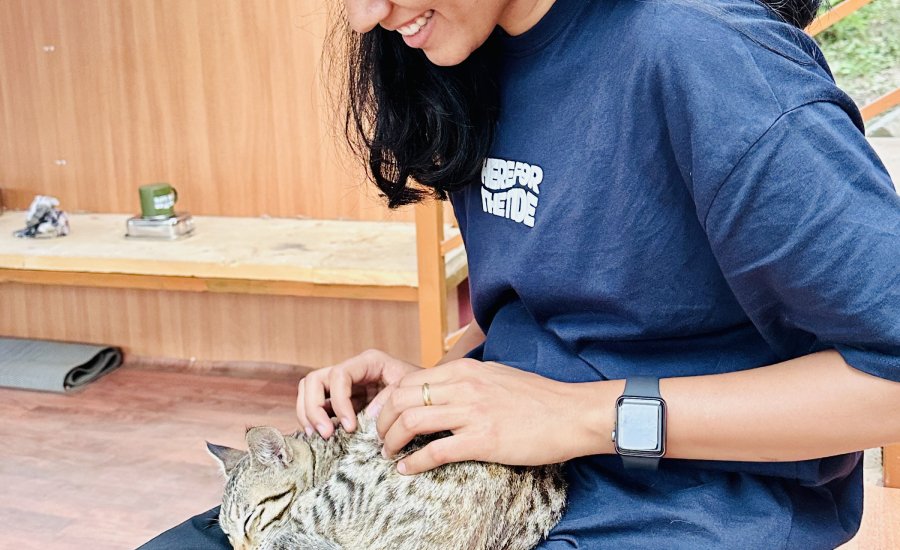
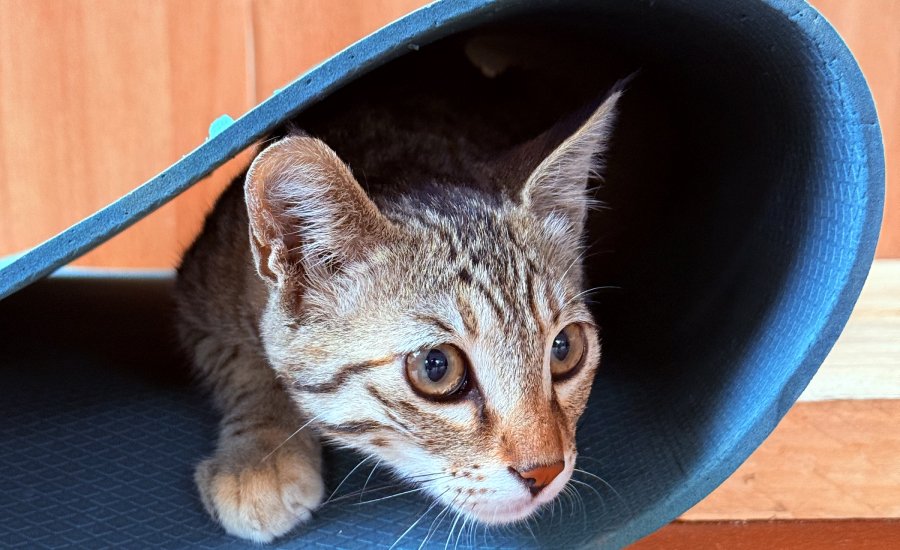
As I sat quietly in the common area, a friendly campus cat walked over, climbed onto my lap, curled up, and peacefully fell asleep.
I didn’t move for quite a while.
Some moments don’t need words—they simply become memories.
Trek Briefing & Responsible Trekking
Before dinner, the Indiahikes team completed our document verification and fitness checks. We also shared our previous trekking experiences, any health concerns, and discussed what to expect over the coming days.
Later in the evening, our trek leader gave a detailed briefing about the Kanamo Peak Trek.
We discussed:
- The route and itinerary.
- Altitude gain and acclimatisation.
- Challenges we might face.
- Preventing Acute Mountain Sickness (AMS).
- Safety protocols.
- Questions from the group.
The briefing wasn’t meant to scare us—it was meant to prepare us mentally for one of India’s highest trekking summits.
Why I Love Trekking with Indiahikes
After dinner, we were given two important items:
- A hygiene liner for our sleeping bags.
- An eco bag.
If you’ve read my previous trekking experiences, you’ll know why this matters to me.
Throughout the trek, every trekker carries an eco bag to collect and bring back any waste generated in the mountains instead of leaving it behind.
This simple initiative perfectly aligns with something I strongly believe in:
Leave the mountains exactly as you found them.
Nature gives us so much. The least we can do is leave no trace behind.
💛 Rinkal’s Note
This is one of the biggest reasons I enjoy trekking with Indiahikes. Their “Leave No Trace” philosophy isn’t just something they talk about—it’s something every trekker actively participates in.
Calling It a Night
Back in the dormitory, I met another roommate who was preparing for the Bhrigu Lake Trek the next morning. We spent some time chatting about our work, trekking experiences, and our shared love for nature before finally calling it a night.
Wrapped inside a warm comforter after an eventful day, I drifted off to sleep feeling excited.
Tomorrow, the real journey to Kanamo Peak would begin.
Day 2: From Manali's Green Valleys to the Rugged Landscapes of Spiti
Today marked the beginning of our journey into the heart of Spiti Valley. Although there was no trekking involved, this 7–8 hour road journey from Manali to Kibber is an experience in itself.
In just one day, we would ascend from around 6,000 ft in Manali to nearly 13,500 ft in Kibber, witnessing one of the most dramatic landscape transitions in the Himalayas.
After a hearty breakfast at the Indiahikes Jungle Line Campus, we packed our bags, walked down to the road, loaded our luggage into the Tempo Traveller, and set off around 8:30 AM.
Before leaving, we were offered fresh plums picked straight from the orchard surrounding the campus. Sweet, juicy, and refreshing—it was a simple gesture that perfectly captured the warmth of the place.
The Mountains Slowly Begin to Change
The drive began through dense forests of towering deodar and pine trees. The weather was cool, cloudy, and occasionally rainy, making the winding mountain roads even more beautiful.
As we passed through small Himalayan villages, I noticed groups of locals sitting together outside their homes, sipping tea and chatting without any rush.
That simple scene stayed with me.
Watching them reminded me that perhaps the mountains aren’t beautiful only because of their landscapes—they’re beautiful because they slow life down.
Sometimes, sharing a cup of tea with friends on a quiet morning is enough.
💛 Rinkal’s Note
We often travel to the mountains searching for peace, but perhaps the locals have already found it in their everyday lives.
Crossing the Atal Tunnel
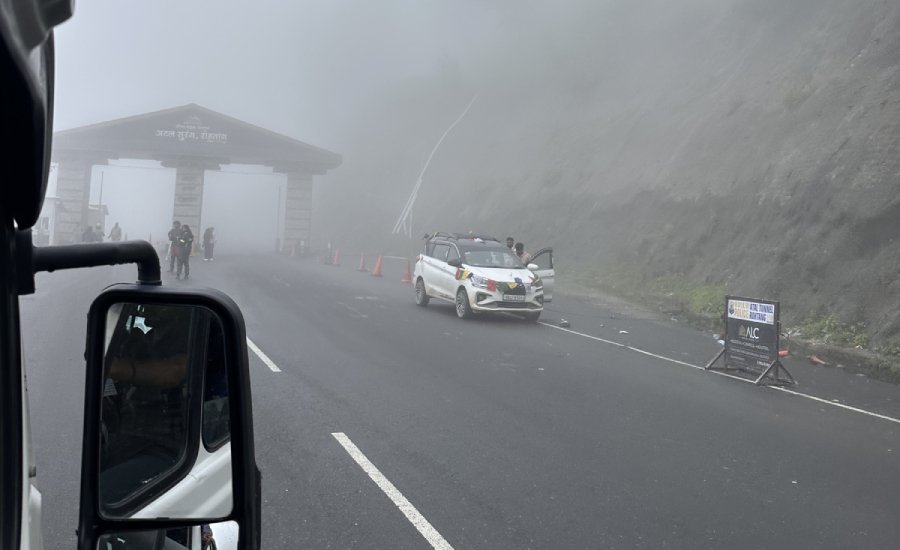
One of the highlights of the drive is crossing the Atal Tunnel, one of the world’s longest highway tunnels above 10,000 feet.
Stretching over 9 kilometres, the tunnel connects Manali with Lahaul Valley throughout the year, drastically reducing travel time that once depended on crossing the snowbound Rohtang Pass.
But what fascinated me even more was what happened after exiting the tunnel.
Within minutes, the lush green forests slowly disappeared.
The landscape transformed completely.
The dense alpine forests gave way to barren mountains, rocky cliffs, and vast open valleys. It almost felt as though we had entered an entirely different world.
Stories That Make the Journey More Interesting
Road trips become even more memorable when someone shares the stories behind the places you pass.
Our transport coordinator, Umesh Ji, kept us engaged throughout the journey with fascinating facts about the region.
One story that particularly caught my attention was about Malana, a remote village in Himachal Pradesh known for preserving its unique traditions and social customs. The villagers believe they are descendants of Alexander the Great’s army and have long maintained a distinct cultural identity. Visitors are expected to respect local customs, including avoiding physical contact with people or sacred places in the village, as a mark of respect for their traditions.
Listening to these stories made me realise that every mountain road carries centuries of history beyond what we can see.
💡 Traveller’s Tip
If your guide or local driver shares stories during the journey, listen closely. They often know fascinating details that you’ll never find in guidebooks.
Welcome to Lahaul
As we entered Lahaul Valley, the scenery changed once again.
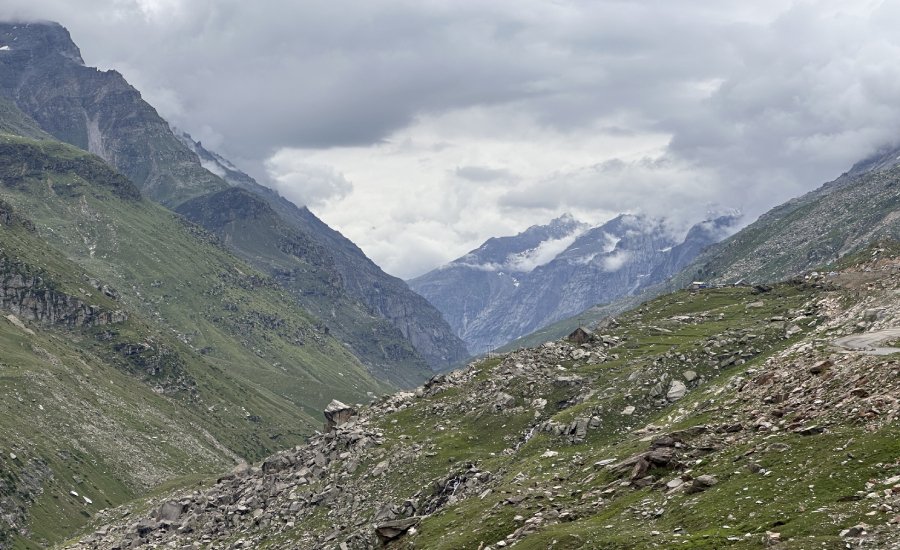
Endless waterfalls cascaded down towering mountainsides, feeding rivers that rushed alongside the road.
Green valleys, dramatic cliffs, and countless waterfalls created one of the most beautiful drives I’ve experienced in the Himalayas.
Lunch at Chhatru
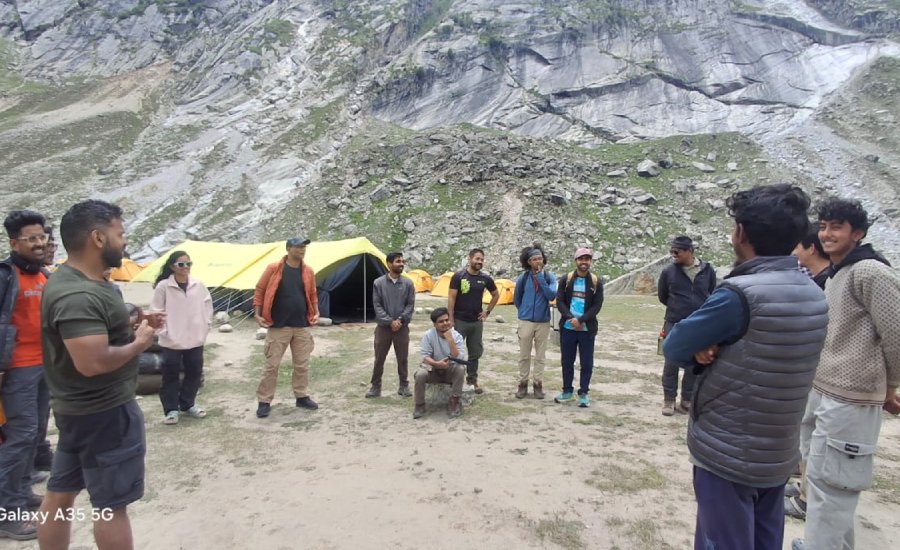
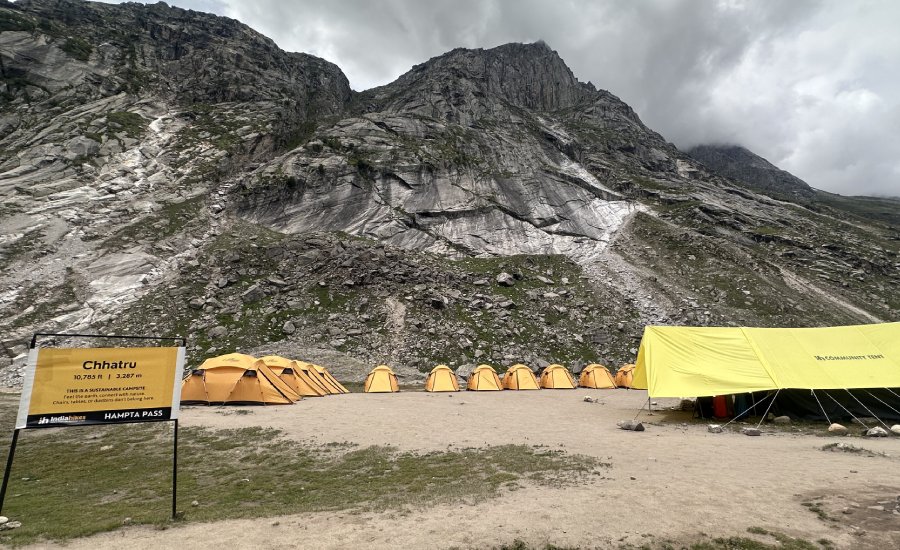
Around 12:00 PM, we reached Chhatru, where Indiahikes operates one of its campsites for the Hampta Pass Trek.
The kitchen team welcomed us with a refreshing glass of Aam Panna, which tasted wonderful after the long drive.
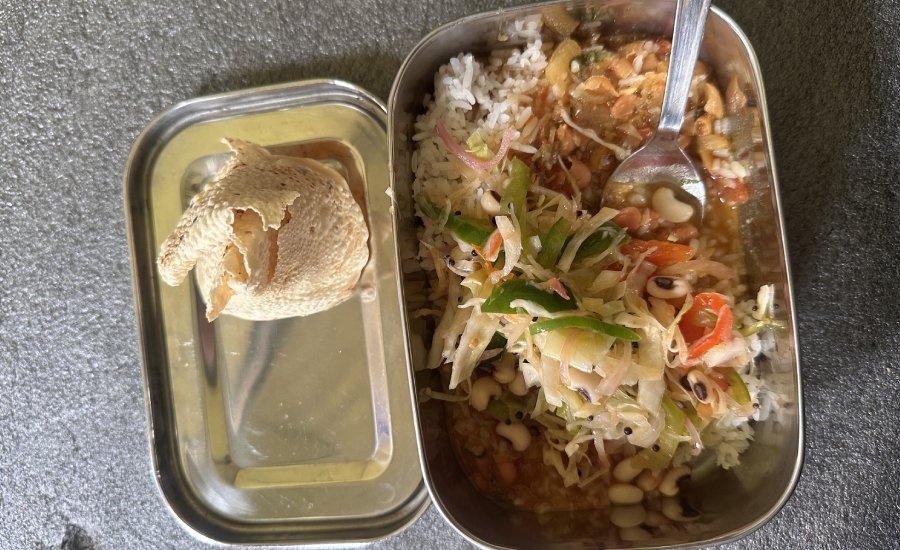
Lunch was simple:
- Rajma
- Rice
- Salad
- Papad
Yet, surrounded by towering mountains and crisp mountain air, it became one of the most satisfying meals of the journey.
Before leaving, we thanked the kitchen team for their warm hospitality and continued towards Spiti.
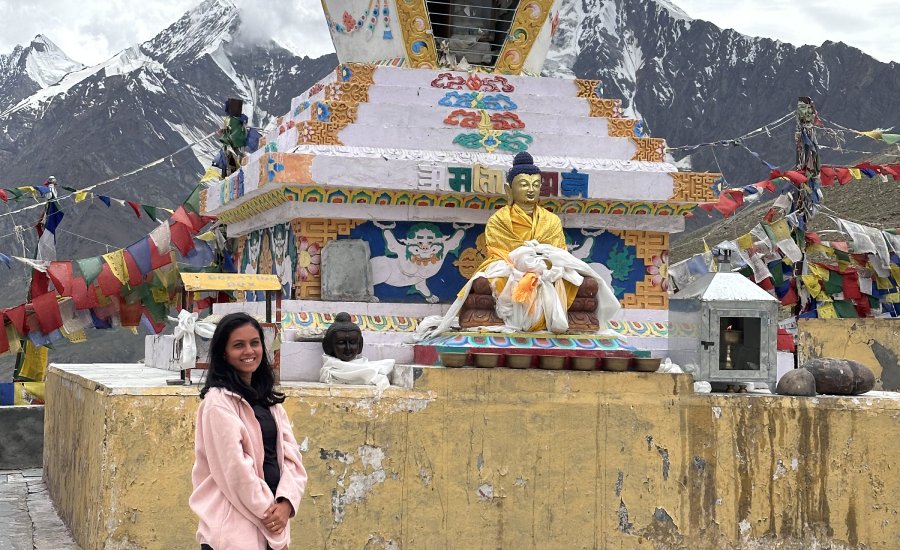
Praying at Kunzum La
Our next major stop was Kunzum La (Kunzum Pass), situated at an altitude of around 4,551 metres (14,931 ft).
Kunzum Mata Temple is considered sacred by locals and travellers alike. It is customary to stop here, seek blessings from Goddess Kunzum Devi, and pray for a safe journey before entering the remote regions of Spiti.
Like everyone else, we offered our prayers and hoped for a safe trek, a successful summit, and an equally safe return.
A Small Gesture Along the Way
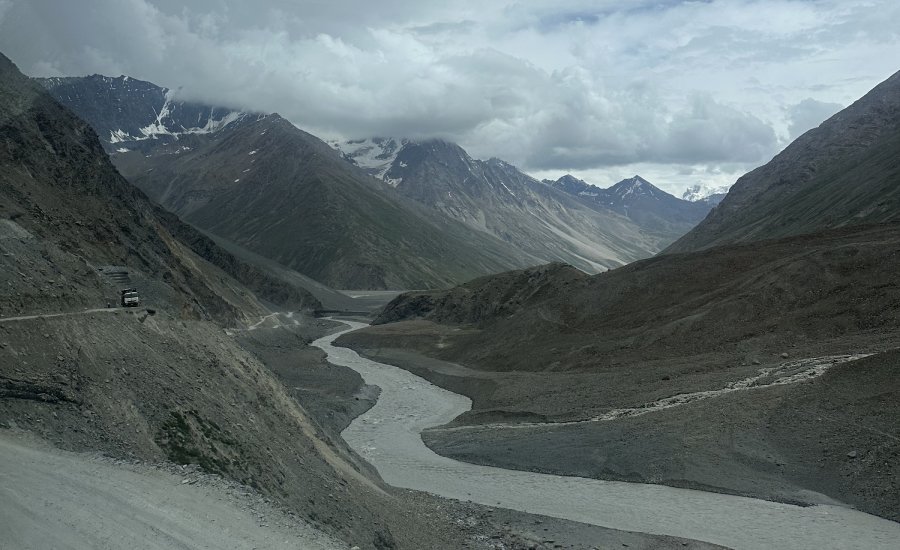
As we entered Spiti, a police checkpoint was recording the entries of travellers heading towards Kaza and Chandratal.
One elderly officer asked if anyone had a water bottle.
Most of us carried reusable bottles that were already half empty.
I handed him mine without thinking much about it.
He smiled and took a few grateful sips before returning it.
It was a tiny interaction, but it reminded me how challenging life can be in these remote high-altitude regions, where even basic necessities like drinking water aren’t always within easy reach.
Sometimes, the smallest acts of kindness matter the most.
Mountains Teach Humility
The deeper we entered Spiti, the larger everything around us became.
Massive mountains.
Powerful rivers.
Towering cliffs.
Looking out of the window, I couldn’t stop thinking about how insignificant we are in front of nature.
No matter how advanced we become, the mountains always remind us who’s truly in charge.
💛 Rinkal’s Note
Never challenge nature. Respect it, admire it, and learn from it. The mountains have existed long before us and will remain long after we’re gone.
Tea Break at Losar
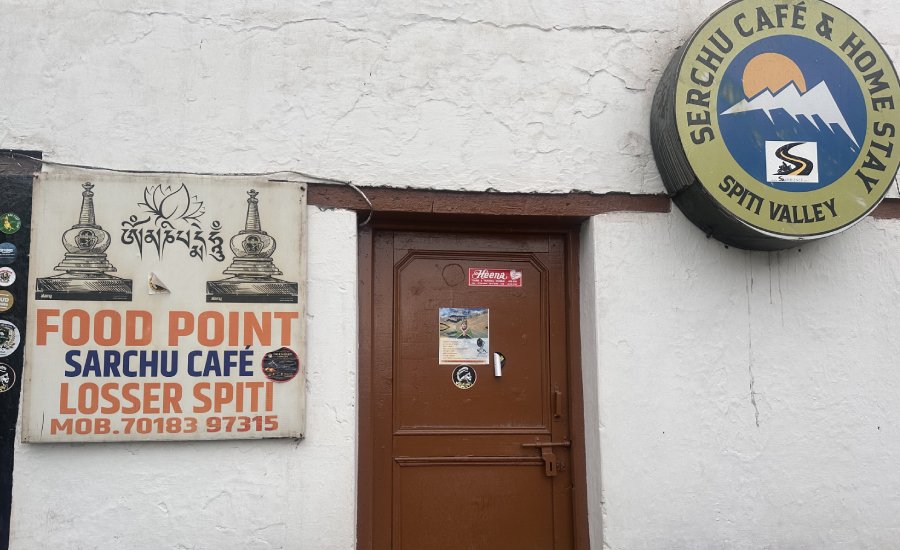
Around 4:00 PM, we stopped at Losar, one of the last villages before entering the higher reaches of Spiti.
We enjoyed hot tea and snacks at Sarchu Café before continuing our journey.
By then, light rain had started, adding another layer of beauty to the already dramatic landscapes.
The People Who Build These Roads
One sight throughout the drive touched me deeply.
Even at these extreme altitudes and in cold weather, road workers continued repairing roads and building bridges.
Many worked with their families nearby.
At one point, I waved at two young children playing beside a construction site. They smiled and waved back.
I offered them a packet of biscuits I had in my backpack, and they happily accepted.
Later, I realised I had forgotten to take back the wrapper.
That small mistake reminded me of something important.
Even while trying to do something kind, we should ensure we leave no waste behind.
It’s a lesson I’ll carry on every trek from now onwards.
💛 Rinkal’s Note
Whenever you meet road workers in the mountains, offer them a smile, greet them, or share something if you can. More importantly, respect the work they do. Without them, many of these incredible journeys wouldn’t even be possible.
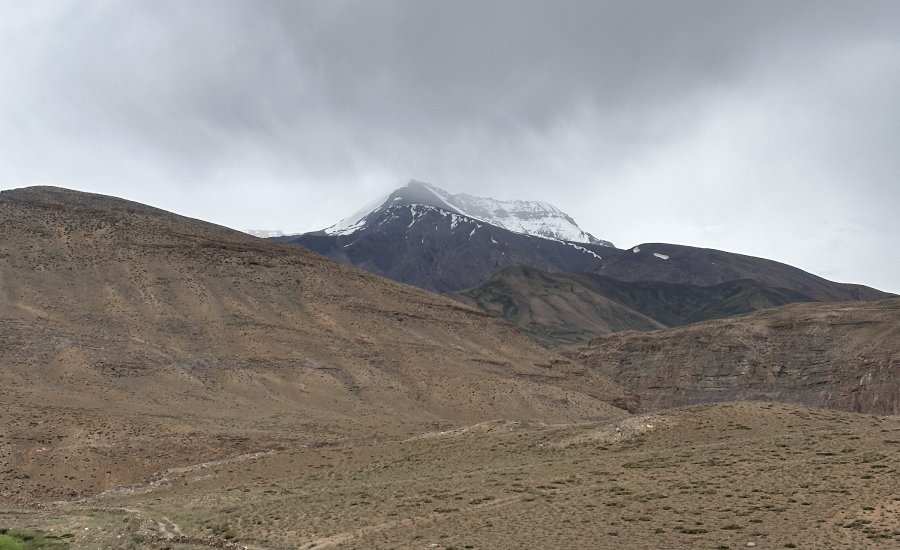
First Glimpse of Kanamo Peak
Passing through fields where locals grow peas, potatoes, and garlic, Umesh Ji pointed towards a massive mountain in the distance.
“That’s Kanamo Peak.”
For a few seconds, everyone inside the vehicle fell silent.
Standing there in all its vastness, the mountain looked far more intimidating than I had imagined.
Crossing Chicham Bridge
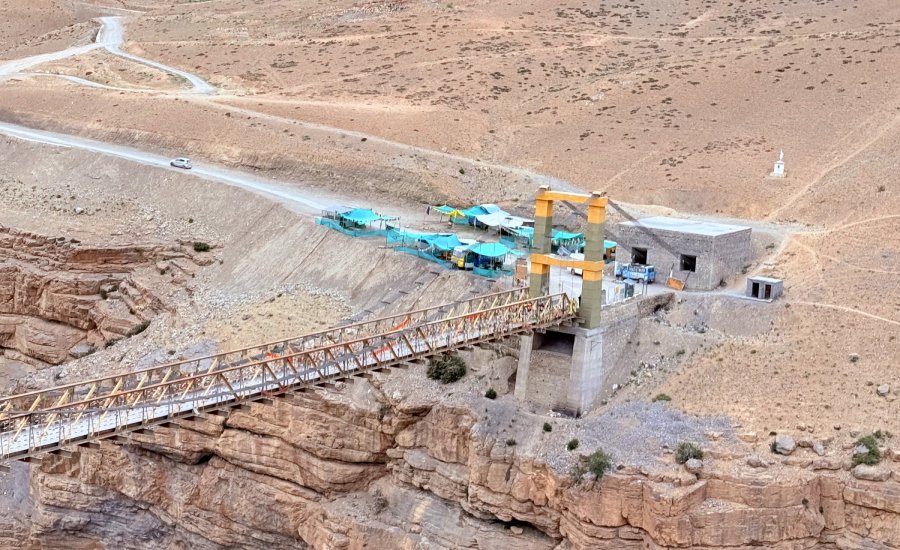
Before reaching Kibber, we crossed the impressive Chicham Bridge, one of the highest suspension bridges in Asia.
Built over a dramatic gorge approximately 1,000 feet deep, the bridge connects the villages of Chicham and Kibber, replacing what was once a risky ropeway crossing. Driving across it offers breathtaking views of the canyon below and is an experience in itself.
Arriving in Kibber
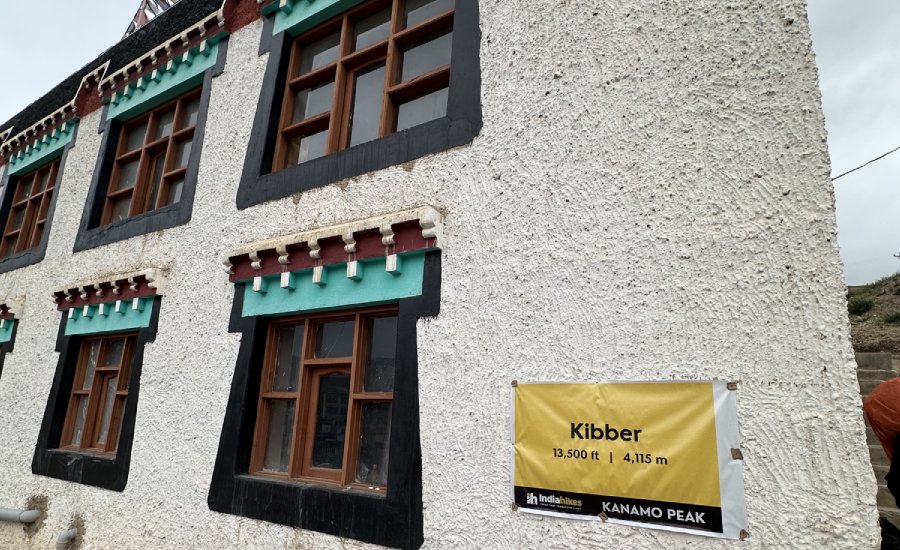
Around 6:00 PM, we finally reached Kibber, one of the highest permanently inhabited villages in the world.
At first glance, the village looked incredibly peaceful.
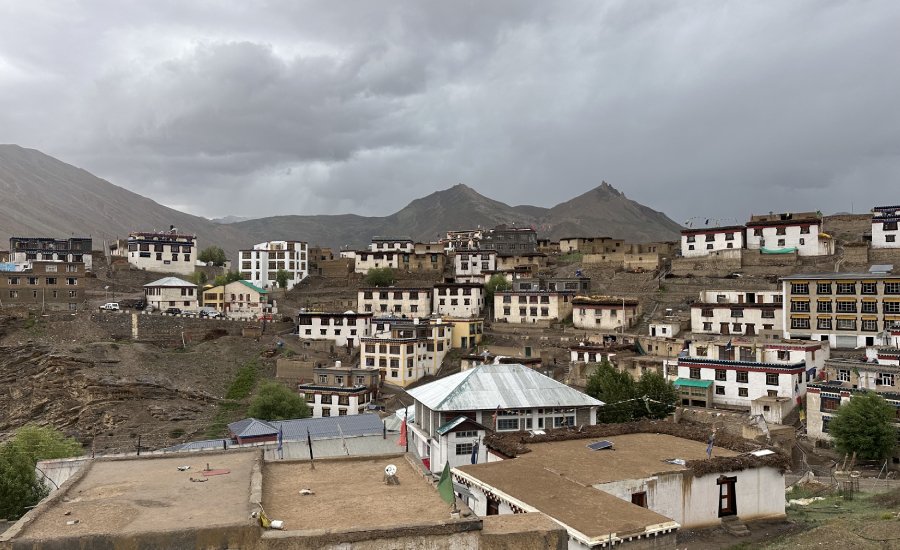
Traditional mud houses, narrow lanes, prayer flags fluttering in the wind, and endless barren mountains surrounding the village created a picture that felt almost unreal.
It was fascinating to think that, until a few decades ago, villages like Kibber remained isolated for much of the year. Today, improved roads have made them more accessible while still preserving their unique character.
Our Homestay
This was where we finally met our trek leader.
After a quick welcome, we were shown around the homestay and assigned our rooms.
I couldn’t believe how comfortable the accommodation was.
For a trek, I had expected something basic, but instead, I found a cosy room with a stunning mountain view. It honestly felt more like a boutique mountain stay than a typical trek accommodation.
As always, the very first thing I did after reaching was layer up. If you’ve followed my previous trekking stories, you’ll know this is one of my golden rules at high altitude—change into warm layers before your body starts losing heat.
💡 Traveller’s Tip
As soon as you reach any high-altitude campsite or homestay, put on your warm layers—even if you don’t feel cold yet. It’s much easier to stay warm than to warm up after your body temperature drops.
The Best Surprise of the Evening
After settling in, we gathered in the dining hall for our routine health check. Oxygen saturation levels and overall health were checked before continuing with the trek.
Then came an unexpected surprise.
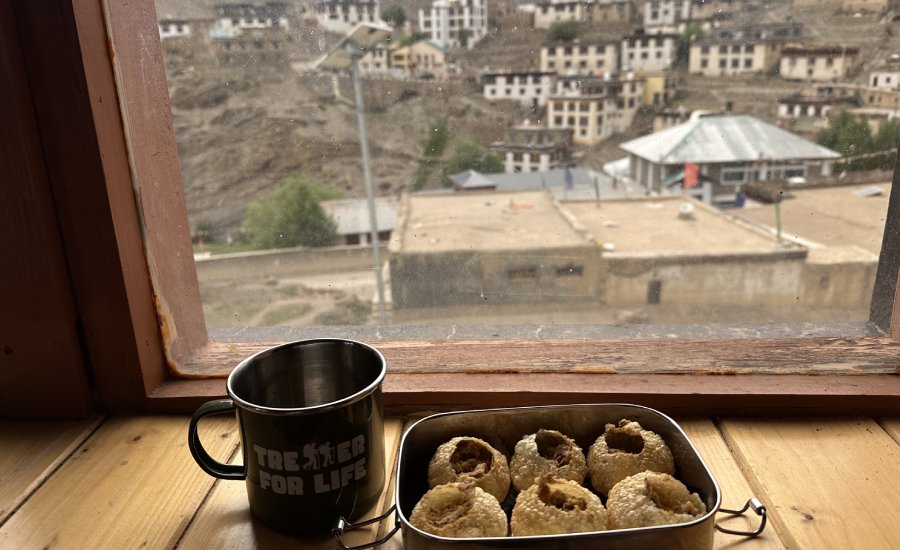
Pani Puri.
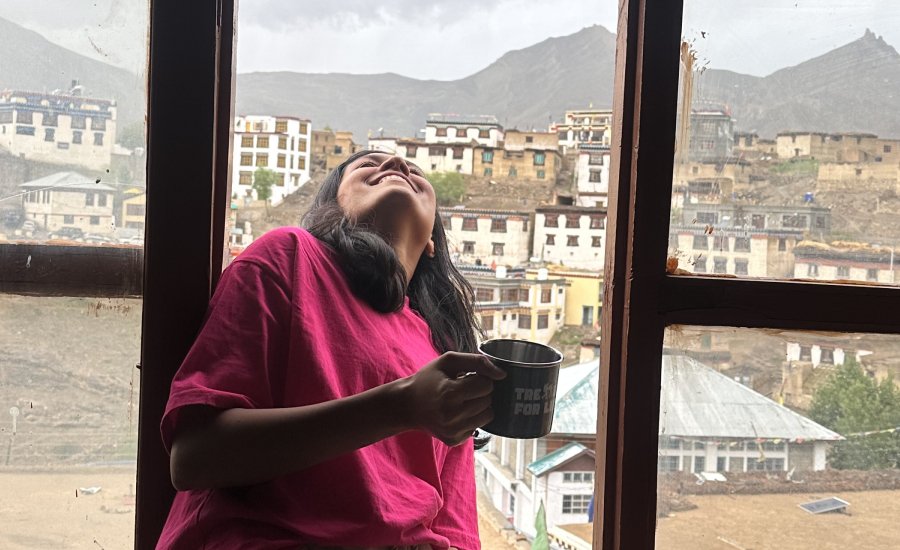
Yes—at 13,500 feet!
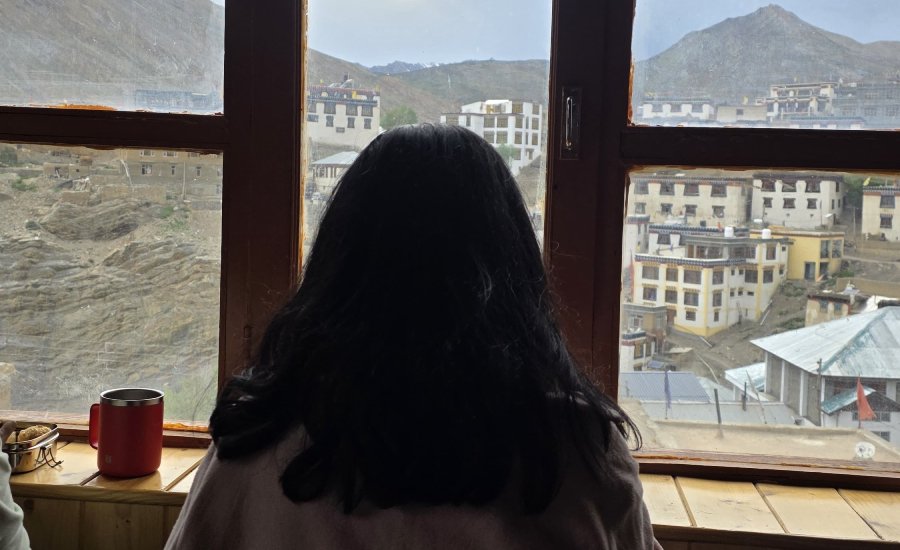
I happily carried my plate near the window so I could enjoy every bite while looking out at the mountains.
A Walk Through Kibber
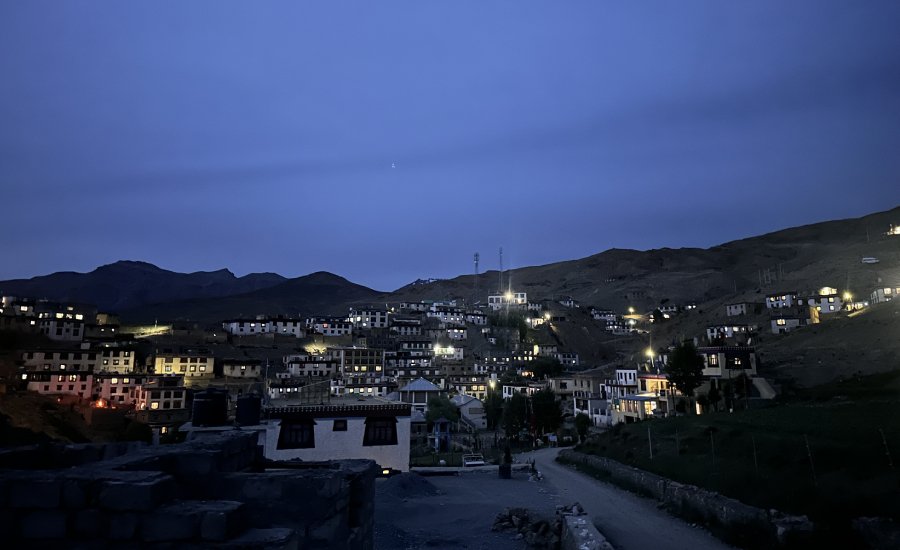
As the sun began to set, we took a short walk through the village.
We visited a small stupa, explored the quiet lanes, admired the traditional houses, and ended the evening with a little stargazing session led by our trek leader.
Standing beneath a sky full of stars in the silence of Spiti was the perfect ending to the day.
After dinner, we returned to our rooms, knowing that the road journey was over.
From tomorrow onwards, every step would be on foot.
The real Kanamo Peak adventure was finally about to begin.
Meet the Team
Every trek becomes memorable because of the people you share it with. Over the next few days, these strangers slowly became teammates, friends, and eventually a family. Each one brought something unique to the journey.
Diptarka – Our Trek Leader
This was going to be around his 110th trek as a trek leader, and his experience showed in every conversation.
Whether it was birds, mountain geology, Himalayan flowers, constellations, food, or trekking techniques, there was hardly a topic he couldn’t explain beautifully. I had met him briefly before, but this trek gave me the opportunity to truly learn from him. He even entertained us by mimicking the sounds of different birds and animals along the trail.
Debarati
I had already introduced Debarati earlier, but she deserves another mention.
A school teacher by profession, she’s one of the calmest and kindest people I’ve met on a trek. From Day 1 itself, she kept motivating me to run uphill, push my limits, and believe in myself.
We shared rooms, tents, stories, and countless conversations throughout the trek. Whenever I needed help, she was always the first to offer it.
Advaith (aka “Ganit”)
If I had to describe him in one word…
Crazzzyyyyy.
The youngest member of our group and undoubtedly the loudest source of laughter.
He could talk throughout the trail without losing energy and still somehow lead the group uphill. On summit day, when everyone was exhausted, he somehow managed to make us laugh until our stomachs hurt.
Also…
He’s probably the only person I’ve met who proudly told us a donkey bite him while he was playing with it.
Only Advaith could have a story like that.
Sumit & Junior Manojkumar
Sumit enjoyed giving me a new name every day. Throughout the trek, I was called by every random name except my own.
We also had endless conversations about Gujarati food, which made me miss home even more. On summit day, he truly earned the Spirit of Trekking Badge by carrying another teammate’s backpack through the difficult climb.
Junior Manojkumar – we called him Jr. because we have two Manoj in our team and he is younger one. He was our cinematic cameraman. While most of us walked, he somehow managed to run ahead on almost every trail. He was one of the trekkers opening the summit route and captured many beautiful moments throughout the journey.
Nagendra
If there was one person who made trekking at high altitude look effortless, it was Nagendra.
He had completed many treks before, yet remained incredibly humble. Always ready to help, always encouraging others, and never trying to show off his experience. Looking at him trek in shorts and flip-flops almost made us question our own fitness.
He was another deserving recipient of the Spirit of Trekking Badge, not because he was the fastest, but because he was always helping others from Day 1 until the summit.
Shakthi
Shakthi amazed me the moment I learnt he had just completed Mt. Yunam before joining Kanamo Peak.
Doing one difficult expedition is challenging enough, but choosing another immediately after showed how mentally and physically strong he is. Despite that, he remained one of the quietest people in our group.
Strong people don’t always speak the loudest.
Adil
If there was any topic worth discussing, Adil was already part of the conversation.
Running, fitness, travel, current affairs—you name it, he had something interesting to add. Debating with him was always fun because every discussion somehow became more engaging once he joined in.
Senior Manojkumar
Some people click photos only at viewpoints.
Senior Manojkumar captured everything.
From funny little moments to beautiful landscapes, many of the memories from this trek exist today because he never stopped recording them.
Prasun
Prasun had two things that stood out immediately—his knowledge and his expressions.
Being a professor, conversations with him were always fascinating. But my favourite memory was waking up every morning to the sound of his flute. It became our unofficial morning alarm.
Samiran & Nitin Ji
Both were among the quieter members of our group, but they left their own impressions.
Samiran once recorded our water-saving utensil washing system just to show his daughter back home. I loved that even such a simple mountain practice became something worth sharing with family.
Nitin Ji’s determination inspired all of us. His health wasn’t great on the very first day, and there were moments when continuing seemed difficult. Yet he never gave up and proudly completed the summit.
Nandu Ji & Vamsea
At 59 years old, Nandu Ji quietly became everyone’s inspiration.
He was often ahead of many younger trekkers on the trail, and I kept wondering what his fitness routine looked like. He also became famous in our group for bringing Podi Masala, which somehow made every meal taste even better.
Vamsea was one of the quietest members of the team. Soft-spoken and calm, he preferred listening more than speaking, but his presence blended perfectly with the peaceful atmosphere of the mountains.
More Than Just Trek Mates
Over the next few days, we discussed everything from health and fitness to current affairs, physics, mathematics, stars, travel, and life itself.
Listening to everyone, I often felt like I knew the least in the group—and honestly, I loved that feeling because it meant there was so much to learn.
As the trek slowly came to an end, I realised I wasn’t just leaving the mountains. I was saying goodbye to people who had become a part of my journey.
Every trek reminds me that the mountains don’t just reward you with breathtaking views—they introduce you to some of the kindest and most humble people you’ll ever meet. Kanamo Peak gave me another family I’ll always be grateful for.
Day 3: Acclimatising to the Rhythm of Spiti
After yesterday’s long journey from Manali to Kibber, today was all about acclimatisation. At nearly 13,500 ft, giving your body enough time to adjust to the altitude is just as important as physical fitness. It was a relatively relaxed day with no major trekking involved, but little did I know it would become one of my favourite days of the entire trip.
The plan was simple—visit the iconic Key Monastery in the morning, spend some quiet time exploring Kibber in the evening, and let our bodies slowly adapt to the thinner air before the real trekking began.
A Slow Morning in Kibber
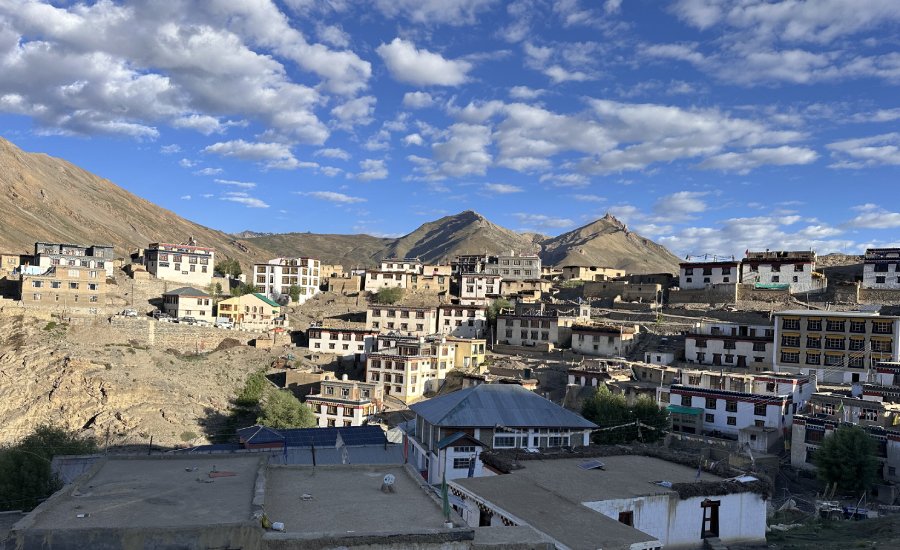
I woke up to a bright, sunny morning with golden sunlight pouring through the window of my room. Before stepping outside, I spent a few quiet minutes simply enjoying the view. The barren mountains surrounding Kibber looked completely different under the morning sun, and for a moment, everything felt incredibly still.
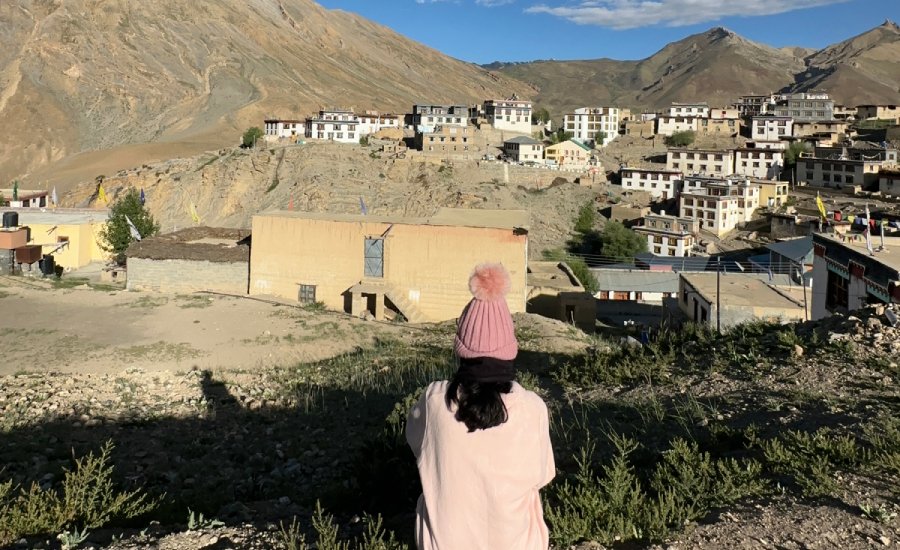
As I walked outside, the village was slowly coming to life. Some of my teammates were already standing in the warm sunlight, enjoying the pleasant weather after the chilly night. A few were stretching, while others simply stood quietly taking in the mountain views.
Then, in the middle of that peaceful morning, I heard the soothing sound of a flute.
Prasun had already found himself a quiet corner and was playing softly while birds chirped around us. It honestly felt like the perfect mountain morning.
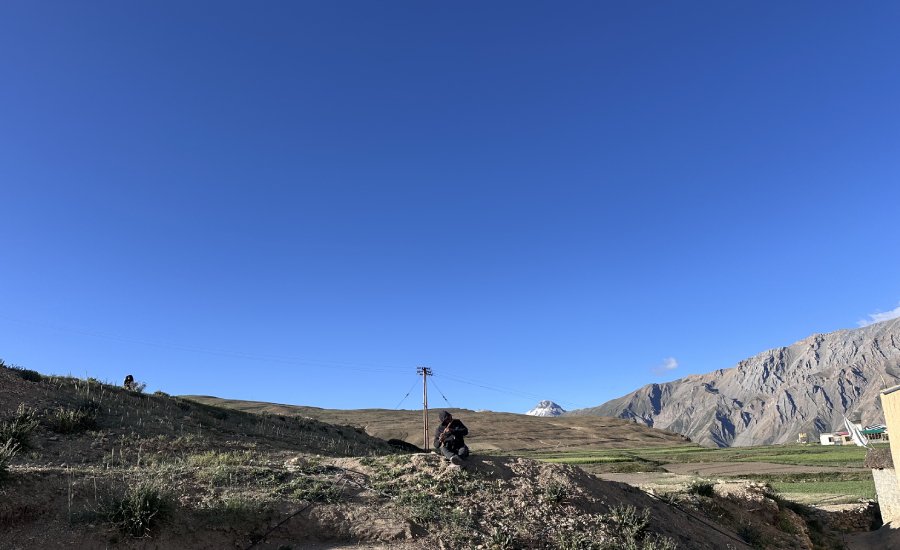
While sitting there, I watched the locals begin their daily routine. Some were feeding livestock, others were sweeping their courtyards, chatting with neighbours, or carrying out simple household chores. Life here moved at its own pace.
Watching them reminded me of something.
We often travel to the mountains searching for peace, but perhaps the people who live here already have it.
💛 Rinkal’s Note
The mountains don’t ask you to slow down—they simply make you realise how fast you’ve been living.
Breakfast & A Beautiful Ride to Key Monastery
After breakfast, we were ready to leave for Key Monastery, one of the oldest and most iconic monasteries in Spiti Valley.
The best part?
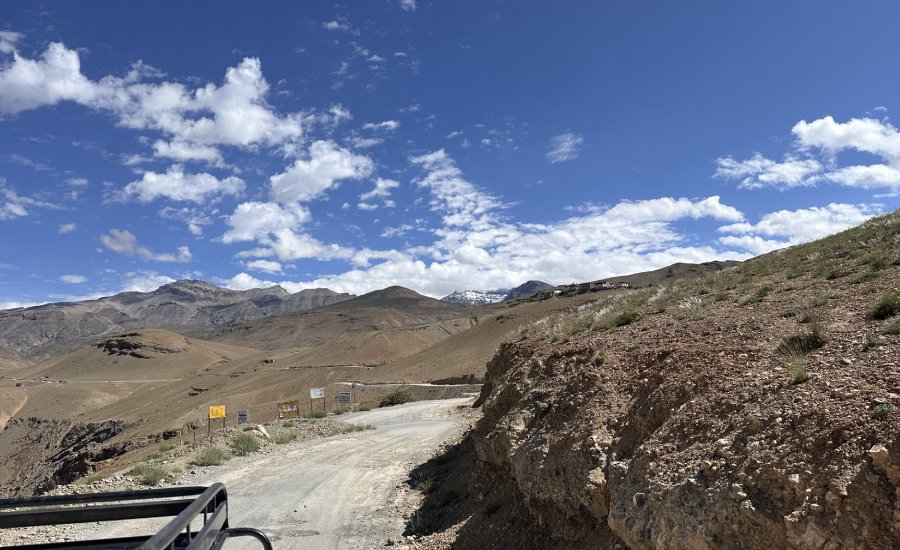
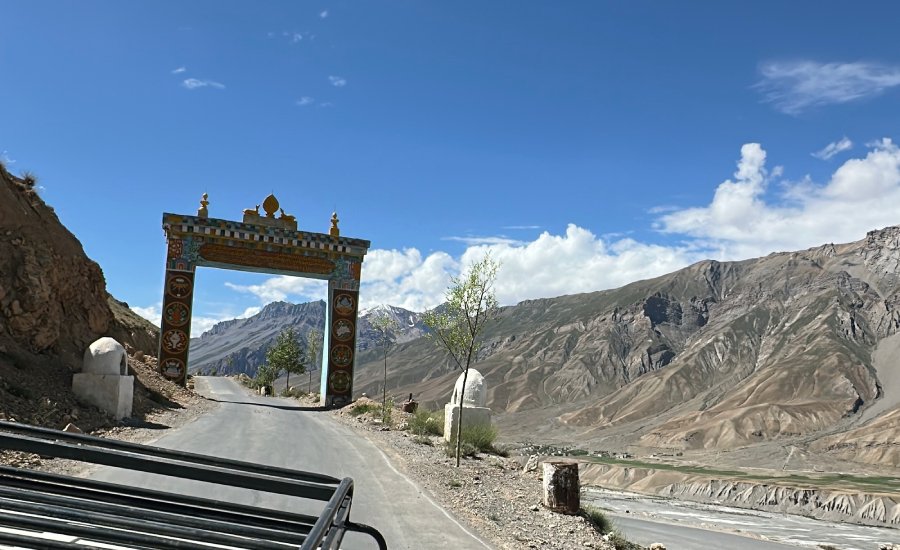
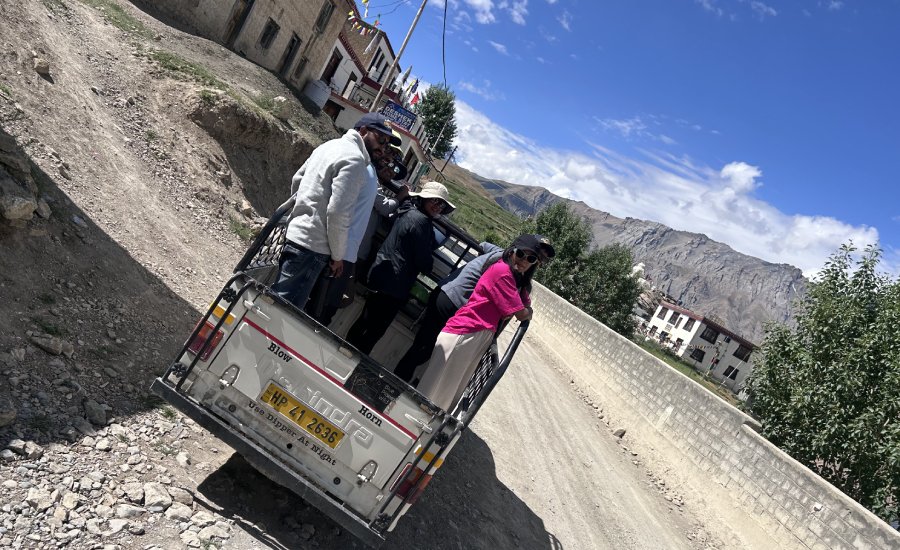
We travelled in an open camper van.
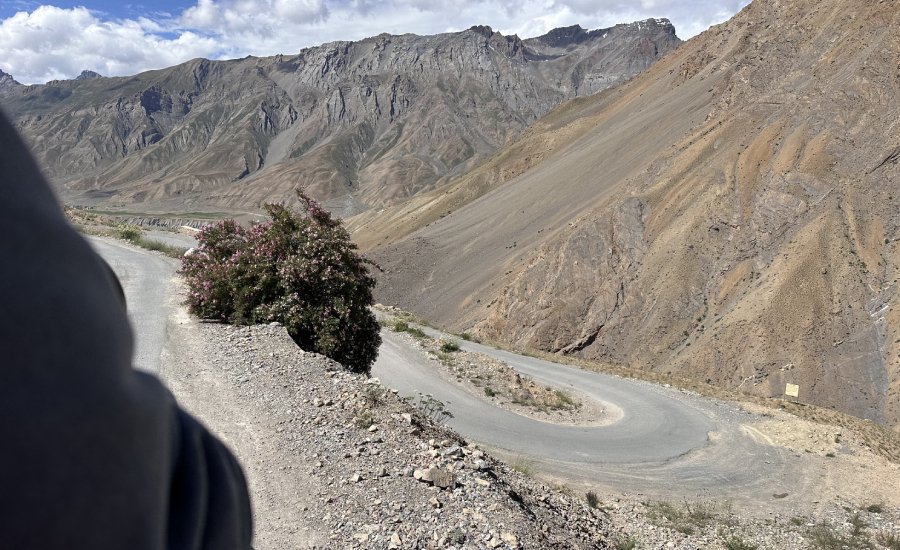
The drive from Kibber to Key Monastery takes only about 30 minutes, but I wished it lasted much longer.
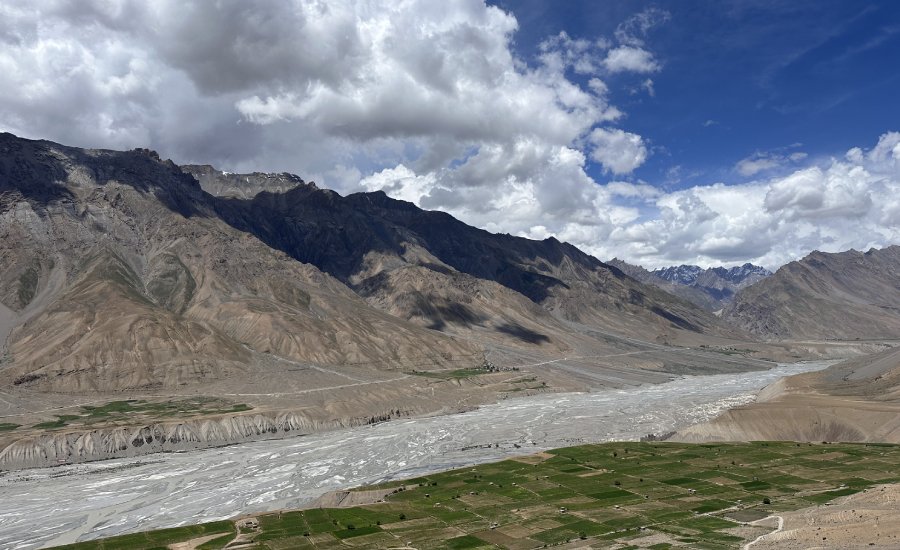
Imagine this.
A narrow mountain road.
Towering barren peaks on both sides.
The Spiti River flowing far below.
Cool mountain air hitting your face.
Visiting the Timeless Key Monastery
This was my second visit to Key Monastery, but somehow it felt just as special as the first.
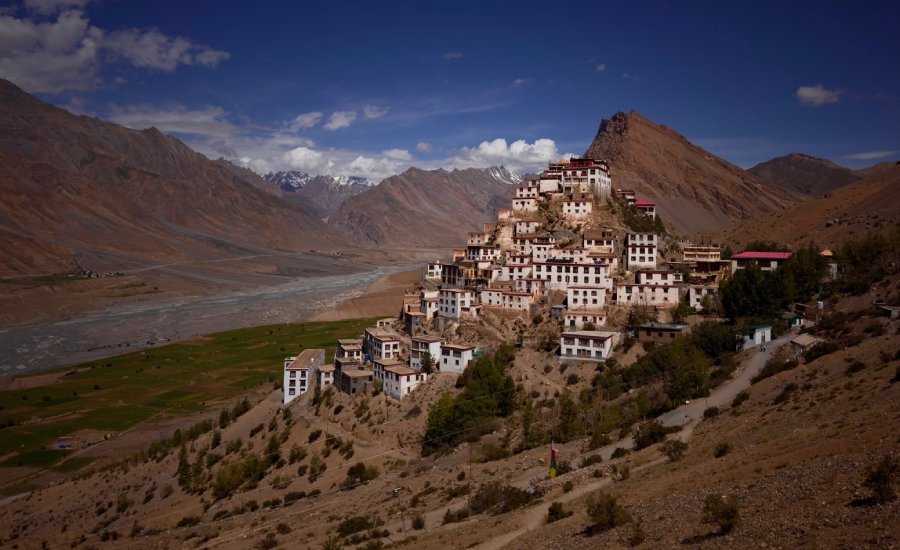
Perched dramatically on top of a hill at an altitude of around 4,166 metres (13,668 ft), Key Monastery is believed to be over 1,000 years old. It is the largest monastery in Spiti Valley and serves as an important centre for Tibetan Buddhism. Over the centuries, it has survived invasions, earthquakes, and harsh Himalayan winters, yet it continues to stand proudly overlooking the valley.
Explore More of Spiti
Explore Spiti Valley
Before entering the monastery, we first walked to the viewpoint above it.
From there, the entire monastery looked magnificent—whitewashed buildings stacked one above another against the rugged brown mountains, almost as if they had grown naturally out of the hillside.
No matter how many photographs you’ve seen of Key Monastery, seeing it in person is something else entirely.
As we walked towards the monastery, I noticed a school where young monks study and live while learning Buddhist teachings. Seeing children in maroon robes running around and laughing reminded me that this wasn’t just a tourist attraction—it was their home, their school, and their place of worship.
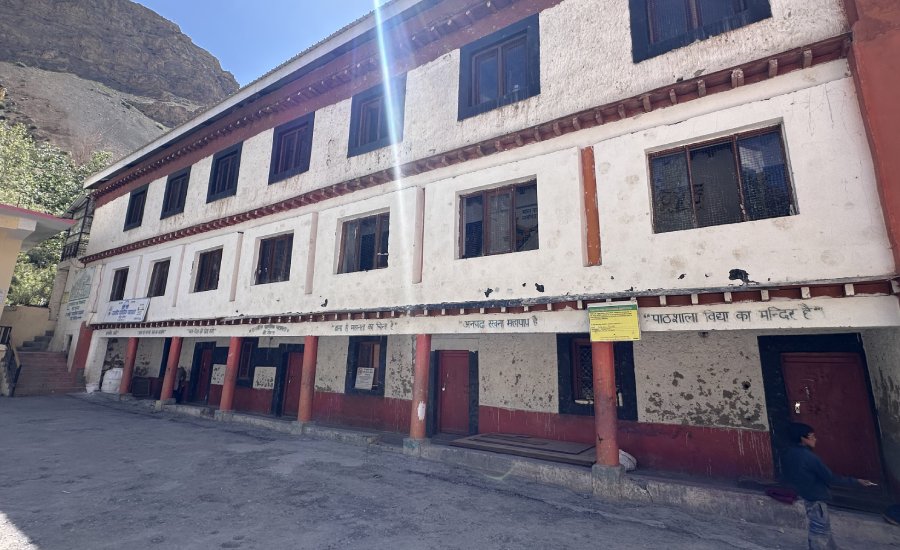
Stepping Inside
The moment we entered, colourful prayer wheels lined the entrance. Like every visitor, I gently spun each wheel before walking further inside.
The monastery is a maze of narrow stone staircases, tiny rooms, and ancient prayer halls. Despite being built almost entirely from stone and mud, the interiors felt surprisingly warm and comfortable. Even the smallest rooms never felt suffocating.
It amazed me how beautifully traditional Himalayan architecture works with nature instead of against it.
A Few Minutes of Complete Silence
One room that stayed with me the most was the meditation hall.
Unlike the prayer halls, this space was completely silent. We all sat there for a few minutes, closed our eyes, and simply breathed.
Just silence.
In today’s world, we rarely get moments like these, and perhaps that’s why they feel so special.
I’ve always been curious about Buddhism and its philosophy, so while exploring the monastery, Debarati and I ended up discussing a few Buddhist teachings. Those conversations made the visit even more meaningful because I wasn’t just looking at the monastery—I was beginning to understand a little more about the way of life it represents.
Before leaving, we were served a warm cup of herbal tea. It was simple, comforting, and exactly what we needed in the cool mountain weather.
Back to Our Homestay
By the time we returned to Kibber, our welcome drink and lunch were already waiting for us.
There’s something incredibly satisfying about returning to a warm meal after spending a morning exploring the mountains.
We enjoyed lunch together, cleaned our utensils—as had become our little post-meal routine—and then everyone started discussing how to spend the rest of the afternoon.
Some wanted to rest.
Some planned to explore more of the village.
And a few had a very different plan…
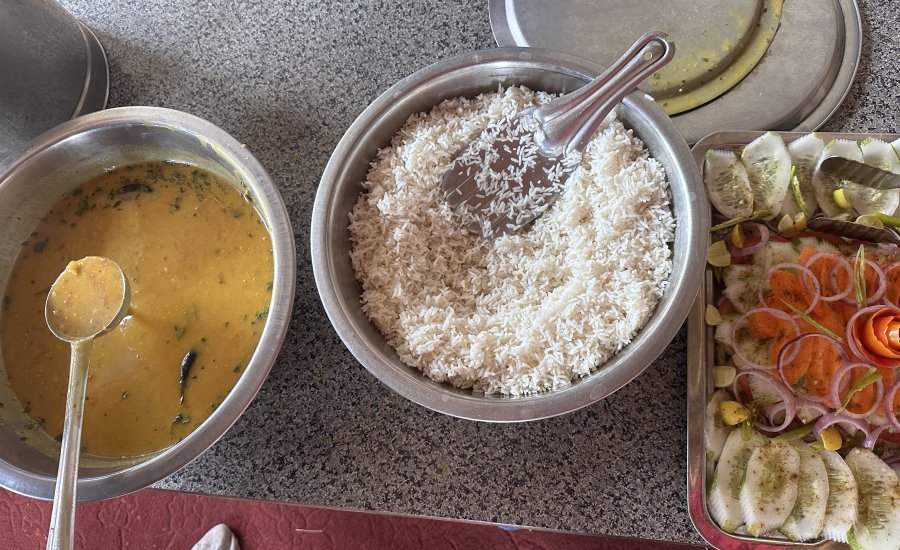
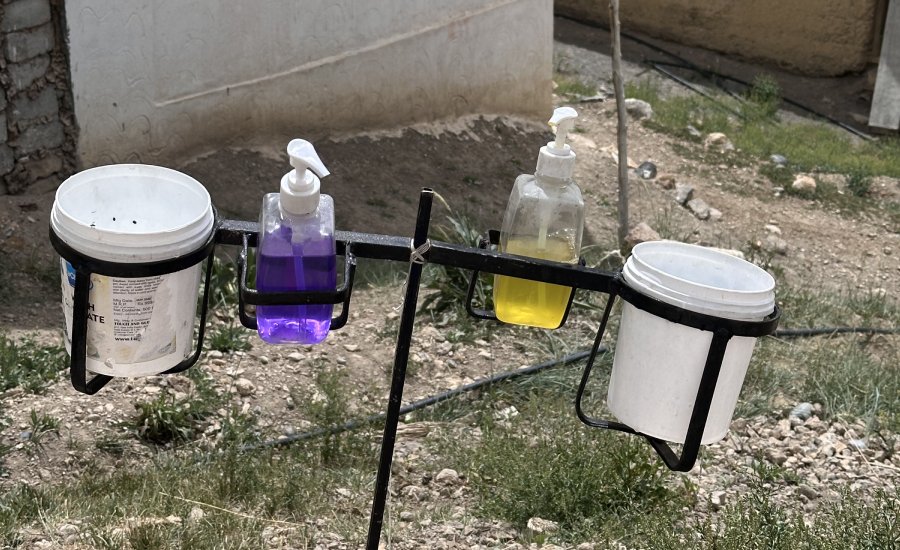
The Café Adventure We Didn't See Coming
Just then, Adil, Advaith and Shakthi casually mentioned they were heading to the café.
Without thinking much, I asked, “Can I join you?”
“Of course,” they replied.
We got ready, and walked together towards the only café in Kibber village.
Only after reaching the café did we discover the real reason behind this sudden outing.
Our homestay had temporarily run out of water, so the village café had suddenly become everyone’s favourite destination to use the washroom.
Since we were already there, ordering something was only fair.
Debarati, Shakthi and Adil ordered the Burnt Garlic Soup, while Advaith and I confidently chose Hot Chocolate.
Within minutes, we realised we’d made a terrible decision.
Their soup tasted as good as it looked.
Our hot chocolate…
Well…
Let’s just say the soup won by a huge margin.
If you’re ever visiting this café, do yourself a favour and order the Burnt Garlic Soup.
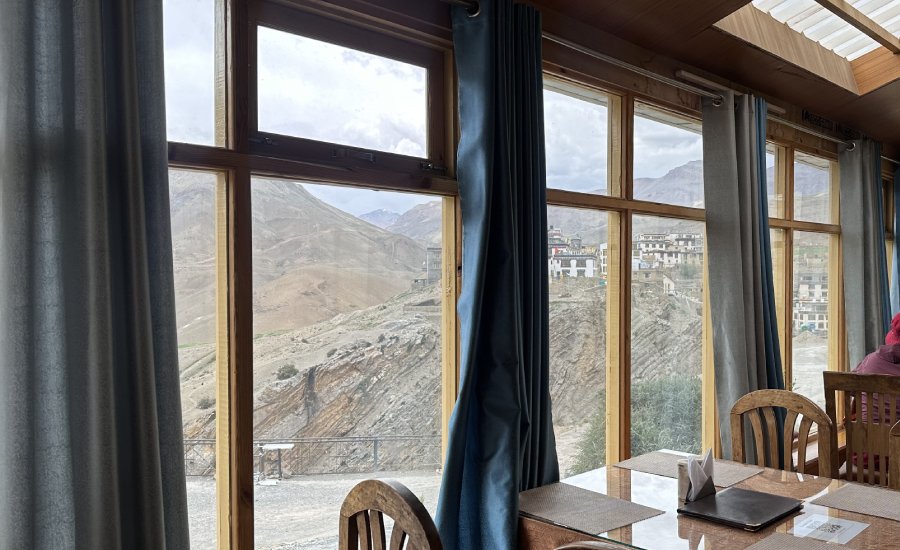
A Walk Through the Village
By the time we stepped outside, it had started drizzling lightly.
Our original plan was to go for a small acclimatisation hike, but the weather had different plans. So instead of rushing out, we sat together with tea and snacks, hoping the skies would clear.
Thankfully, after a while, the rain eased, and we decided to go for a leisurely walk through Kibber village instead.
Kibber is one of those villages where every lane feels like a postcard.
Whitewashed mud houses stood neatly against the backdrop of barren mountains. Colourful prayer flags fluttered gently in the breeze, while children played outside their homes without a care in the world.
Everything looked so simple.
Yet so beautiful.
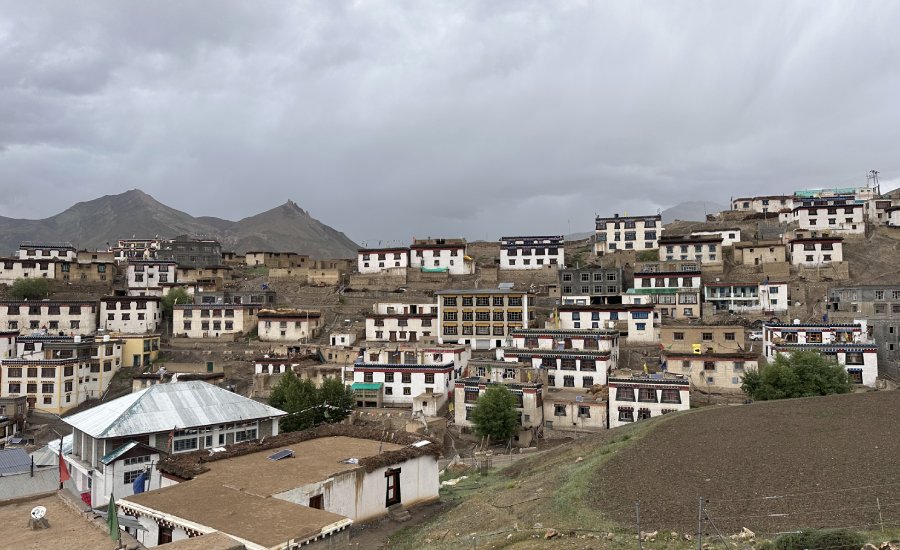
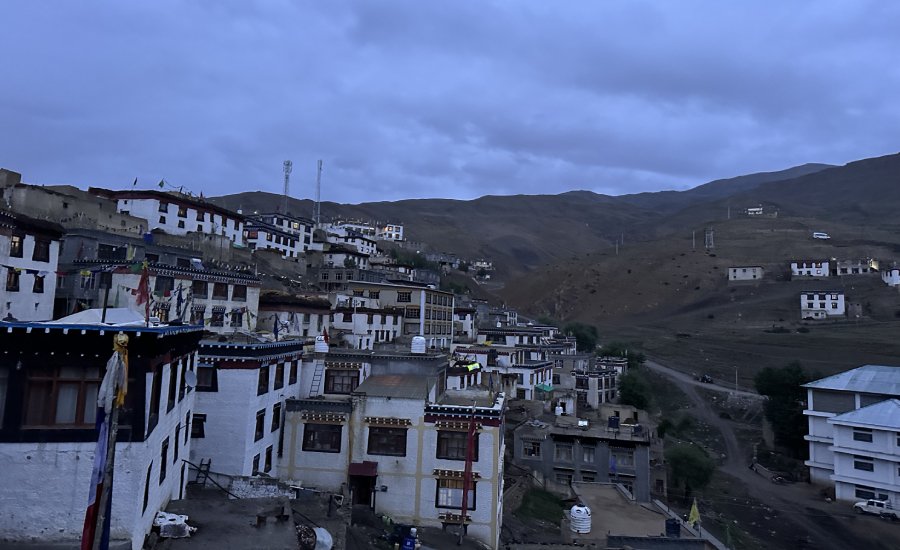
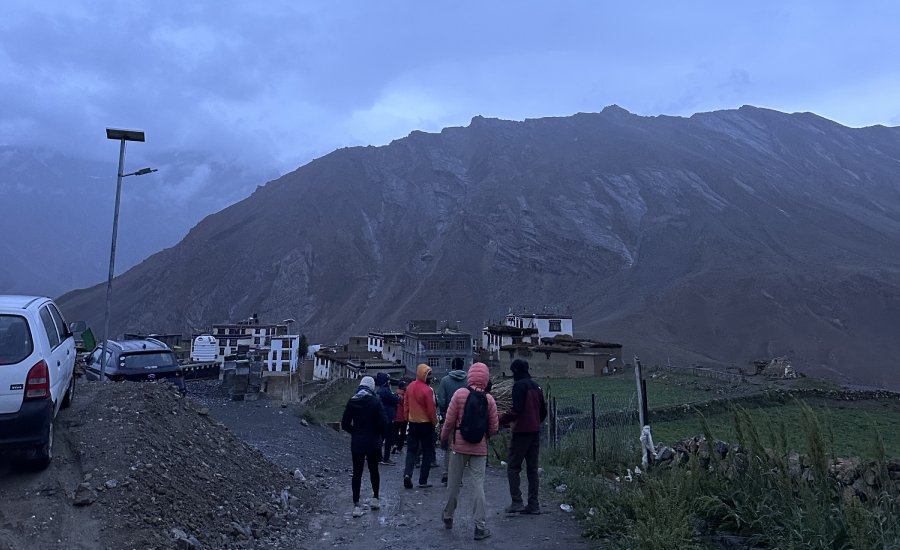
As we continued walking, we passed small farms where locals had already finished most of their work for the day. A few people greeted us with warm smiles, while others quietly continued with their evening routine.
No rush.
Only the sound of the wind, distant conversations, and the occasional bark of a village dog.
It felt incredibly peaceful.
💛 Rinkal’s Note
The villages of Spiti taught me that life doesn’t always have to be fast to be fulfilling. Sometimes, slowing down is exactly what we need.
Dinner, Laughter & A Peaceful Night
Dinner was filled with laughter, stories, and excitement for the days ahead. It was amazing how quickly strangers had started feeling like friends.
After dinner, we packed our backpacks, checked our gear one last time, and called it a night. Tomorrow, the real adventure would finally begin as we started our trek towards Kanamo Base Camp.
Day 4: Kibber to Kanamo Base Camp – Into the Wilderness
Today was the day we had all been waiting for.
The road journey was behind us, the acclimatisation was complete, and now it was finally time to shoulder our backpacks and begin the actual trek towards Kanamo Base Camp.
The route would take us from 13,550 ft in Kibber to around 15,900 ft, with a gradual ascent through the vast landscapes of Spiti. It wasn’t the hardest day physically, but it was the day that truly made us feel like trekkers.
The Morning Begins
Our day started around 6:00 AM. After freshening up, we gathered for breakfast, packed our last-minute essentials, and made sure everything was ready before leaving the comfort of our homestay.
This was also the first time we met our local guide, who would accompany us throughout the trek.
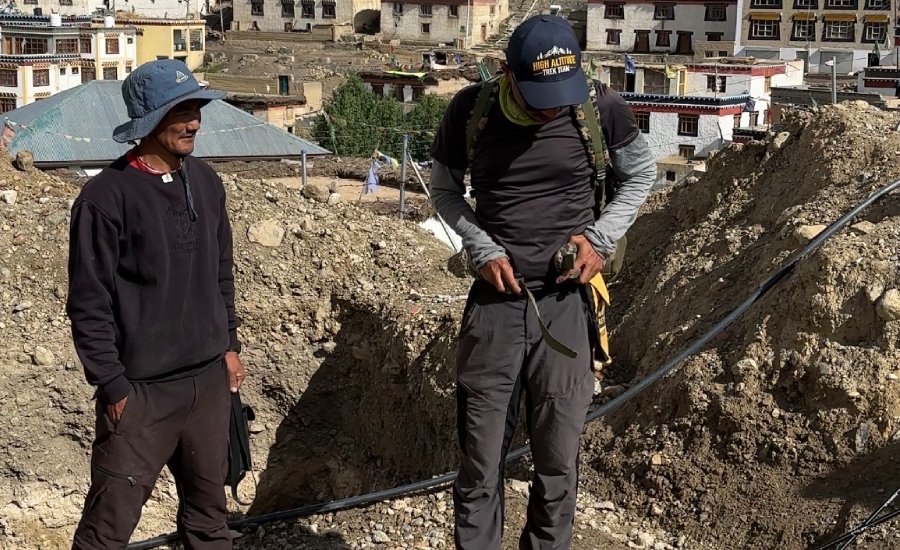
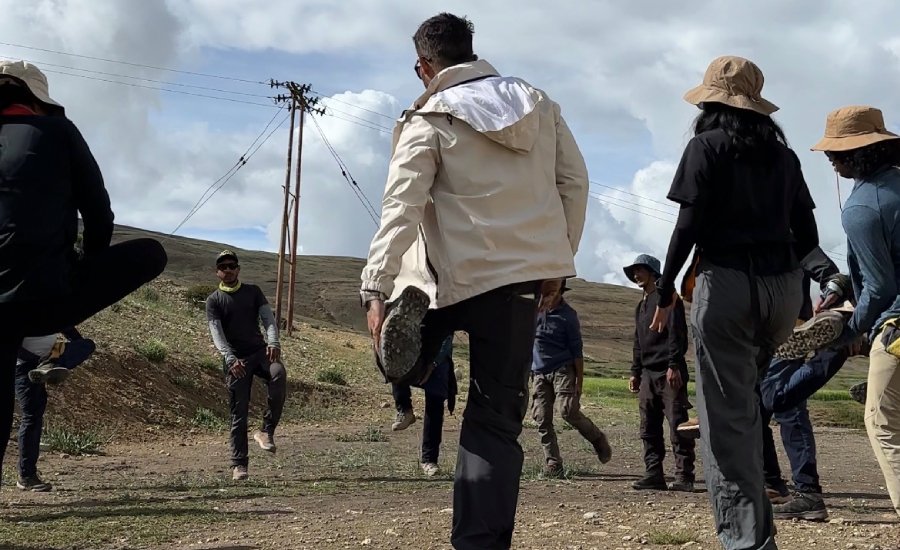
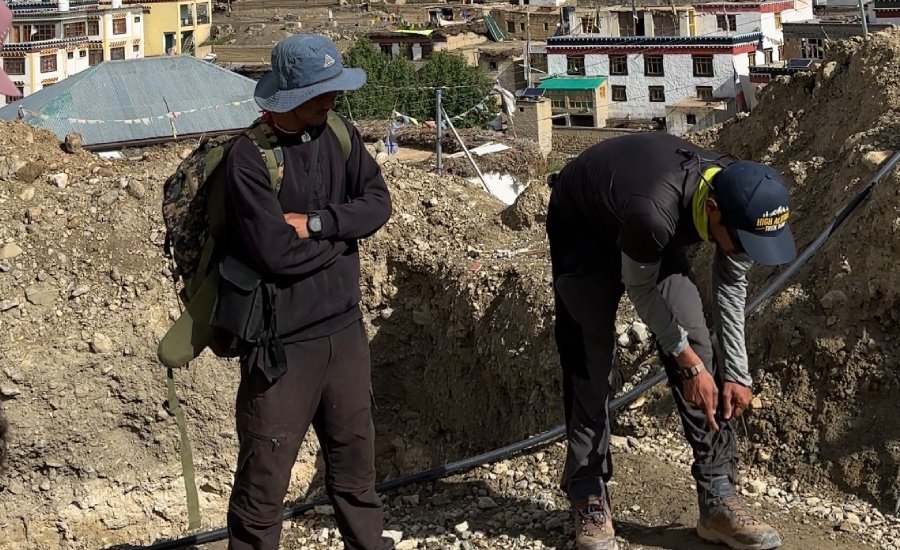
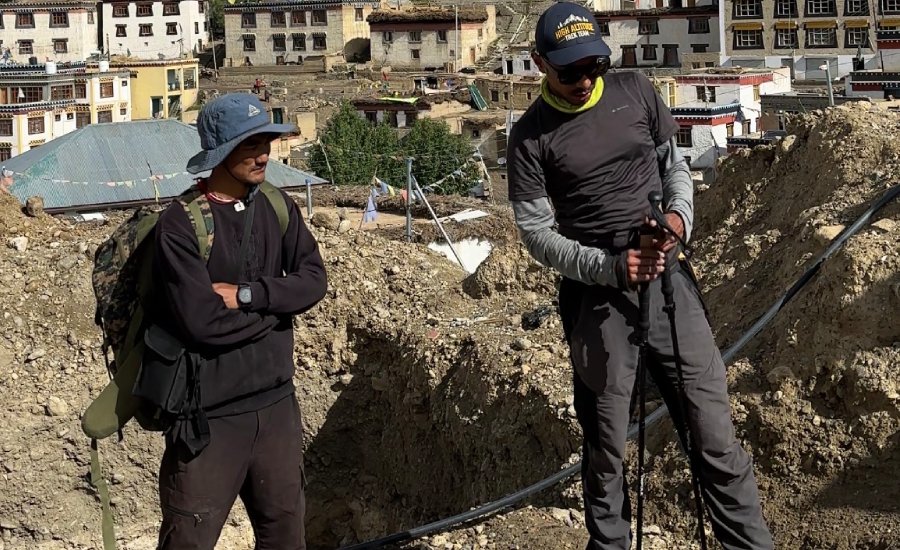
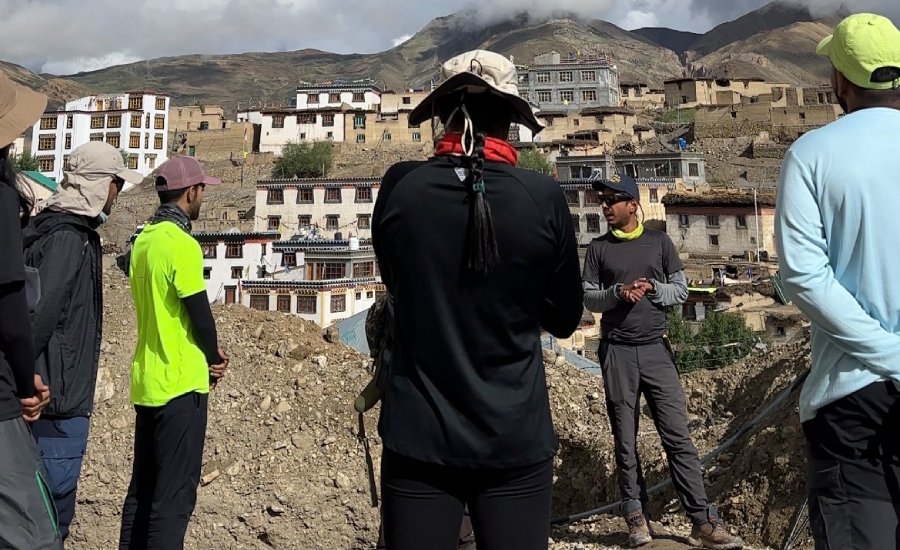
Before we started walking, Diptarka gathered everyone for a final briefing. He explained how to properly wear our backpacks, adjust the chest and waist straps, use trekking poles efficiently, and the common mistakes trekkers often make on the trail.
For experienced trekkers, these may sound like basic instructions.
But I genuinely appreciate that Indiahikes never skips them.
No matter how many treks you’ve completed, every mountain is different. Just like airlines repeat safety instructions before every flight, trekking basics deserve to be repeated before every expedition.
After a quick warm-up session, backpacks were on, trekking poles were in hand, and around 9:00–9:30 AM, we finally took our first steps towards Kanamo Base Camp.
💡 Trekker’s Tip
Before starting the trek, take a few extra minutes to adjust your backpack properly. A well-fitted backpack can make a huge difference during long days on the trail.
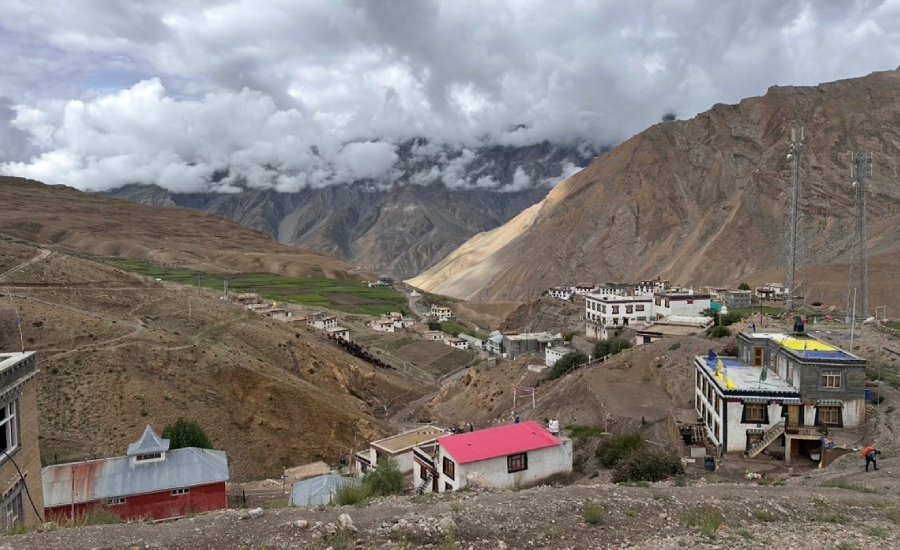
Leaving Kibber Behind
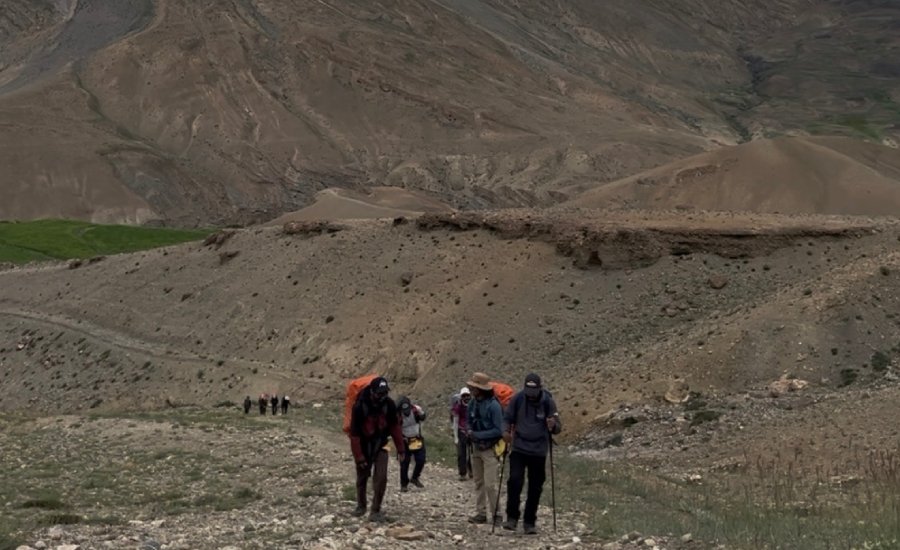
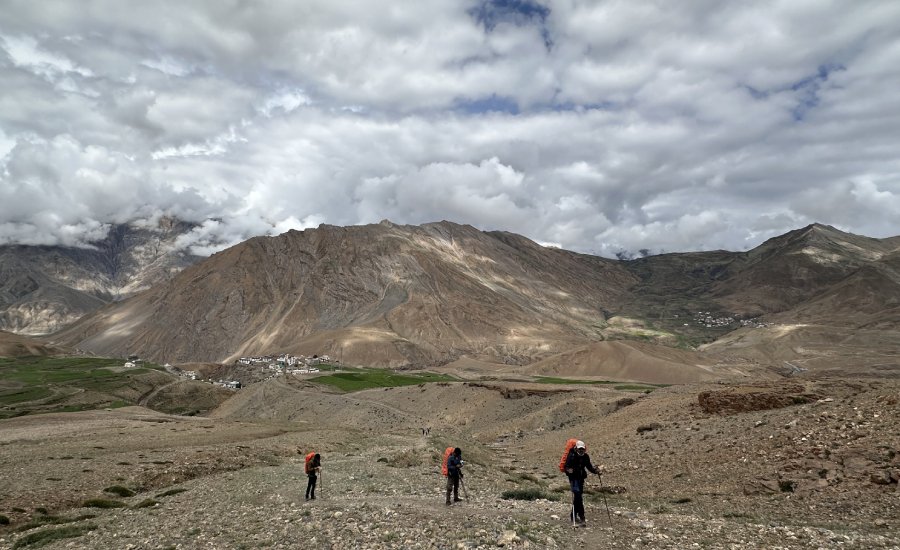
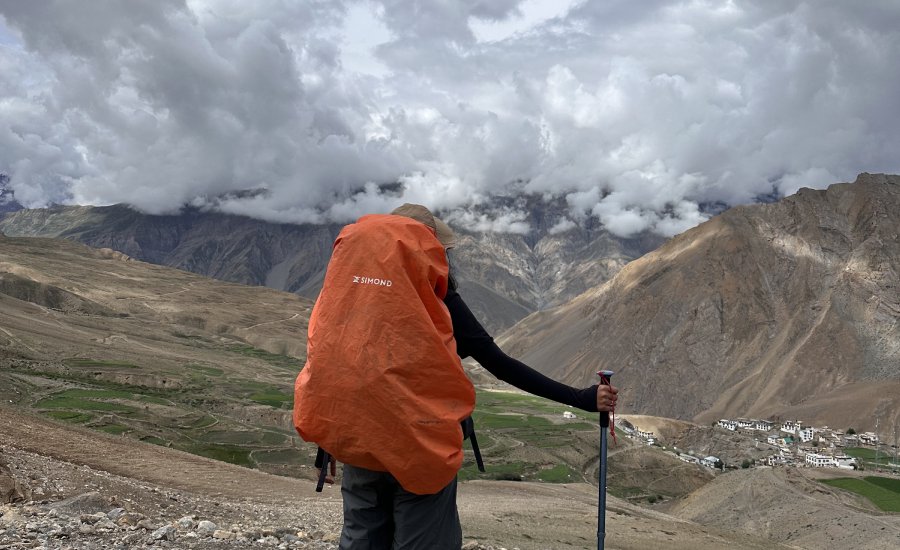
The trail began with a gradual climb through the open landscapes of Spiti.
There were no dense forests.
No tall alpine trees.
Just endless mountains stretching in every direction.
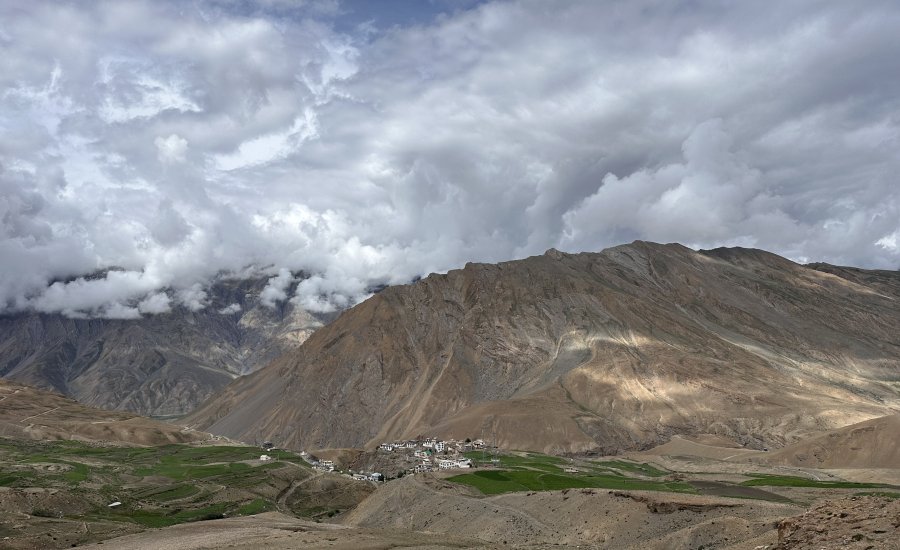
Every time we turned around, the views became even better. Kibber and Chicham villages slowly started looking smaller and smaller, almost like tiny toy villages nestled between enormous mountains.
It was fascinating to see how quickly civilisation disappeared behind us.
We weren’t in a hurry.
Today wasn’t about speed.
It was about enjoying the journey, letting our bodies adjust to the altitude, and taking in every bit of the landscape around us.
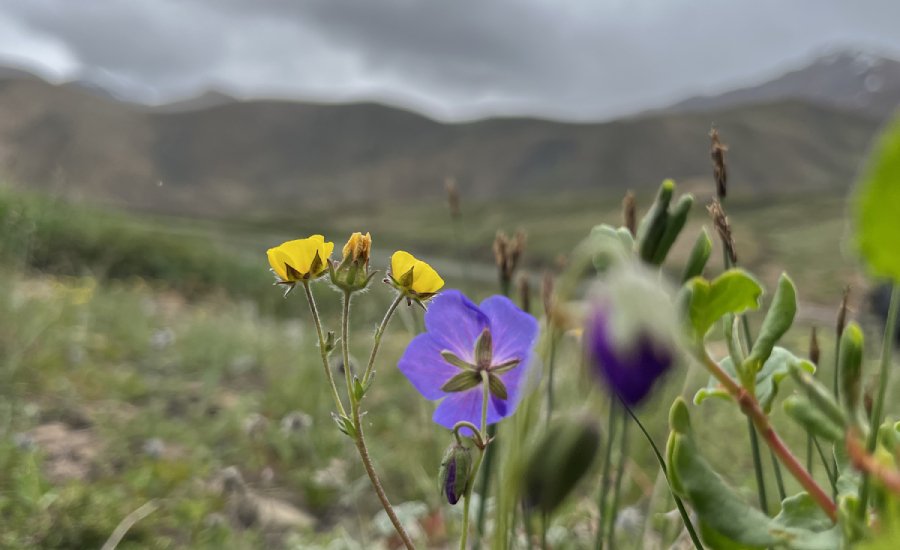
Walking Through a Carpet of Wildflowers
Tiny yellow, white, and blue flowers covered sections of the mountainside, adding beautiful colours to an otherwise rugged landscape.
Every few minutes, someone would stop to admire a flower, click a picture, or simply appreciate how alive the mountains looked despite the harsh terrain.
It’s amazing how nature finds a way to bloom even at such high altitudes.
Looking for Fossils
As we continued climbing, our guide encouraged us to keep looking at the ground.
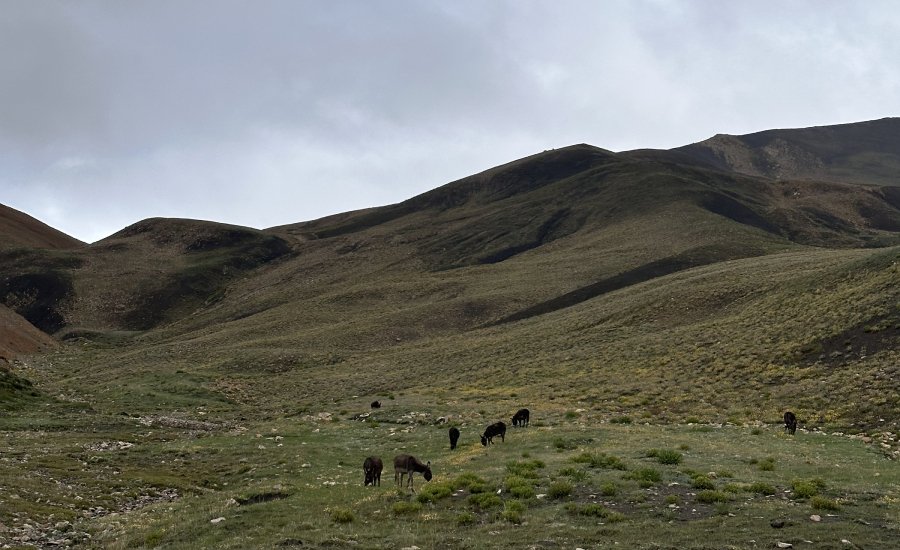
This region around Kibber is known for its marine fossils.
Millions of years ago, this entire region lay beneath the ancient Tethys Sea. Over time, tectonic activity pushed the seabed upwards, eventually forming the mighty Himalayas.
Knowing that these towering mountains were once hidden beneath an ocean completely changed the way I looked at the landscape.
Every stone suddenly carried a story millions of years old.
Naturally, all of us turned into amateur fossil hunters, carefully scanning the trail with every step. Although none of us were lucky enough to find one.
💛 Rinkal’s Note
Standing at nearly 15,000 feet and imagining that this land was once underwater is one of those moments that makes you realise how extraordinary our planet truly is.
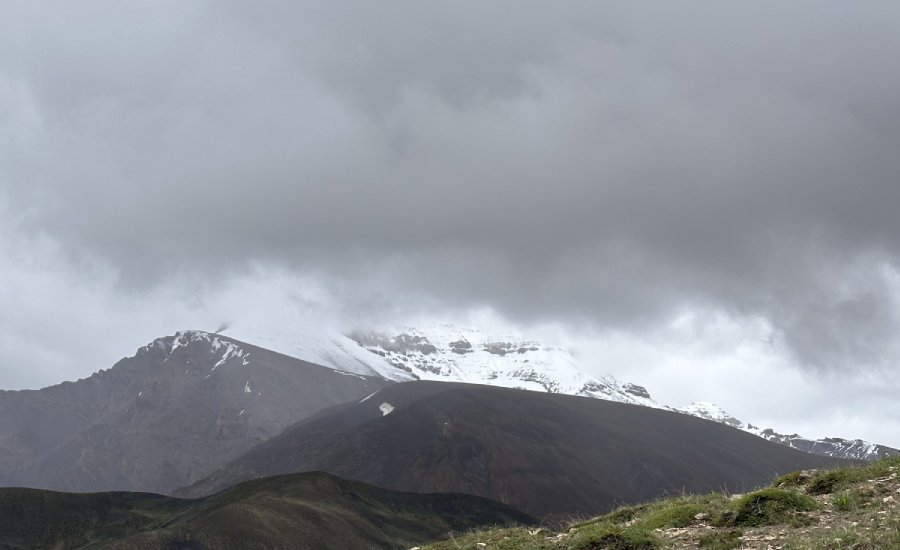
The First Clear View of Kanamo Peak
For the past two days, clouds had been playing hide-and-seek with the mountain.
But today, as we gained altitude, they slowly began drifting away.
And there it was.
Kanamo Peak.
Standing tall in the distance.
The mountain looked far bigger than it had from Kibber.
Somewhere up there…
In just a couple of days…
We would be standing on its summit.
That thought was both exciting and slightly intimidating.
Lunch Beside the Most Beautiful Lake
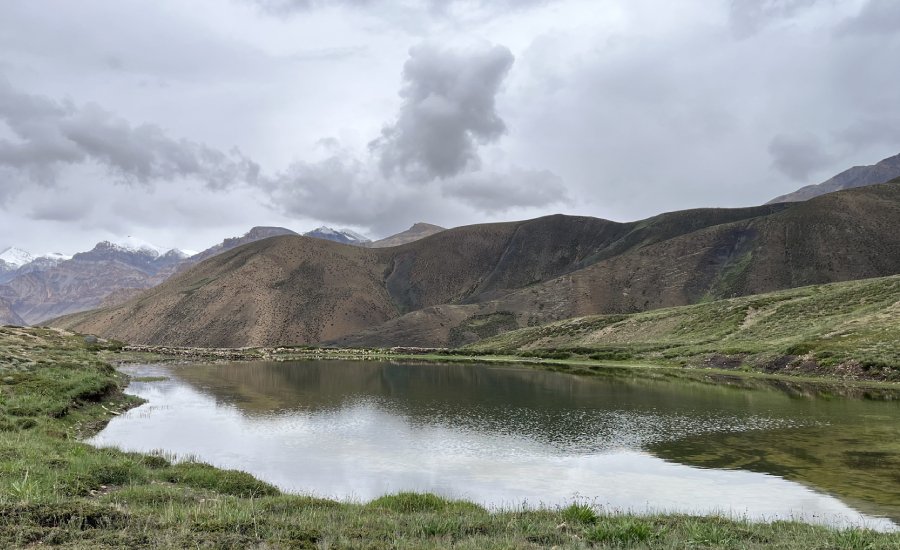
Around noon, we reached our lunch point.
Honestly…
I couldn’t have asked for a better place.
A beautiful alpine lake reflected the surrounding mountains while clouds drifted lazily across the sky. Lush green patches around the lake made the entire place look like a painting.
The moment I saw it, I couldn’t resist.
I almost ran towards the lake and quietly found a place to sit.
I didn’t want to leave.
I chose a spot right beside the water and enjoyed my lunch while looking at the reflections dancing on the lake.
Those are the moments that remind me why I love trekking so much.
Just simple food, fresh mountain air, and a view that money simply cannot buy.
💛 Rinkal’s Note
Some of the richest moments in life come with the simplest meals and the most extraordinary views.
Mountains Have Their Own Plans
Just as we started eating…
It began to drizzle.
Everyone suddenly became very efficient at finishing lunch.
Rain and lunch have somehow become regular companions on many of my treks, so this wasn’t new for me.
I’ve learnt that the mountains don’t wait for perfect weather.
You simply adapt.
We quickly packed everything, wore our rain gear, and continued climbing.
The next stretch was only about one and a half hours, but the combination of rain, cold wind, and increasing altitude made it much more challenging than it looked on paper.
As the trail became steeper and the weather harsher, I gradually fell behind the group. Luckily, Umesh Ji stayed back with me. Originally from Uttarakhand, he shared stories about his home while we slowly made our way towards Base Camp. We spoke about the mountains, the people, and why Uttarakhand continues to hold a special place in my heart. It’s always been one of my favourite places—for trekking, for living, and simply for feeling at home. Somehow, those conversations made the final stretch feel much shorter than it actually was.
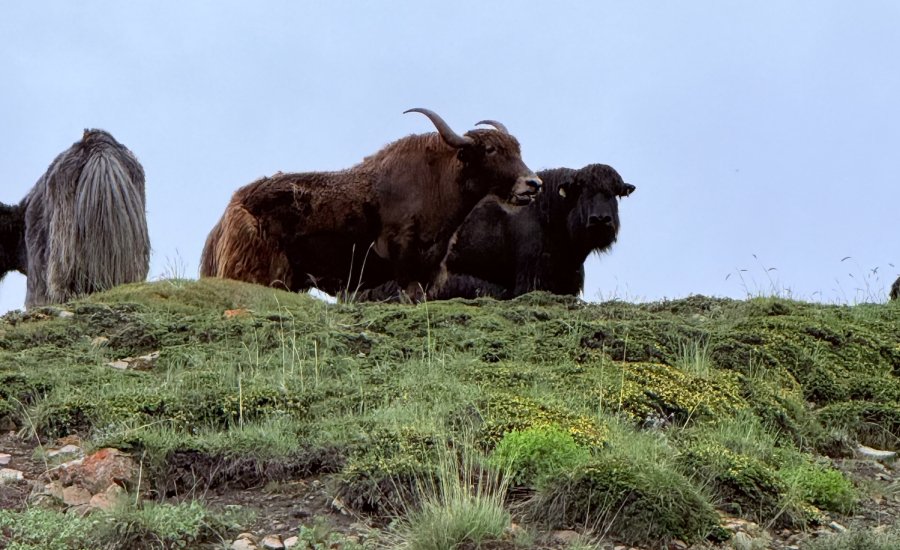
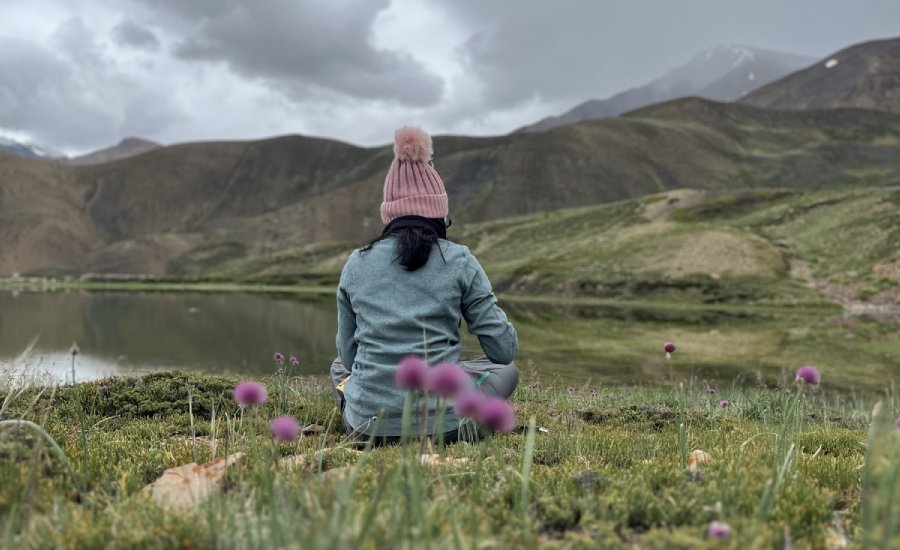
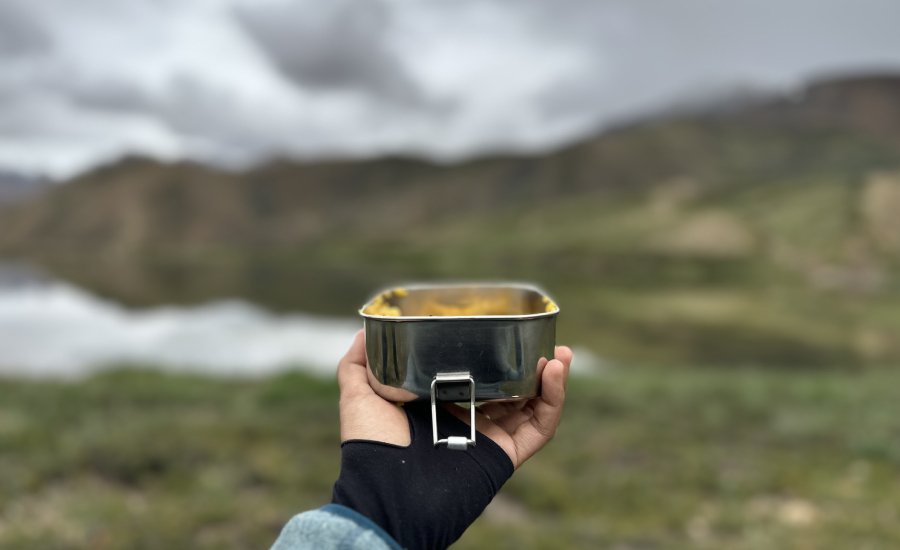
Reaching Kanamo Base Camp
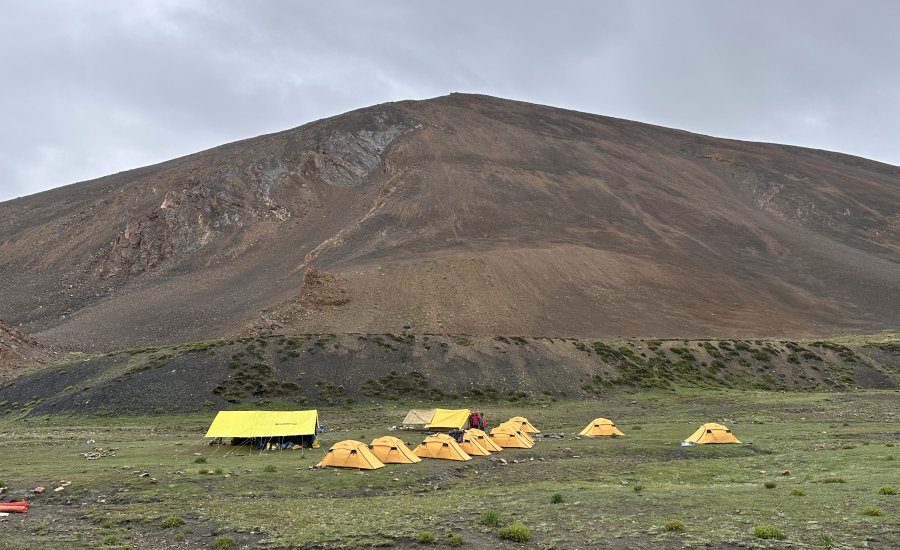
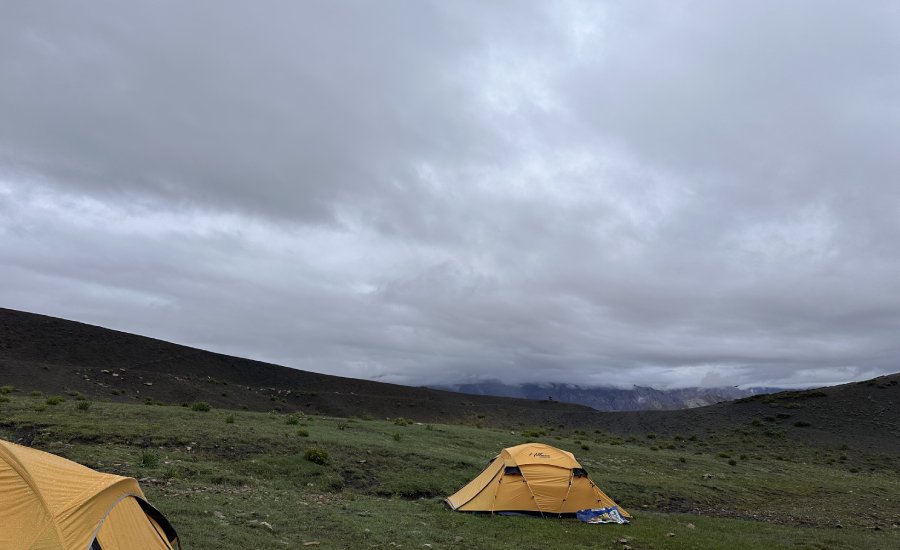
Around 2:00 PM, we finally reached Kanamo Base Camp.
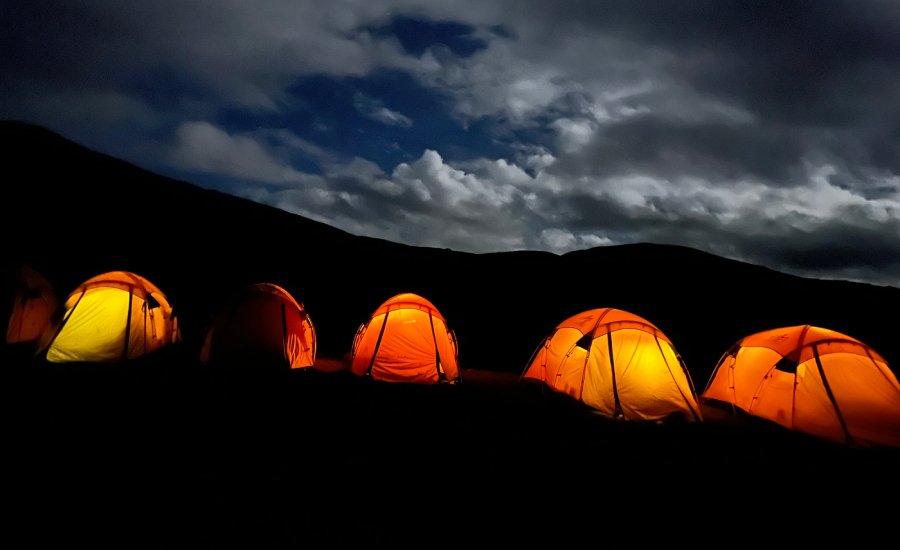
The colourful tents stood surrounded by endless mountains, with no signs of civilisation anywhere nearby.
It finally felt like we were deep in the Himalayas.
After settling into our tents and keeping our backpacks inside, everyone naturally wanted to crawl into their sleeping bags.
But…
That’s actually one of the worst things you can do at high altitude.
As tempting as it is, staying inside your tent for long periods isn’t recommended during acclimatisation. Your body needs gentle movement to adjust to the thinner air.
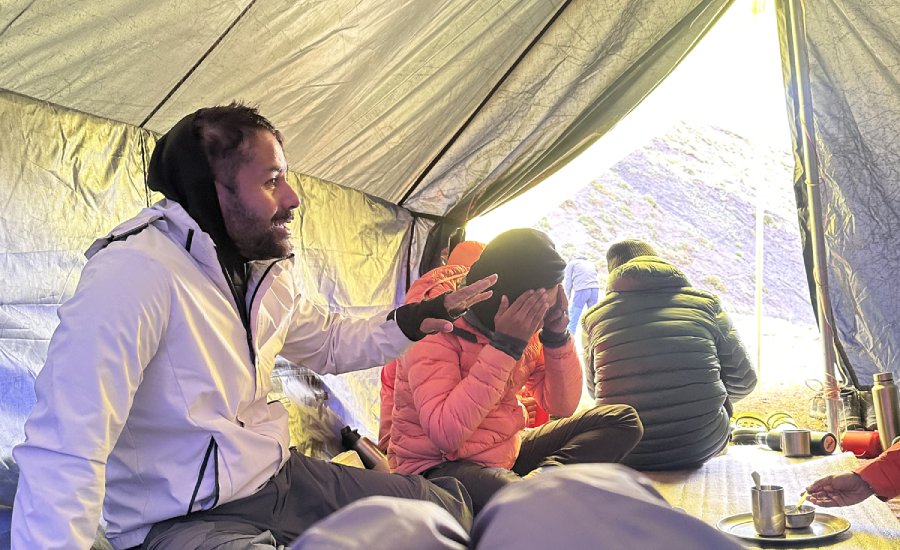
Instead, we gathered in the community tent, warming ourselves with cups of tea, snacks, conversations, and, quite literally, each other’s body heat.
💡 Trekker’s Tip
Resist the temptation to sleep immediately after reaching a high-altitude campsite. A short walk and staying lightly active help your body acclimatise much better.
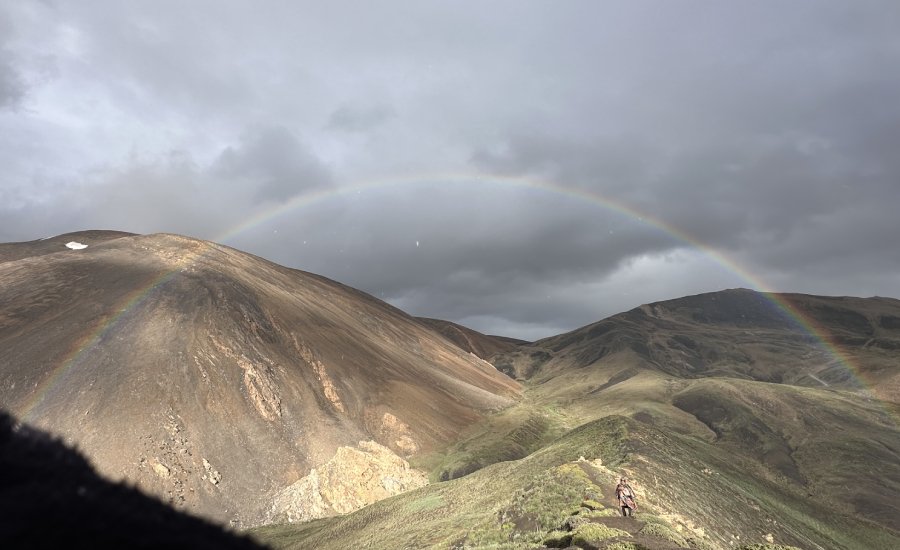
Chasing a Rainbow
Later in the afternoon, we went for a short acclimatisation walk to the hill just opposite our campsite.
The weather kept changing every few minutes.
At 5:49 PM, the sun was shining.
By 5:50 PM, it started raining.
And by 5:52 PM…
A beautiful rainbow appeared over the mountains.
I genuinely don’t remember the last time I felt so excited seeing a rainbow.
It only lasted a couple of minutes, but those few minutes were enough to make me ridiculously happy.
That’s mountain weather for you.
Unpredictable.
Beautiful.
And full of surprises.
Ending the Day Together
As the weather turned cloudy again, we returned to the community tent.
The rest of the evening was filled with hot tea, laughter, and an intense game of Imposters.
It’s funny how quickly trekking groups become families.
Just a few days ago, we were strangers introducing ourselves.
Now, we were accusing each other of being imposters and laughing louder than the mountain winds outside.
Tomorrow would be our final acclimatisation day before the biggest challenge of the trek.
Kanamo Peak was waiting.
Day 5: Acclimatising at Kanamo Base Camp – One Step Closer to the Summit
The summit was now just a few hours away.
Today was our final acclimatisation day before attempting Kanamo Peak, and just like every other acclimatisation day, the plan wasn’t to exhaust ourselves but to help our bodies adapt to the altitude. We would go on a short hike to around 17,000 ft, spend some time there, and return to Base Camp before lunch.
It sounded like an easy day on paper.
But mentally, I think all of us had already started thinking about tomorrow.
Another Beautiful Mountain Morning
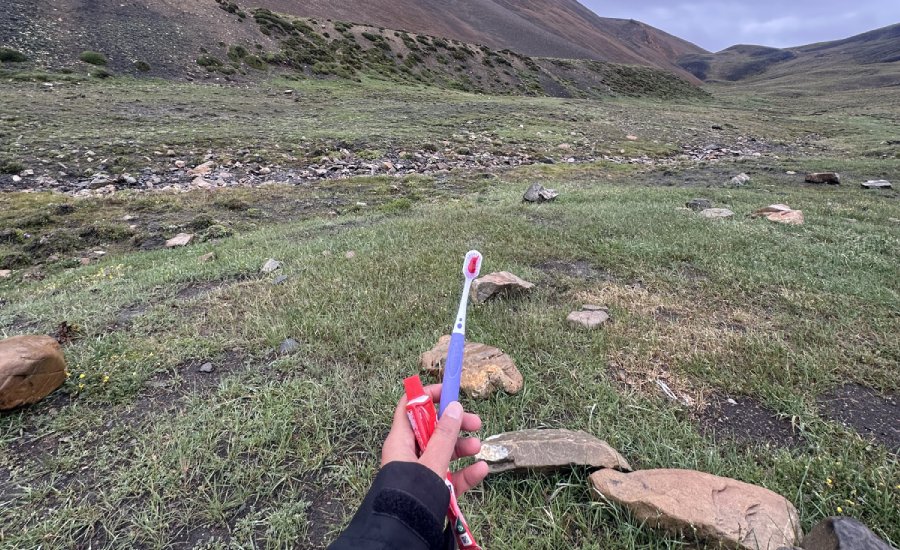
I stepped outside with my toothbrush, and just like every trekking morning, I enjoyed my morning routine with nothing but mountains in front of me. It’s funny how quickly these simple moments become normal during a trek.
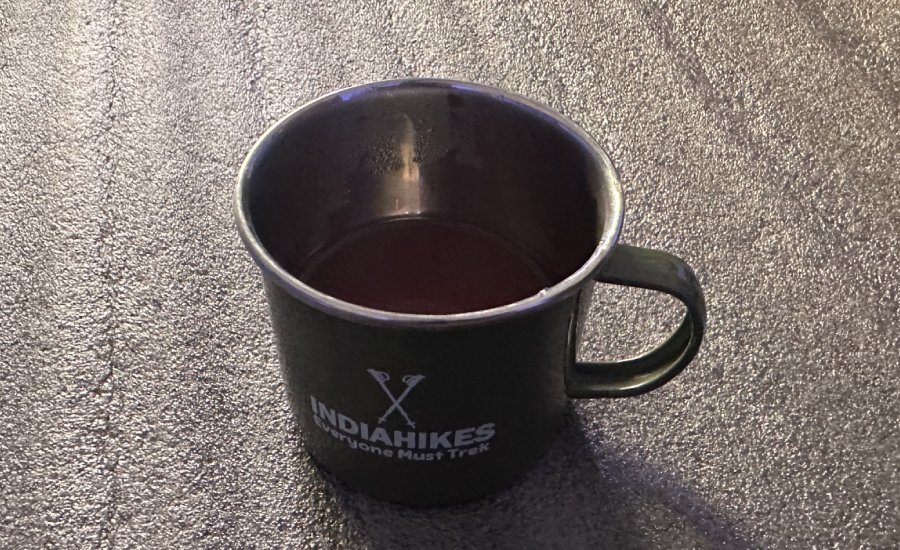
A hot cup of black tea was waiting in the dining tent, and soon everyone slowly gathered there. Before breakfast, another interesting conversation had already begun—this time between Adil and Vamsea discussing current affairs. One thing I loved about this group was that there was never a shortage of conversations. Whether it was trekking, science, politics, travel, or life, someone always had an interesting perspective to share.
The Breakfast I Was Waiting For
Then came the best announcement of the morning.
“Today’s breakfast is Aloo Paratha with Tomato Chutney.”
I don’t think anyone was happier than me.
The previous day, I wasn’t feeling well and had barely eaten any snacks or dinner, so hearing those words instantly made my day.
And let me tell you…
I didn’t stop at one.
I happily ate until my stomach was completely full because I knew tomorrow’s summit push would demand every bit of energy I could store.
💡 Trekker’s Tip
Even if you don’t feel very hungry at high altitude, try to eat well before summit day. Your body needs the extra energy much more than you realise.
Climbing Higher for Acclimatisation
Around 9:30 AM, we geared up for our acclimatisation hike.
The weather looked uncertain, with a light drizzle already beginning, so everyone quickly pulled out their rain jackets before starting.
The trail climbed steadily above Base Camp, and with every step, the views became wider.
And of course…
Advaith was with us.
That meant silence was absolutely impossible.
From his hilarious Diamox stories to his imaginary YouTube vlog commentary and random observations about low oxygen, he somehow managed to entertain the entire group throughout the climb.
Sometimes I wondered whether he ever ran out of things to talk about.
The answer was clearly no.
Reaching 17,000 Feet
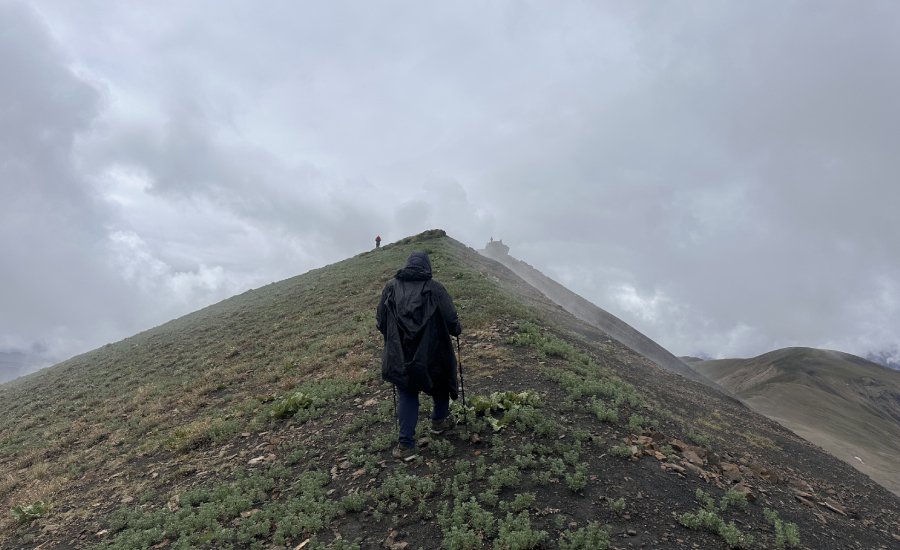
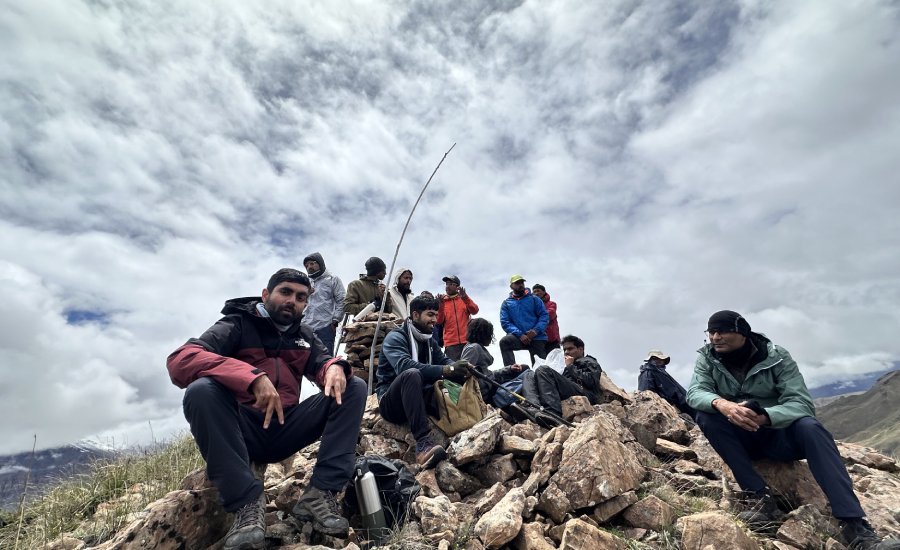
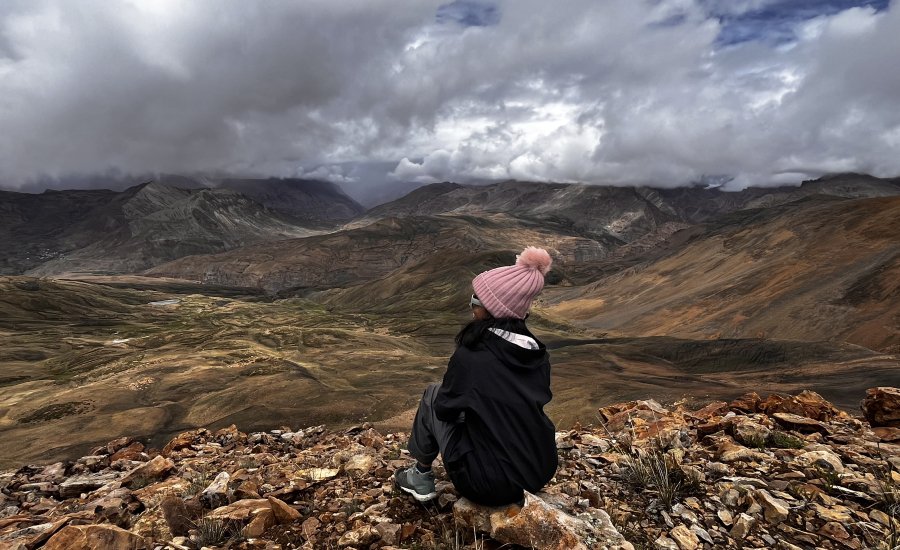
After nearly two hours of gradual climbing, we finally reached our destination.
Standing there, we could see almost everything.
Our colourful tents at Kanamo Base Camp looked tiny below.
The beautiful alpine lake where we had lunch yesterday shimmered in the distance.
Kibber and Chicham villages looked even smaller than before.
On the opposite side, new lakes appeared between the mountains, while snow-covered peaks stretched across the horizon.
The view made every step worthwhile.
Winning the Battle in My Mind
There was one thing I hadn’t told anyone.
Throughout the climb, I was walking behind almost everyone else.
The rest of the group looked so comfortable.
Meanwhile, I kept wondering…
“If I’m this slow today, how am I going to reach the summit tomorrow?”
That thought stayed in my mind for most of the climb.
But when I finally reached the top, something changed.
I wasn’t the first one there.
I wasn’t the fastest.
But I had reached.
And in that moment, I felt incredibly proud of myself.
Sometimes we compare our pace with others and forget to celebrate our own progress.
That small victory gave me a little more confidence for the biggest day ahead.
💛 Rinkal’s Note
Trekking has taught me that reaching the destination matters far more than how quickly you get there. Every trekker has a different pace, and that’s perfectly okay.
We spent nearly half an hour at the top, eating snacks, clicking photos, talking, and simply enjoying the incredible views around us.
Nobody was in a hurry to leave.
Moments like these are meant to be lived slowly.
Back to Base Camp
The descent was much quicker.
Within 30–45 minutes, we were back at Base Camp, where another pleasant surprise was waiting.
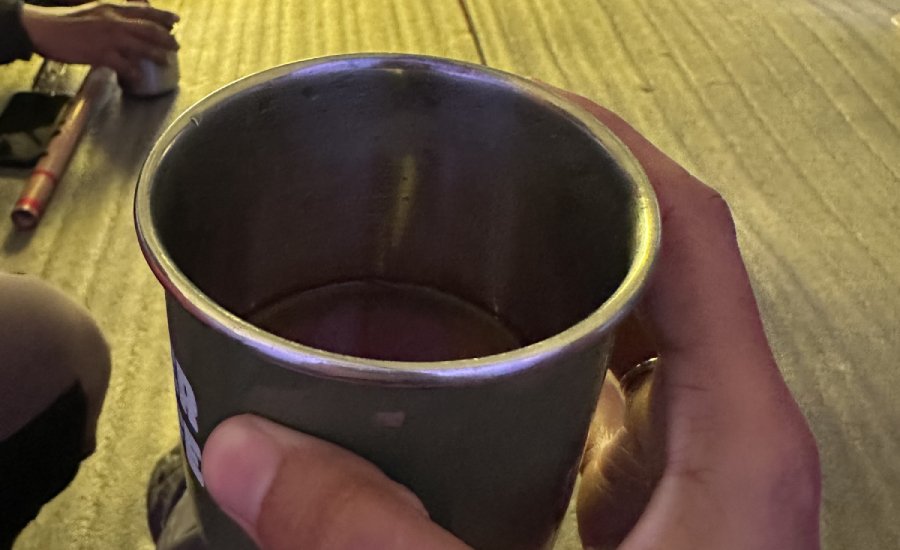
The kitchen team had already prepared hot black tea.
After walking in the cold wind, that first sip felt incredibly comforting.
An Afternoon Filled with Laughter
The rest of the afternoon was all about relaxing.
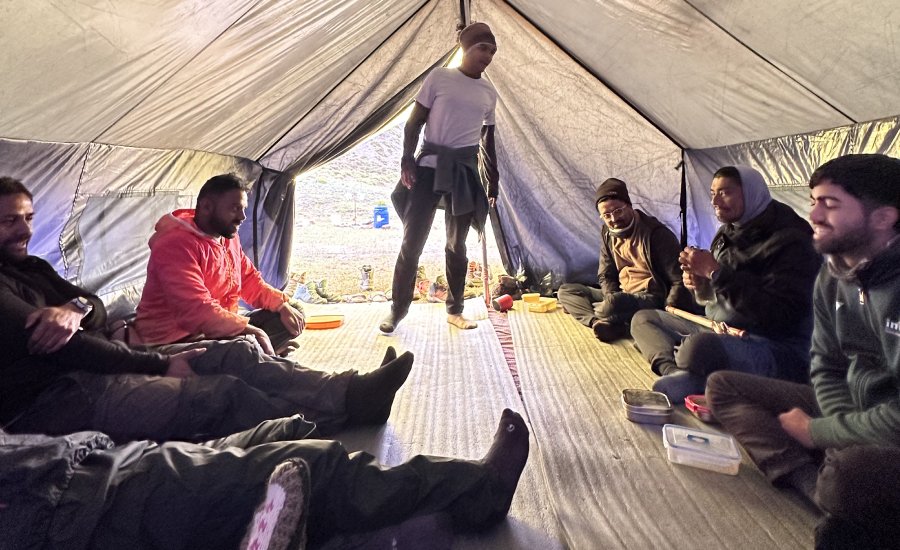
We gathered inside the community tent and played a game.
Unfortunately…
The name of the game stay within the group.
Let’s just say it was one of the funniest sessions of the trek, and Advaith somehow ended up becoming our “God” for the game.
No further questions.
Some secrets are better left in the mountains.
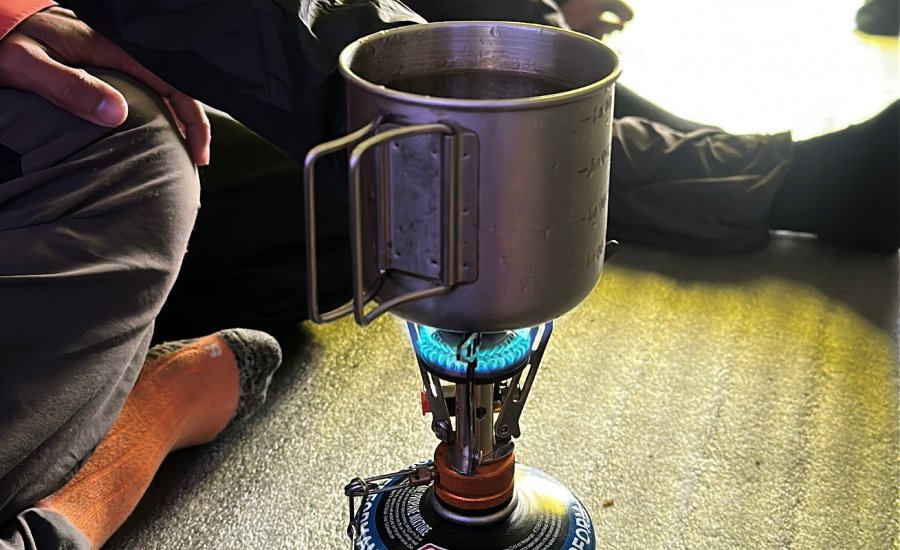
After the game, Diptarka prepared fresh coffee, and we happily continued our endless conversations over steaming cups.
That eventually turned into another round of UNO, more laughter, friendly arguments, and the kind of memories that only happen when a group of strangers slowly becomes friends.
Sleeping Before the Biggest Day
Unlike the previous nights, dinner was served much earlier—around 6:00 PM.
The reason was simple.
We weren’t waking up early tomorrow.
We were waking up before midnight for the summit push.
And then came one final surprise from the kitchen team.
Gajar Ka Halwa.
If you’ve been following my trek stories, you’ll know I can never say no to sweets.
Seeing dessert at nearly 16,000 ft instantly made me happier than it probably should have.
Before calling it a day, I couldn’t help but thank our incredible kitchen team. Preparing fresh, nutritious, and delicious meals at nearly 16,000 feet in unpredictable mountain weather is no small task, yet every meal was served with a smile. Our trek leader, guides, and kitchen staff constantly reminded us to eat well, even when the altitude reduced our appetite, because they knew those meals were our biggest source of energy for the days ahead. Looking back, I realised they weren’t just feeding us—they were quietly helping us reach the summit.
💛 Rinkal’s Note
Trek leaders often receive the credit for a successful summit, but behind every trek is a hardworking kitchen team preparing hot meals in freezing conditions. They deserve just as much appreciation because every step we took was fuelled by their effort.

By 6:30 PM, everyone was inside their tents.
Backpacks for the summit had already been packed.
Headlamps were checked.
Extra layers were kept ready.
The excitement was real, but so were the butterflies in my stomach.
Tomorrow wasn’t just another trekking day.
Tomorrow was the reason we had travelled all the way to Spiti.
It was finally time to climb Kanamo Peak.
Day 6: Summit Push – Climbing Above the Clouds
This was the day we had all been waiting for.
Months of preparation, days of acclimatisation, countless conversations, and one common goal had finally led us here.
Today, we would attempt Kanamo Peak (5,960 m / 19,553 ft)—one of the highest non-technical trekking summits in India.
The excitement was real.
So were the butterflies in my stomach.
A Day That Began Before Midnight
While the rest of the world was fast asleep, our summit day had already begun.
At 11:00 PM, alarms started ringing across the campsite. One by one, everyone quietly stepped out of their tents and began layering up for what would be the coldest and longest day of the trek.
Outside, it was pitch dark.
The only light came from our headlamps and the warm glow inside the community tent.
After collecting our summit backpacks from the tents, we gathered in the dining tent where the kitchen team had already prepared our breakfast.
Yes…
Breakfast at 11:30 PM.
It felt strange at first, but when you’re climbing nearly 6,000 metres, your body doesn’t really care what time the clock shows.
It only needs energy.
Along with breakfast, we packed our trail snacks, carried nearly 3 litres of water, and picked up the fruits thoughtfully packed by our kitchen team.
Everyone quietly checked their backpacks one last time.
Headlamps.
Gloves.
Down jackets.
Water.
Snacks.
Everything was ready.
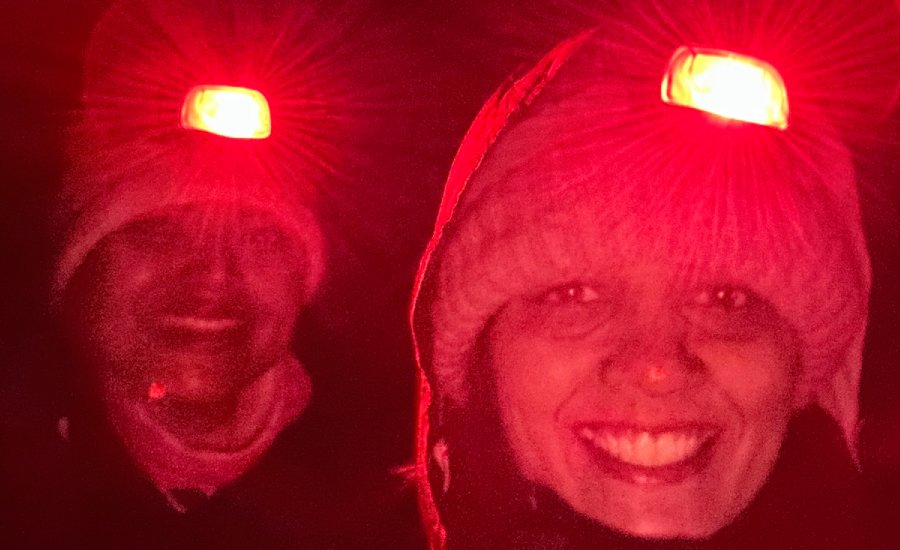
Waiting for the Mountains to Say "Go"
It was raining.
Everyone was ready with backpacks on, shoelaces tied, trekking poles in hand, and headlamps switched on.
In the mountains, weather always has the final say.
Umesh Ji calmly told us,
“We’ll leave as soon as the rain stops.”
Those twenty minutes somehow felt much longer.
There was excitement.
A little nervousness.
Everyone was mentally preparing for the night ahead.
Finally, around 12:20 AM, the rain eased.
It was time.
The First Steps Towards the Summit
Before leaving, we gathered for a roll call to make sure everyone was present.
Nobody gets left behind.
That simple routine always gives me a sense of comfort.
Then Diptarka explained the walking order.
To my surprise, Debarati and I were asked to walk right at the front with Umesh Ji and our local guide. The rest of the team would follow behind with Diptarka and the remaining guides.
The moment I heard that…
I felt relieved.
Yesterday, one thought had been bothering me constantly.
“What if I’m the slowest? What if I keep falling behind and lose confidence before the summit?”
Walking at the front meant I could follow a comfortable pace without worrying about everyone else.
That small decision removed a huge mental burden before we had even taken our first step.
Finding a Rhythm in the Dark
The first few minutes were surprisingly difficult.
My breathing felt heavier than usual, and my body was still adjusting to moving in the cold.
But slowly…
Everything settled into a rhythm.
Step.
Breathe.
Step.
Breathe.
That became our world for the next several hours.
Umesh Ji led the way beautifully.
Every now and then, he’d stop us for a 30-second to one-minute break, followed by regular water breaks and even reminders for toilet breaks.
I absolutely loved this pace.
There was never any pressure to rush.
The goal wasn’t to reach the summit first.
The goal was to help every single person reach it safely.
From 16,000 ft onwards, every step counts.
And conserving energy becomes far more important than speed.
When Kindness Lights the Way
As we continued climbing, I noticed something worrying.
My headlamp was slowly losing brightness.
With every passing minute, the beam became dimmer, making it harder to see the rocky trail ahead.
Since I was walking at the front, this could easily have become dangerous.
Without saying much, Umesh Ji noticed it too.
He simply asked me for my headlamp, handed me his own, and continued walking using the dim one.
Such a small gesture.
Yet it meant everything at that moment.
It’s little acts of kindness like these that often go unnoticed, but they make all the difference in the mountains.
Walking on Scree
As we gained altitude, the trail changed completely.
We entered a long scree section.
Scree is a slope covered with loose rocks and small stones that constantly shift under your feet. Every step feels slightly unstable, and if you’re not careful, your feet can slide backwards just as you try to move forward.
It demands patience more than speed.
Trying to rush through scree usually means wasting more energy.
So we kept following the same rhythm.
One careful step at a time.
One Last Break Before the Final Climb
After several hours of climbing through darkness, we reached the point just before the shoulder.
From here onwards, proper places to sit and rest would become rare.
Umesh Ji asked us to stop, sit down, and eat something before continuing.
Removing gloves in freezing temperatures is never fun.
Within seconds, our fingers started feeling numb.
Still, everyone somehow managed to pull out energy bars, dry fruits, chocolates, or snacks from their backpacks.
We sat together in complete darkness, quietly eating while our headlamps lit up little circles around us.
The Hardest One Kilometre
As the sky slowly began to brighten around 5:00 AM, we finally switched off our headlamps.
For the first time since leaving Base Camp, we could properly see the mountain around us.
And that’s when reality hit.
The summit was still above us.
Far above us.
The final stretch looked incredibly steep, and although it was only about one kilometre, everyone knew this would be the hardest part of the entire trek.
The cold had become harsher, the wind stronger, and every breath now demanded more effort than before.
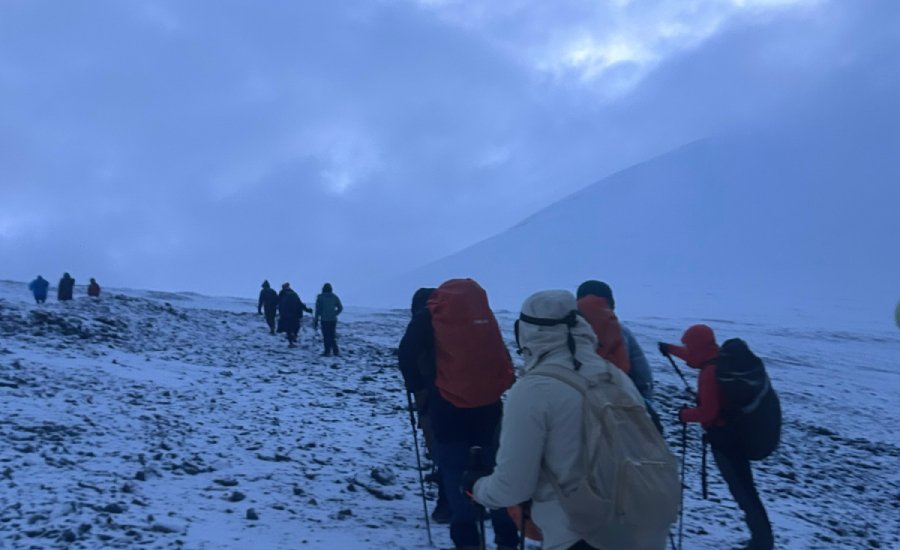
Teamwork Takes Over
As we continued climbing, circumstances changed quickly.
One of our guides wasn’t feeling well and had to descend. A little later, another guide accompanied a trekker who wasn’t able to continue the summit push.
Suddenly, the responsibility of opening the trail shifted.
Without hesitation, Junior Manojkumar, Nagendra, and Adil stepped forward.
The snow had become deeper, and there wasn’t a clear path anymore. Using ice axes, they began breaking the trail for the rest of us.
Walking in fresh snow isn’t easy. Every step sinks in, and the person leading the way uses far more energy than everyone following behind.
Watching them volunteer without being asked was something I deeply admired.
That moment reminded me that trekking is never just about reaching the summit yourself.
Sometimes, it’s about making someone else’s journey a little easier.
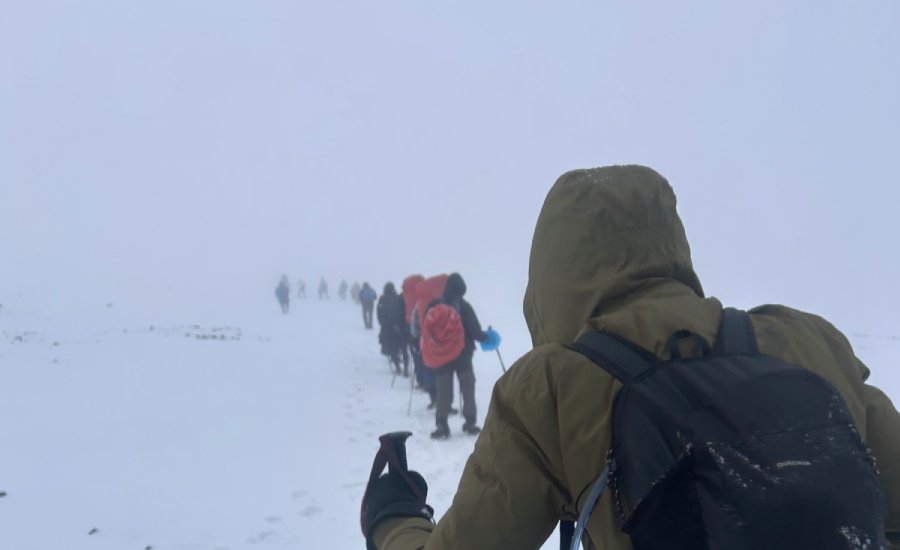
One Step... Then Another
The weather continued to deteriorate.
The wind became so powerful that sometimes it felt like it was pushing us backwards.
Soon, the trail disappeared beneath fresh snow.
At several places, the snow reached almost up to our knees.
Every step demanded effort.
Lift your foot.
Push through the snow.
Take another step.
Repeat.
That final kilometre took us nearly three and a half hours.
It wasn’t because the distance was long.
It was because every single step had to be earned.
The Battle Inside My Mind
I’ll be honest.
There were moments when I simply stopped walking.
Not because I wanted to give up.
But because my body needed a few seconds to gather enough strength for the next step.
Standing in the middle of those fierce winds, I questioned myself.
“Can I really do this?”
Before those thoughts could take over, I heard familiar voices behind me.
Sumit.
Advaith.
Instead of letting me think about the climb, they kept talking about completely random things.
Cracking jokes.
Making everyone laugh.
Keeping the atmosphere light.
Sometimes that’s all you need.
Not advice.
Not motivation.
Just someone who refuses to let your mind focus on how difficult things are.
This Summit Belonged to Everyone
Looking around, I realised something beautiful.
Nobody was climbing only for themselves.
Everyone was helping someone.
Manoj, Nagendra, and Adil continued opening the trail through the snow.
Sumit carried Vamsea’s backpack so he could keep walking comfortably.
Advaith constantly encouraged anyone who looked tired.
At one point, I heard him motivating Senior Manojkumar, asking him not to stop and to keep moving.
Watching all this reminded me of something.
A summit may have one highest point.
But nobody reaches it alone.
💛 Rinkal’s Note
Trekking may look like an individual achievement from the outside, but on the mountain, it’s always a team effort. Sometimes the strongest people aren’t the ones who walk the fastest—they’re the ones who help others keep walking.
"Just a Few More Steps..."
Debarati suddenly stopped.
She looked exhausted.
Quietly she said,
“I don’t want to go any further.”
I looked at her and smiled.
“Just a few more steps.”
“We’re almost there.”
Honestly…
I wasn’t even sure if the summit was really that close.
But I knew one thing.
I couldn’t let her give up after coming this far.
We had climbed together for days.
We would finish together too.
She took another step.
Then another.
And slowly…
We continued climbing.
Walking Into a White World
The higher we climbed, the stronger the whiteout became.
Clouds surrounded us from every direction.
Sometimes we couldn’t see more than a few metres ahead.
Sometimes the people behind us completely disappeared.
There were no distant mountain views anymore.
No landmarks.
Only footprints in the snow.
Each one of us simply followed the footsteps made by the person ahead.
At that moment, my world became incredibly small.
I wasn’t looking at the summit.
I wasn’t asking how much further remained.
I had only one goal.
Keep the gap small.
Stay close to the person in front.
Take the next step.
And then the next one.
I was walking just behind Shakthi, using the line of trekkers almost like a shield against the powerful winds.
That simple focus made the impossible feel manageable.
The Moment We Had Dreamed Of
Then…
Almost without realising it…
The climb ended.
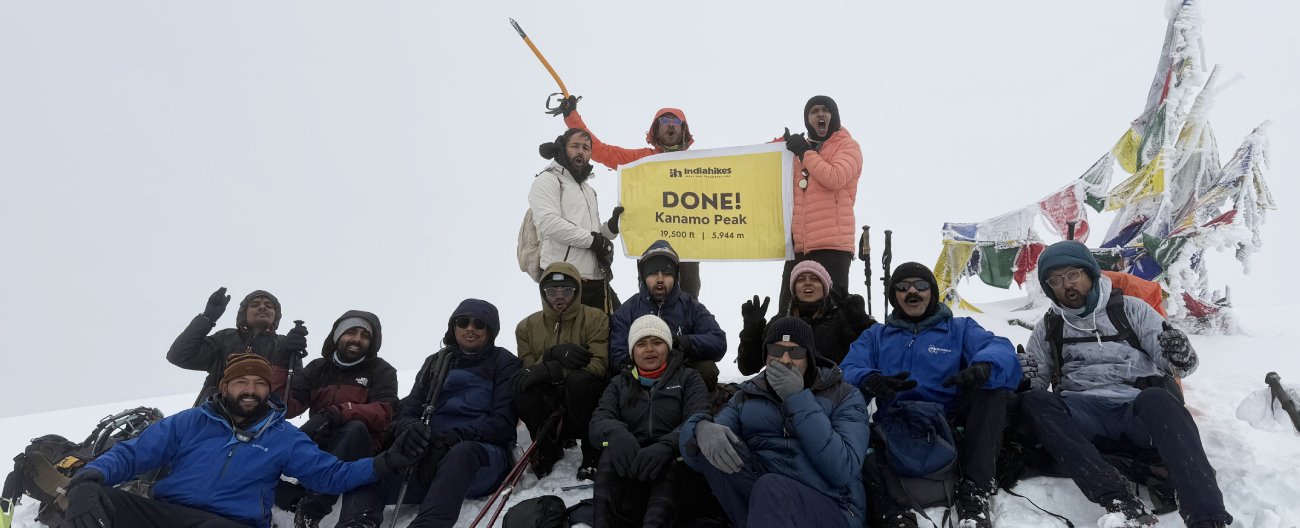
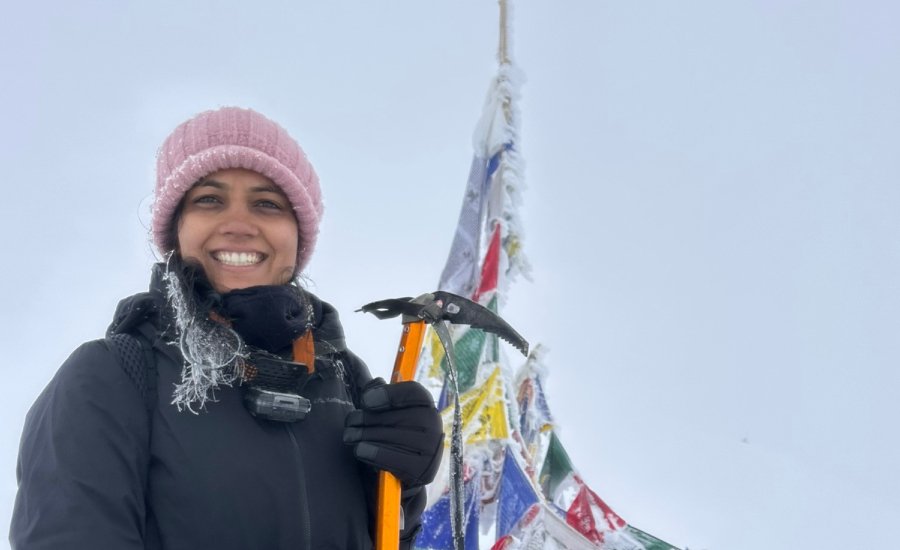
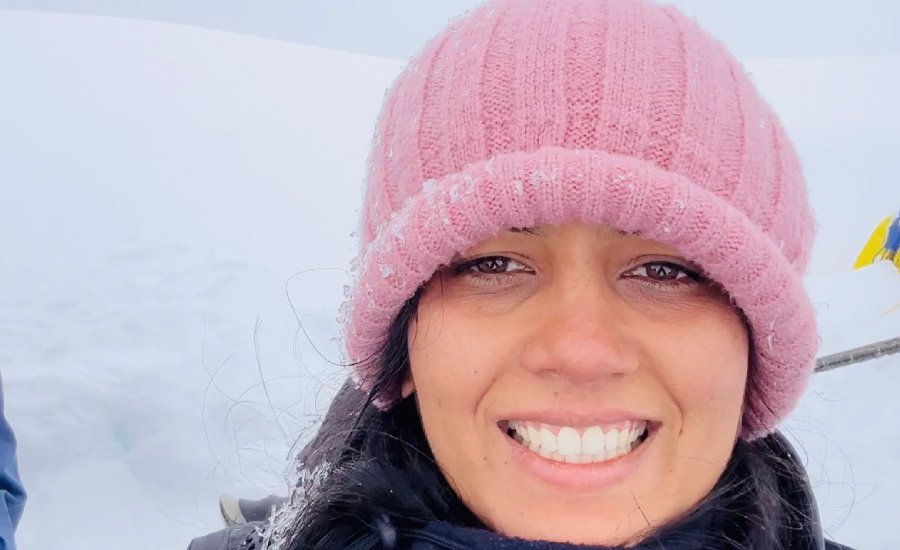
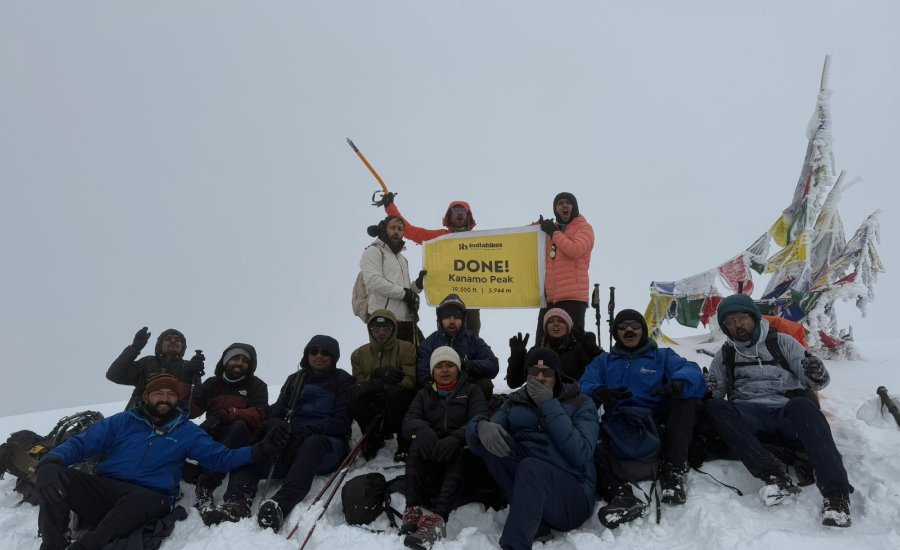
At 8:50 AM, after nearly eight and a half hours of climbing, we finally stood on the summit of Kanamo Peak (19,553 ft / 5,960 m).
I wasn’t emotional.
I wasn’t overwhelmed.
I was simply…
Proud.
Proud because I had done something I once believed was beyond my limits.
I often underestimate my own fitness.
I compare myself with others far too much.
But standing there, nearly 6,000 metres above sea level, none of those comparisons mattered anymore.
I had made it.
And that was enough.
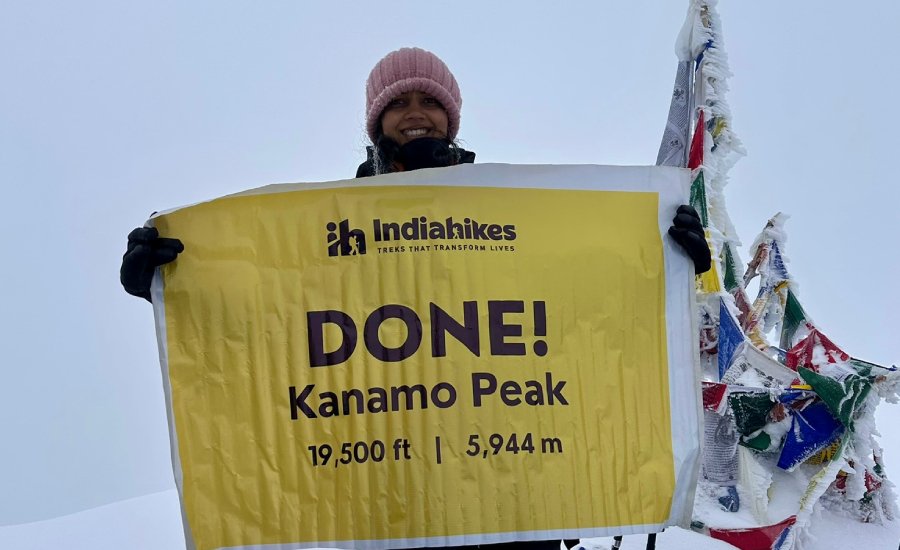
Standing on Top of the World
The summit itself was much narrower than I had imagined.
As I started walking around to take in the views, someone stopped me.
Behind us was a steep drop.
One wrong step could have been extremely dangerous.
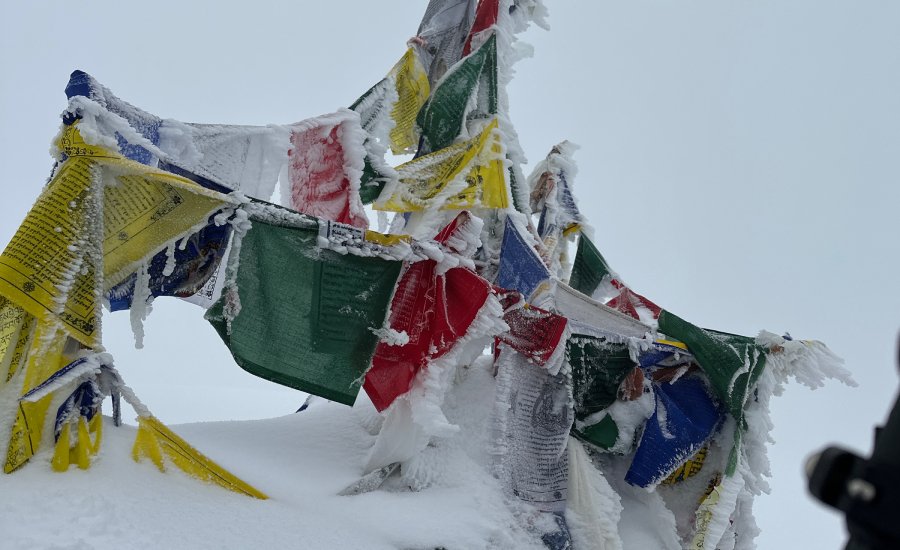
We all stayed close together, sitting near the prayer flags and congratulating one another.
On clear days, Kanamo Peak offers breathtaking 360-degree views of the Spiti, Kinnaur, Kullu, and Ladakh ranges. Peaks near Parang La, Pin Parvati Pass, and many surrounding Himalayan summits can also be seen.
Unfortunately…
The weather had other plans.
Clouds covered almost everything.
But strangely…
I wasn’t disappointed.
Because I hadn’t come here only for the view.
I had come here for the journey.
We clicked a few photographs, hugged one another, and quietly celebrated a dream that had taken months to prepare for.
The Shortest Stay
Around 9:30 AM, it was already time to leave.
It always amazes me.
You spend months preparing.
Days travelling.
Hours climbing.
And after finally reaching the summit…
You only stay for a few minutes.
Then you turn around and begin the descent.
That might sound strange to someone who has never trekked before.
But every trekker understands why.
The summit is never the end of the journey.
Returning safely is.
💛 Rinkal’s Note
A successful summit isn’t when you reach the top. It’s when every single member of the team returns safely to Base Camp.
Running Down the Snow
Going downhill sounded easier.
Reality was slightly different.
The snow was deep, soft, and incredibly slippery.
At some places we carefully walked.
At others…
We simply ran.
Or at least, we tried to.
Within seconds, I’d lose my footing, slip into the snow, laugh at myself, stand up, brush the snow off my clothes, and start walking again.
It happened so many times that eventually I stopped counting.
Falling simply became part of the adventure.
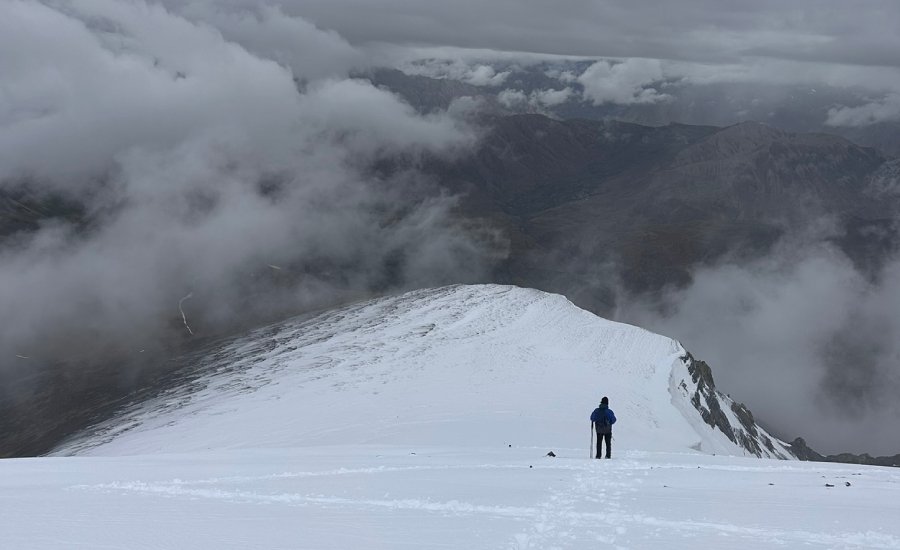
Unlike the climb, I finally had time to look around.
While going up, my entire focus had been on taking the next step.
Now, I could truly appreciate where we had been walking all morning.
The endless white slopes.
The rugged ridgelines.
The trail disappearing into the clouds.
I stopped a few times to capture photos and short videos—not just of the mountains, but of the memories I wanted to take home with me.
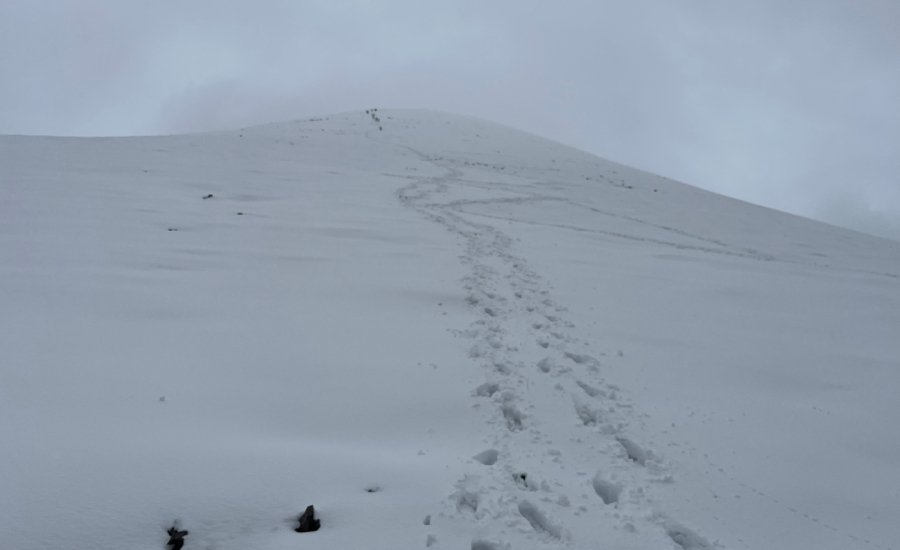
Back Below the Snow Line
Around 10:30 AM, we finally left the snow behind.
The trail became rocky once again, though a light drizzle had started by then.
The weather still refused to stay the same for more than a few minutes.
Typical mountain weather.
One moment sunshine.
The next moment rain.
As the group naturally spread out during the descent, there came a point where none of our guides were walking with us.
Before heading back to assist the trekkers behind, Diptarka looked at me and said,
“Can you find the way back?”
I smiled and replied,
“Yes, I can use GAIA GPS.”
He trusted me with the route and asked us to continue together.
So the four of us—Adil, Junior Manojkumar, Nagendra, and I—continued the descent.
Well…
To be honest…
The three of them didn’t really “walk.”
They practically ran down the mountain.
I followed at my own pace.
Sometimes jogging.
Sometimes walking.
Sometimes simply stopping to admire the views before continuing.
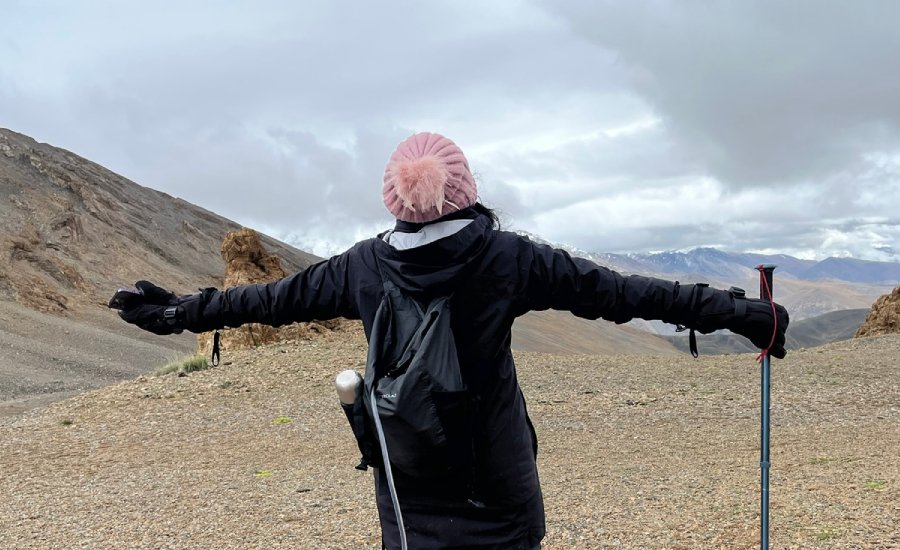
Looking Back at the Mountain
After another hour of descending, we paused for a short break.
For the first time since dawn, I turned around and looked back at the mountain we had climbed in complete darkness.
It looked enormous.
Standing there, I couldn’t believe that just a few hours earlier we had been right at the top.
It’s funny how different a mountain looks once daylight reveals what you couldn’t see during the climb.
Soon, the others gradually moved ahead.
I was now walking completely alone.
No one in front.
No one behind.
Just me.
The trail.
And the mountains.
I’ll admit…
For a brief moment, it felt a little intimidating.
There wasn’t another person in sight.
Only silence.
But after a while, that feeling slowly changed.
Instead of fear, I started enjoying it.
I wasn’t in any hurry anymore.
I admired the tiny wildflowers growing beside the trail.
I looked closely at the different colours of the rocks beneath my feet.
I listened to the wind.
Sometimes, walking alone in the mountains gives you a kind of peace that’s difficult to find anywhere else.
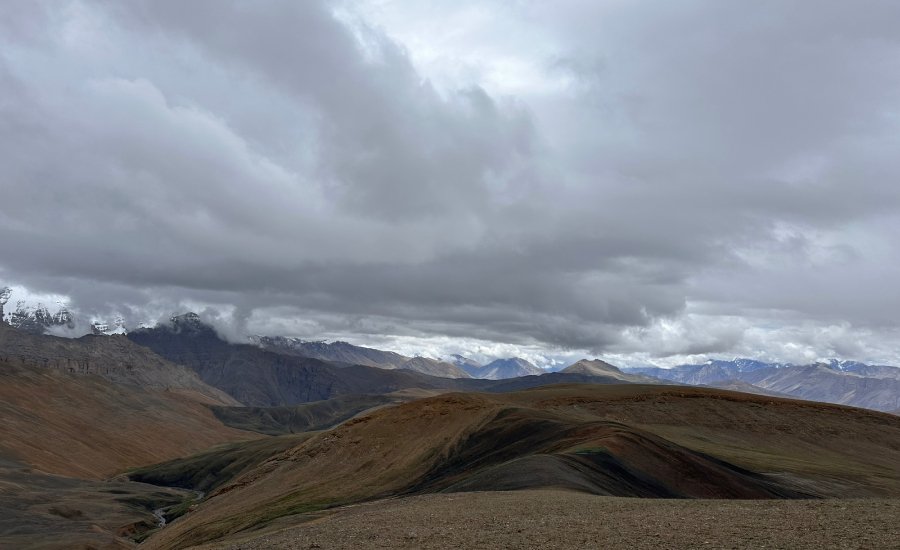
A Small Memory to Take Home
One habit I’ve unknowingly developed over the years is collecting a small stone from every trek I complete.
Nothing big.
Nothing special.
Just a simple stone from the trail.
As I walked, one particular rock caught my attention.
I picked it up, smiled, and quietly slipped it into my backpack.
Today, I have stones from every trek I’ve completed.
Whenever I look at them, I don’t just remember the mountains.
I remember the journey behind each one.
💛 Rinkal’s Note
Souvenirs don’t always have to come from shops. Sometimes the smallest things—a stone, a leaf, or even a memory—become the most meaningful keepsakes.
The Most Unexpected Surprise
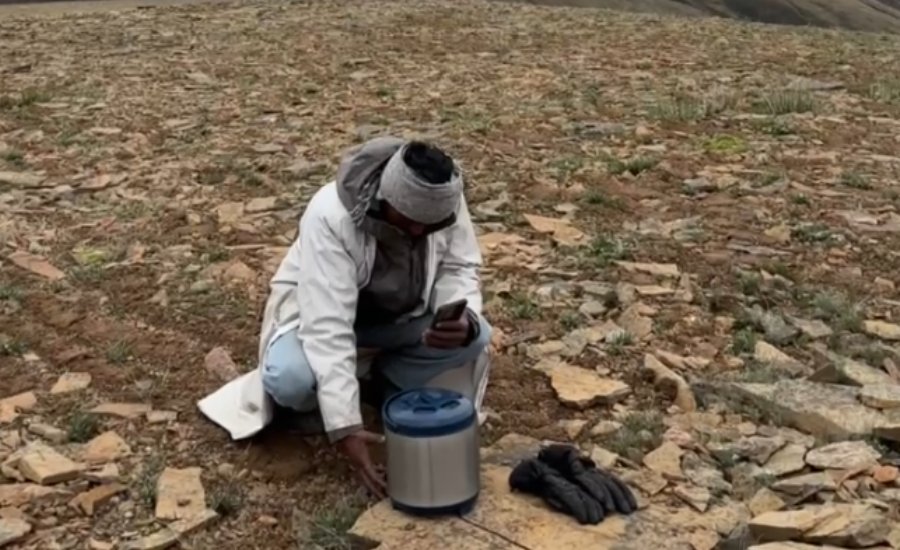
Around 12:00 PM, I noticed someone standing far ahead on the trail.
As I got closer, he waved at me.
I walked towards him, wondering who it could be.
To my surprise…
It was one of our kitchen team members.
Standing in the middle of the trail.
Waiting for every trekker.
In his hands…
A container filled with warm Aam Panna.
He poured me a glass and smiled.
I don’t think I’ve ever appreciated a drink as much as I did at that moment.
After hours of climbing, descending, battling wind, snow, and exhaustion…
That warm glass of Aam Panna felt nothing less than amrit.
I thanked him with all my heart before continuing.
As I walked away, I looked back once.
He was still standing there.
Waiting for the rest of our team.
Moments like these remind me that behind every successful trek are countless people quietly taking care of us.
💛 Rinkal’s Note
It’s often the smallest gestures that stay with you the longest. That glass of Aam Panna wasn’t just a drink—it felt like encouragement waiting for us halfway home.
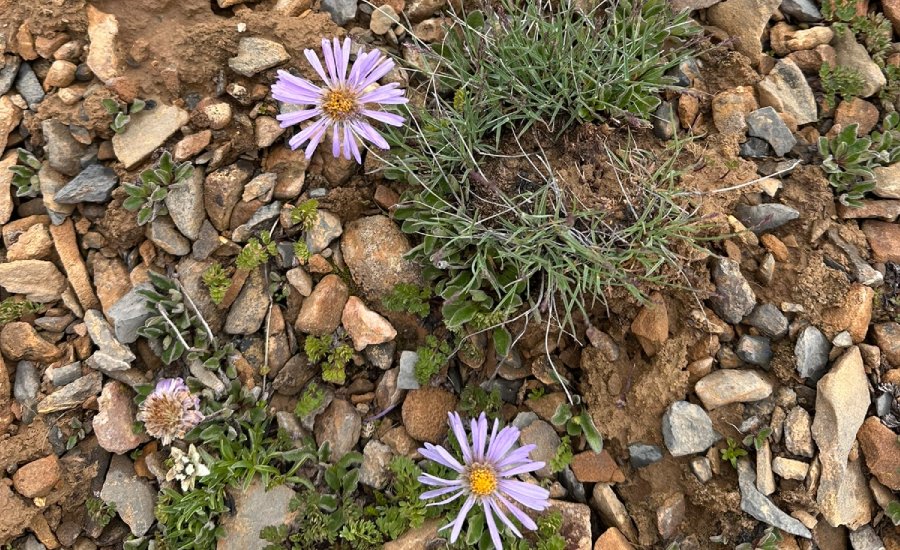
This area, with its dark, loose soil, is known for ancient marine fossils.
I couldn’t resist trying one last time.
I slowed down.
Looked carefully at the ground.
Turned over a few interesting stones.
But just like before…
No fossils.
Perhaps they’ve already been discovered over the years.
Or perhaps the mountain simply wanted us to leave with stories instead.
Either way…
The search itself had been worth it.
"I'm Home."
A little later, I looked up.
Far in the distance…
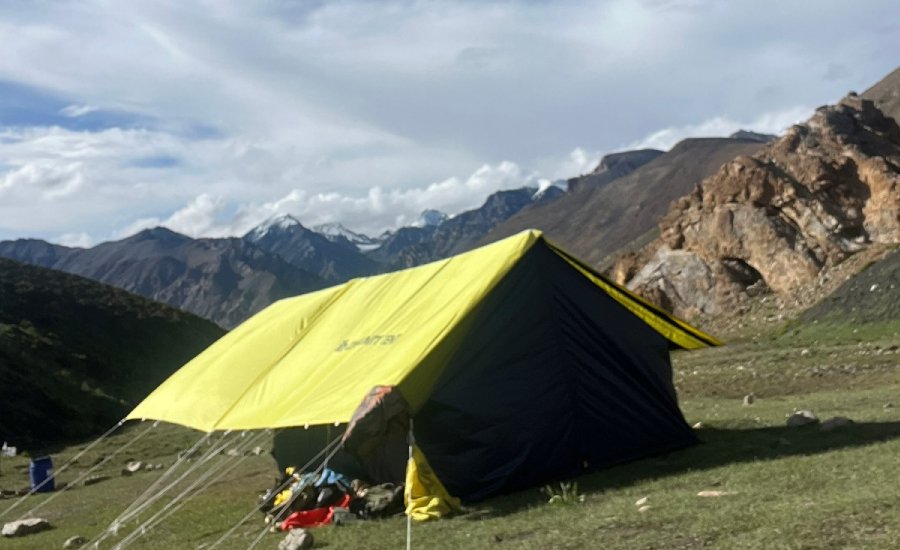
I saw colourful tents.
Our campsite.
Without even realising it, I smiled and quietly said to myself,
“I’m here.”
A few more steps.
Then suddenly…
My emotions caught up with me.
I couldn’t hold back my tears.
It wasn’t because I had reached Base Camp.
It was because I finally allowed myself to realise what we had just achieved.
The toughest trek I’d ever done.
Nearly 6,000 metres.
I thought about the day I started trekking in March 2024.
Back then, I never imagined I’d one day stand on top of Kanamo Peak.
Looking at those tents, I wasn’t thinking about the summit anymore.
I was simply proud of the journey that had brought me here.
Around 12:40 PM, I finally walked into Base Camp.
The kitchen team welcomed me back with warm smiles and congratulations.
That simple welcome somehow made the finish feel even more special.
I quietly walked into the community tent, still wearing my trekking shoes, lay down at the edge of the tent, and simply closed my eyes.
For the first time all day…
There was nothing left to do.
Only let the moment sink in.
A Summit Earned Together
I honestly didn’t have the energy to move.
I had completely skipped lunch, wasn’t thinking about food, and simply wanted to rest. Every muscle in my body felt exhausted, but it was the kind of tiredness that comes after doing something you’ve dreamed about for a long time.
I eventually fell asleep and didn’t wake up until around 4:45 PM.
It wasn’t an alarm that woke me up.
It was the heat.
After spending the entire morning in freezing temperatures, the afternoon sun had turned our tent into an oven. Sleeping inside was almost impossible.
As I stepped outside, the cool mountain air immediately felt refreshing again.
After wearing so many layers for the summit, it felt nice to finally take them off for a while and simply breathe.
The first thing I did was wash my face.
It had been days since I’d properly done that, and somehow such a small thing felt incredibly refreshing after everything we’d been through.
Which part of this journey amazed you the most?
A Small Reminder from the Mountains
While chatting with Diptarka, he looked at me and smiled.
“Your face is completely sunburnt.”
Only then did I realise how much time we’d spent under the harsh Himalayan sun.
We also spoke about snow blindness, something many trekkers experience because sunlight reflects intensely off the snow.
On the way down, I had been a little lazy and hadn’t worn my sunglasses for long enough.
Now my eyes were burning continuously and watering more than usual.
Thankfully, it wasn’t serious and would improve with a little rest.
It was another reminder that even small things—like wearing sunglasses—matter a lot at high altitude.
💡 Trekker’s Tip
Never skip your UV-protected sunglasses while trekking on snow. Even when the weather feels cloudy, sunlight reflecting off snow can irritate your eyes and may lead to snow blindness.
After freshening up, I layered up once again and walked towards my favourite place of this entire trek.
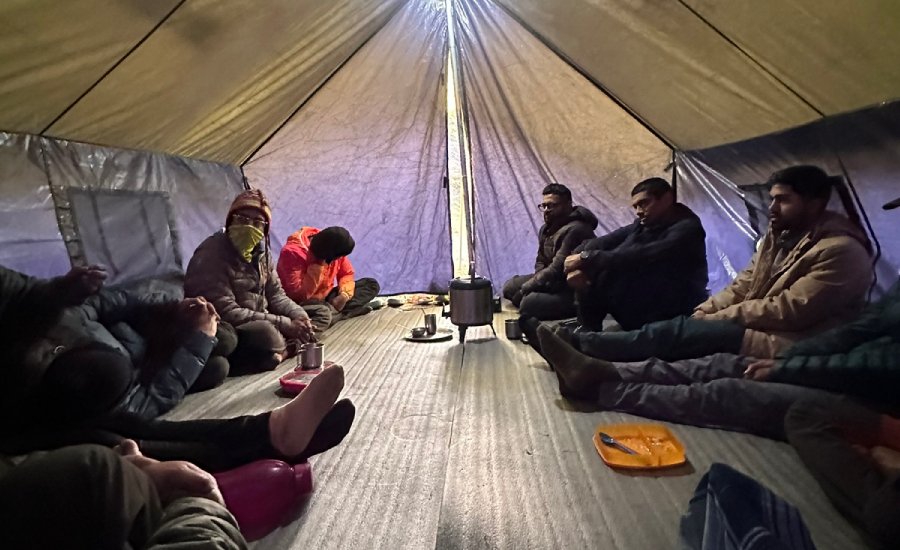
The community tent.
Some of my best memories from Kanamo Peak weren’t on the summit.
They were right here.
This was where we laughed together, shared stories, played games, drank endless cups of tea and coffee, and slowly became friends.
Every evening somehow ended with everyone gathering in this one tent.
Thukpa Never Tasted Better
Around 6:00 PM, the kitchen team served us hot bowls of Thukpa.
After spending hours battling freezing winds and snow, I honestly don’t think anything else could have tasted better.
The warm broth, fresh vegetables, and comforting flavours felt exactly like what our tired bodies needed.
Sometimes, after a difficult day in the mountains, happiness arrives in the simplest forms.
A bowl of hot Thukpa was definitely one of them.
One funny thing we all noticed after returning from the summit was how relaxed everything suddenly felt.
Until that morning, we had constantly reminded each other to finish 3–4 litres of water before evening.
Eat properly.
Don’t skip snacks.
Drink more water.
Now…
Nobody was reminding anyone anymore.
The pressure had disappeared.
The summit was behind us, and it felt strangely comforting to simply eat and drink without constantly thinking about acclimatisation.
It almost felt like we’d passed the biggest exam of the trek.
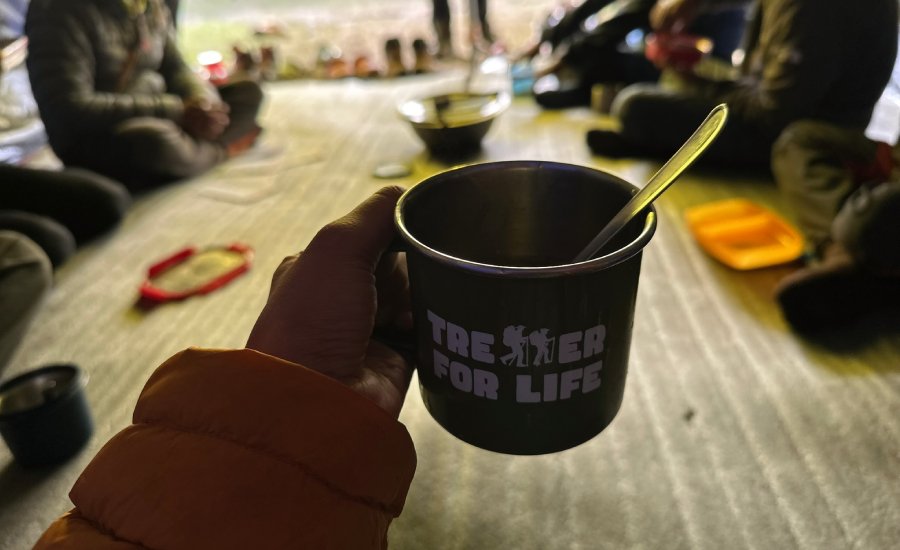
Looking Back Together
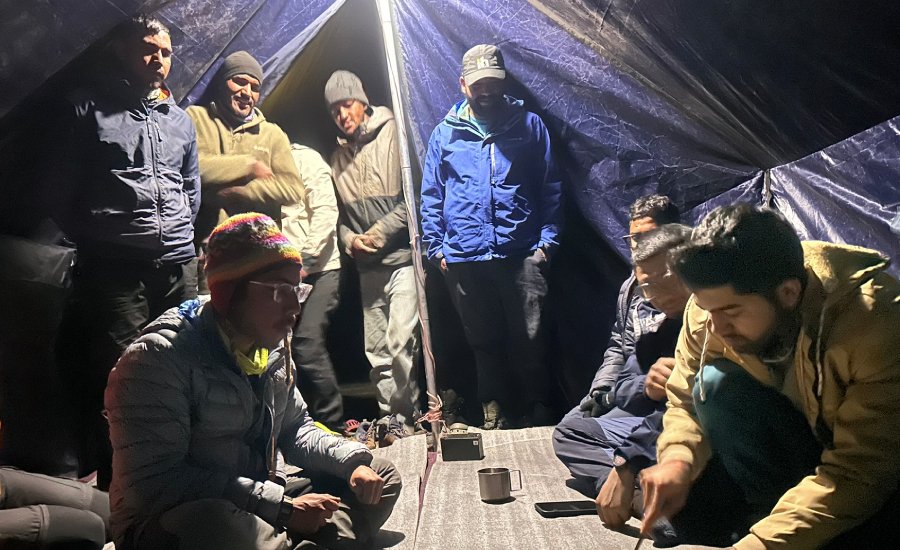
Soon it was time for our debriefing session.
One by one, everyone shared their experience.
Some spoke about the toughest moments.
Some spoke about what kept them going.
Some became emotional while talking about the summit.
Listening to everyone’s journey made me realise that although we had all climbed the same mountain, each of us had experienced it differently.
That is the beauty of trekking.
The mountain remains the same.
The journey becomes personal.
Celebrating the Spirit of Trekking
Then came one of my favourite traditions at Indiahikes.
The announcement of the Spirit of Trekking Award.
This award isn’t given to the fastest trekker or the strongest climber.
It’s given to the people who truly embody the spirit of trekking by helping others without expecting anything in return.
This time, the award went to Sumit and Nagendra.
Throughout the trek, both of them had quietly helped others, encouraged teammates, and proved that reaching the summit together matters more than reaching it first.
It couldn’t have gone to more deserving people.
One Last Celebration
As if the day wasn’t already special enough…
Our favourite surprise arrived.
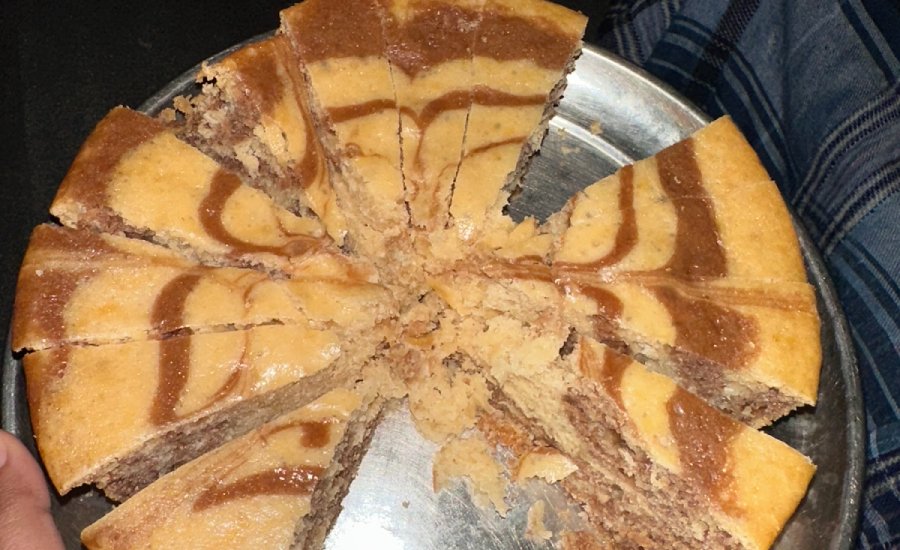
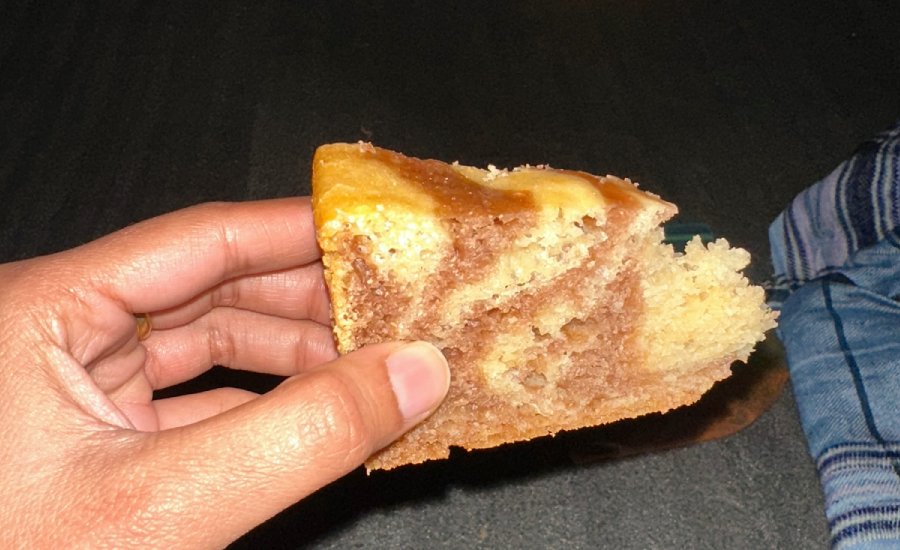
A celebration cake.
No matter how many treks I do, cutting a cake after returning safely from the summit never stops feeling special.
It’s become a tradition that marks not just the achievement of reaching the top, but the joy of returning safely together.
We cut the cake, congratulated one another once again, and laughed about the many memories we’d already created over the past few days.
Thank You to the Real Heroes
Before the day came to an end, I wanted to thank one group of people who often stay behind the scenes.
Our incredible kitchen team.
Preparing fresh, nutritious, and delicious meals at nearly 16,000 feet, in freezing temperatures and unpredictable weather, is no easy task.
Yet every single meal reached us warm and on time.
Our trek leader, guides, and kitchen staff constantly reminded us to eat well, even when the altitude reduced our appetite, because they knew that every meal was helping us prepare for the next challenge.
Looking back, I realised something.
They weren’t just cooking food.
They were quietly helping each one of us reach the summit.
💛 Rinkal’s Note
Trek leaders may guide you to the summit, but the kitchen team quietly fuels every single step. They rarely stand in the spotlight, yet every successful summit carries their hard work with it.
One More Feather in My Cap
That night, everyone looked exhausted.
The kind of exhaustion that comes with deep satisfaction.
There was very little energy left for long conversations.
Tomorrow, we’d leave Base Camp behind and begin our journey back.
As I crawled into my sleeping bag one last time, I thought about how far this journey had brought me.
I started trekking in March 2024, simply because I wanted to explore the mountains.
Just over two years later, I was lying in a tent after standing on the summit of Kanamo Peak—19,553 feet above sea level.
If someone had told me this when I started my first trek, I probably wouldn’t have believed them.
That night, I didn’t fall asleep thinking about the summit.
I fell asleep feeling grateful.
Grateful for the mountains.
Grateful for this incredible team.
Grateful for every lesson the journey had taught me.
And most of all…
Grateful that I had the courage to take that very first step back in 2024.
Day 7: Back to Manali – Until the Next Mountain
Every trek has one day that nobody really looks forward to.
The day you pack your backpack for the last time, leave your campsite behind, and slowly return to everyday life.
Today was that day.
One Last Sunrise at Base Camp
I woke up around 5:45 AM and stepped outside the tent.
The first rays of sunlight were slowly touching the surrounding mountains, painting them in shades of gold and orange. Everything felt calm, almost as if the mountains were giving us one final beautiful morning before saying goodbye.
After freshening up and brushing my teeth with the mountains right in front of me—a routine I had started loving over the past few days—we gathered for breakfast and packed our backpacks one last time.
By 7:00 AM, everyone was ready to leave.
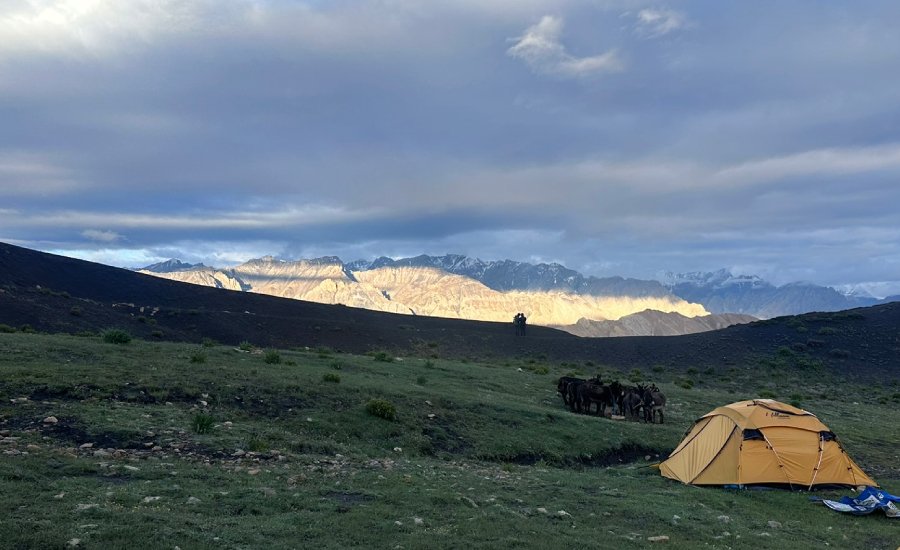
One Last Game Before Goodbye
Before we started descending, Umesh Ji had one more surprise for us.
He introduced us to a fun warm-up game called Ziguja.
Within minutes, everyone was laughing, running around, and forgetting that our trek was coming to an end.
It was such a simple activity, but it perfectly captured the spirit of the entire journey.
Even on the last morning, we were still making memories together.
Meanwhile, the kitchen team began dismantling the campsite, and our colourful tents slowly disappeared one by one.
Looking at them being packed away made it feel real.
Our time at Kanamo Base Camp was officially over.
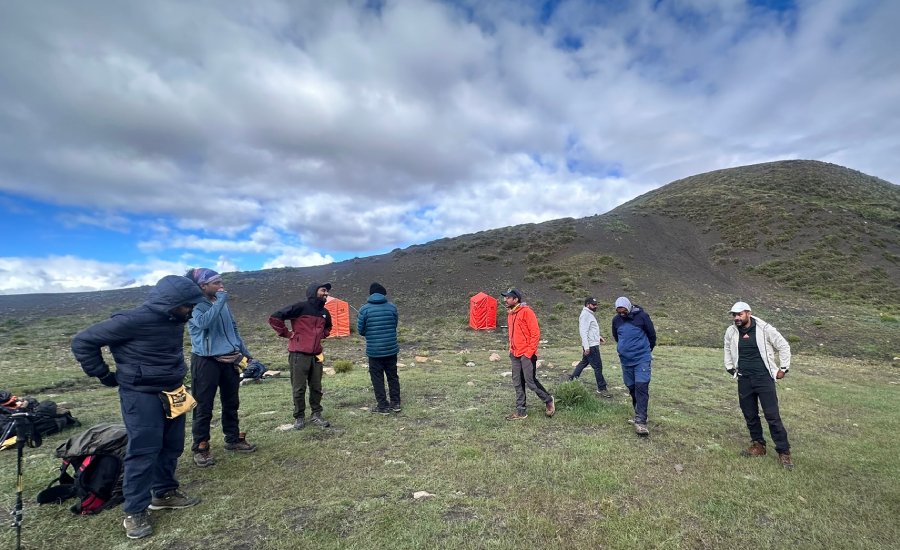
Walking Down with Full Hearts
Around 7:30 AM, we finally started our descent towards Kibber.
Unlike the climb a couple of days ago, there was no pressure today.
No summit waiting ahead.
No altitude to worry about.
Just an easy walk back through the beautiful landscapes of Spiti.
Everyone looked much more relaxed.
The trail was filled with laughter, conversations, funny videos, cinematic shots, proposal reels, memes, and countless random moments that only make sense when you’re travelling with friends.
It felt less like the end of a trek and more like a group of friends enjoying one last walk together.
About 45 minutes later, we reached the beautiful alpine lake where we had stopped for lunch on our way to Base Camp.
This place had already become one of my favourite spots on the trek.
Instead of continuing immediately, Diptarka handed each of us a postcard.
He asked us to write a letter to anyone we wanted.
I chose to write to my future self.
Everyone quietly found their own little corner around the lake.
As I sat there looking at the lake, emotions slowly started catching up with me.
This beautiful journey was coming to an end.
In just a few hours, we’d all go back to our own cities, our own routines, and our own lives.
I wasn’t ready.
I was going to miss everyone.
We spent nearly half an hour by the lake—writing, reflecting, and simply soaking in the peaceful surroundings one last time.
Then I reminded myself of something.
Perhaps these journeys feel so special because they eventually end.
If we lived in the mountains every day, we might never experience the same excitement before every new trek.
Sometimes, returning to everyday life is what makes us appreciate the mountains even more.
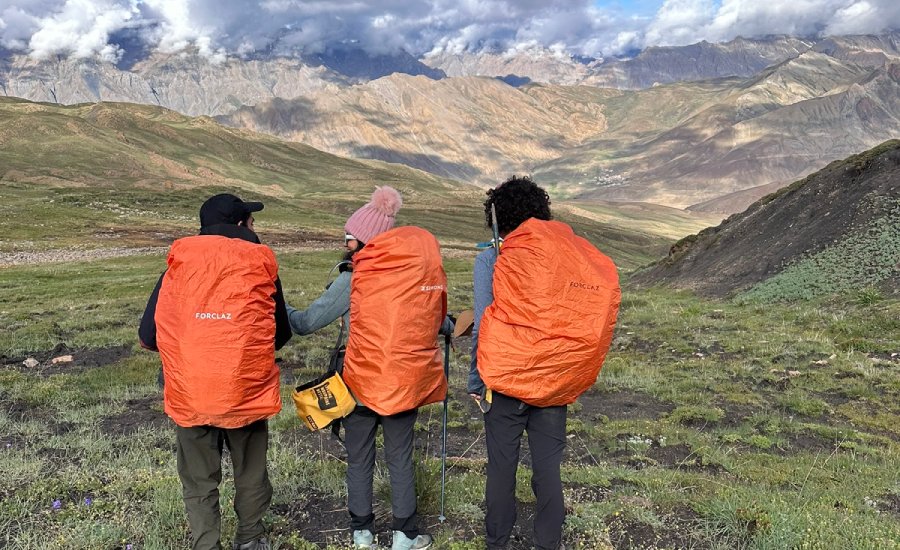
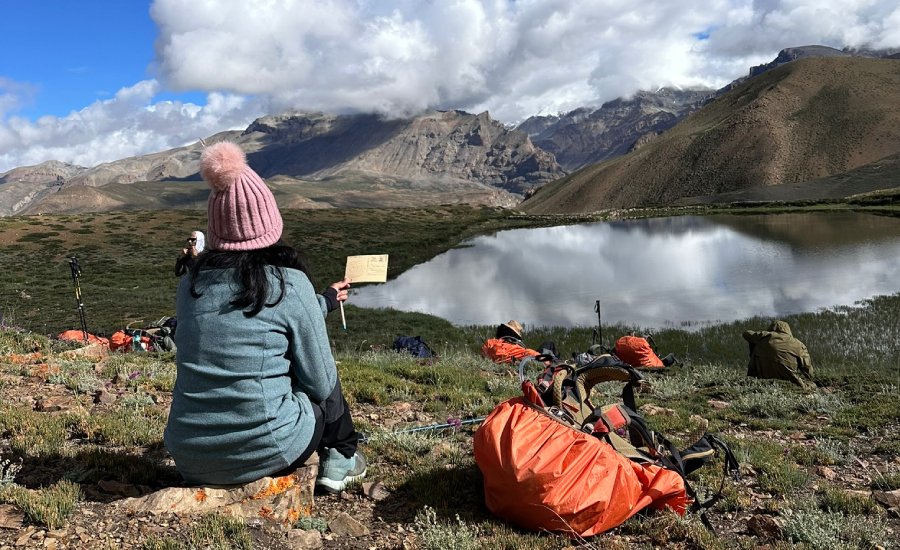
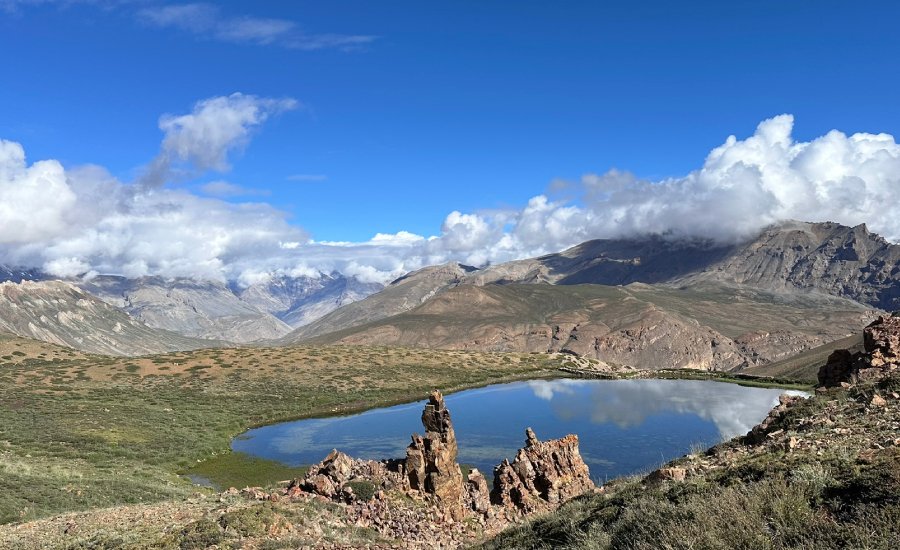
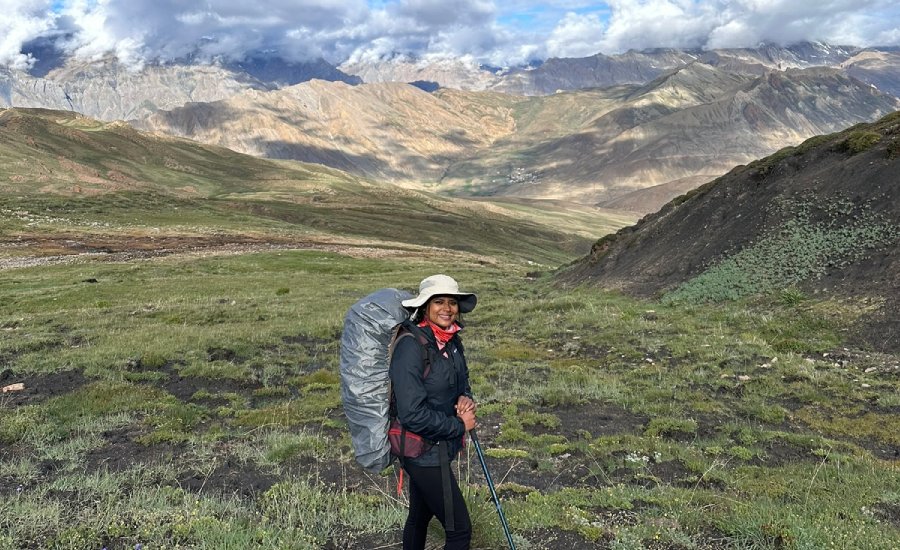
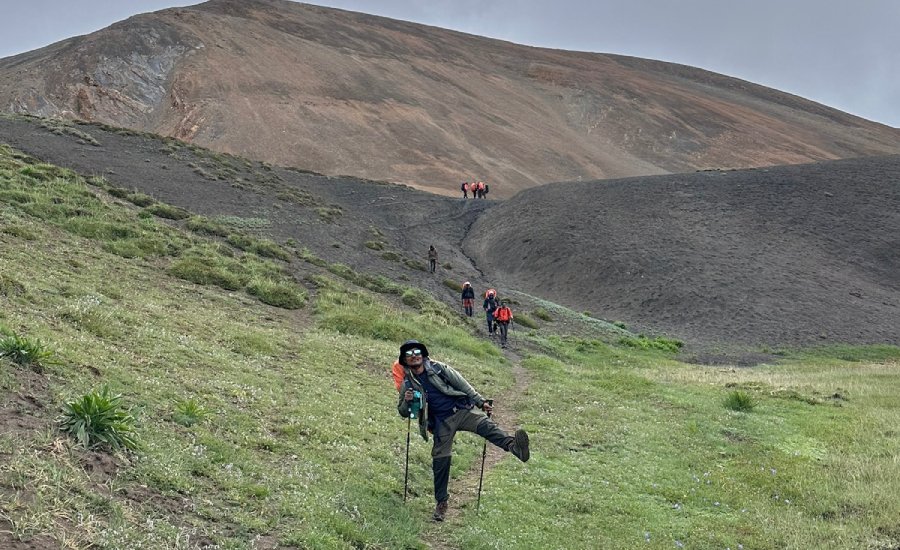
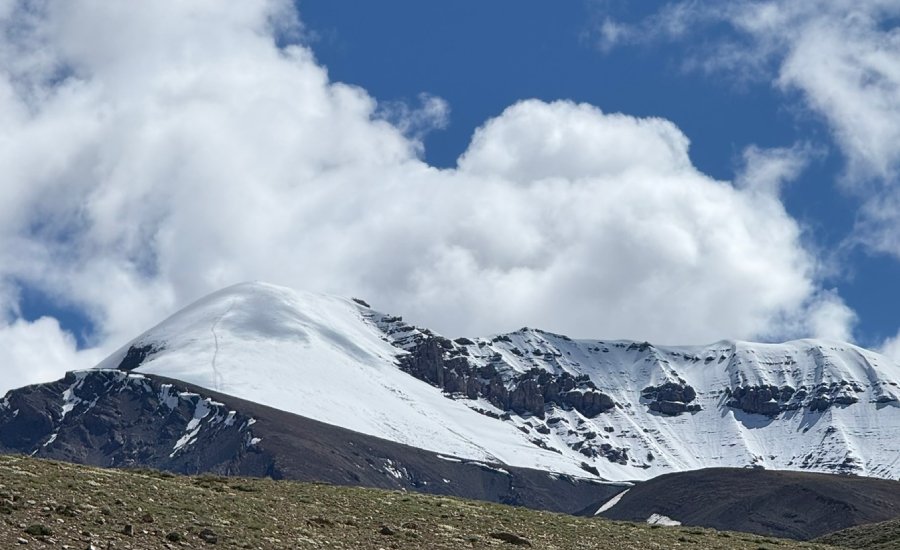
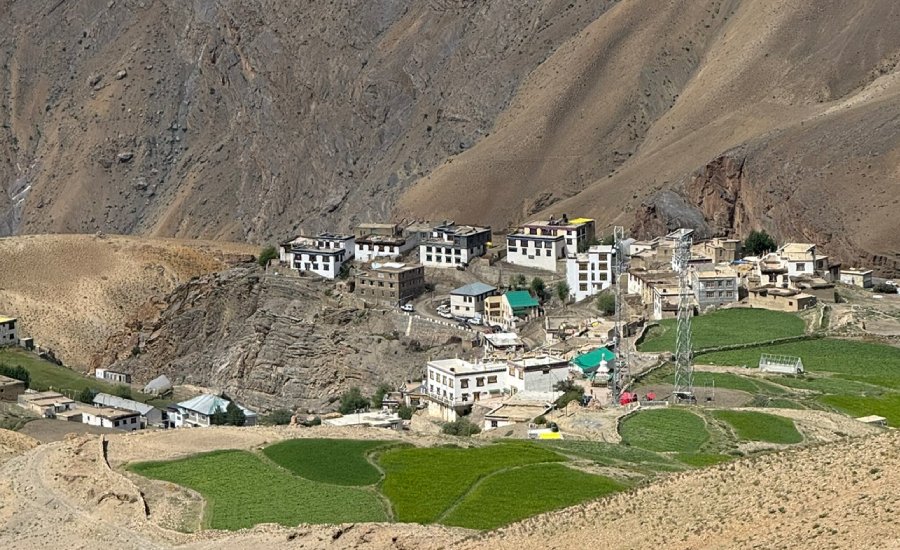
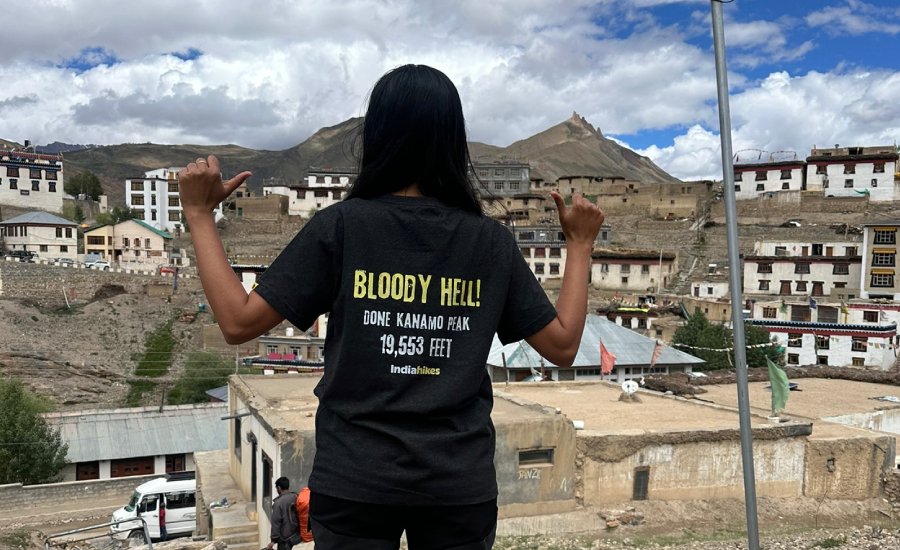
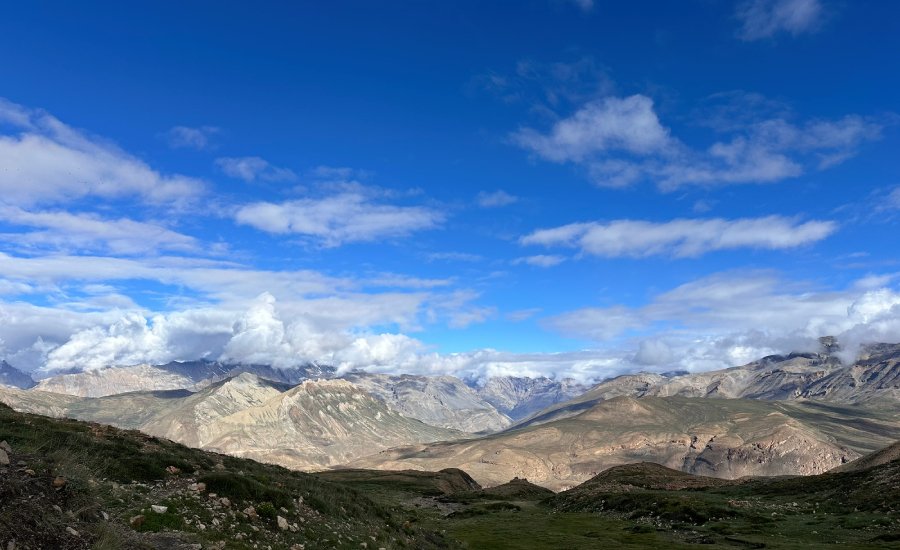
Back to the World
By the time we reached Kibber, something familiar happened.
Network returned.
Almost instantly, everyone started checking their phones, replying to missed messages, and calling their families.
It was funny how quickly we all switched back to the outside world after spending days disconnected from it.
After collecting our luggage from the cloakroom, we loaded everything into the Tempo Traveller and began our long journey back to Manali.
The Road Home
We crossed Losar, where we stopped for lunch, and then continued over the breathtaking Kunzum La, retracing the same roads that had brought us here a few days earlier.
The mighty Chandra Bhaga mountains accompanied us for much of the journey, almost as if they were seeing us off.
The roads were the same.
But somehow…
We weren’t.
Every trek changes you in ways you only realise after returning home.
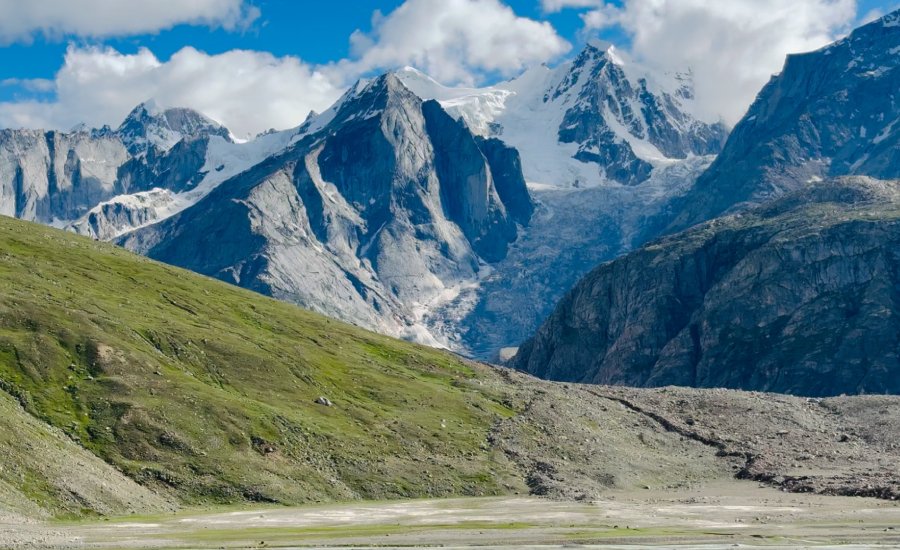
One Last Meal Together
Around 8:00 PM, we reached Beas Bridge in Manali—the very place where our journey together had begun.
Before everyone went their separate ways, we decided to have one final dinner together.
Soon it was time.
Some teammates left to catch their buses.
Some stayed back in Manali for another day or two.
One by one, we hugged, exchanged goodbyes, promised to meet again on another mountain, and slowly walked in different directions.
It’s strange how trekking works.
A week earlier, we had all arrived as strangers.
Now, we were saying goodbye to people who had become a part of one of the most memorable journeys of our lives.
Until the Next Mountain
As I looked back on the entire journey, I realised Kanamo Peak gave me much more than a summit.
It gave me lifelong memories.
Meaningful conversations.
Unexpected acts of kindness.
New friendships.
A little more confidence in myself.
And another reminder that the mountains always have something new to teach us.
Kanamo Peak may have ended here.
But the journey it began within me is still continuing.
Until the next mountain. 🏔️❤️
If this story made you feel connected to the mountains, maybe it’s time to plan your own Himalayan journey and experience the magic beyond the views.

Rinkal
Rinkal is a passionate traveler from Ahmedabad who loves exploring hidden gems, savoring local foods, and sharing adventures with fellow wanderers. Rinkal’s goal is to inspire others to travel on a budget while truly experiencing the essence of each place.

Shakthi
August 16, 2026
Wonderfully written! Felt like I relived the whole thing all over again.